On a clear night in the Pacific Northwest, you can look up and see nothing but the ancient, indifferent stars. But if you possess the right security clearance, a specific frequency of radar, and a certain grim imagination, the sky looks entirely different. It looks like a cage.
For decades, humanity looked at the heavens and saw an open frontier. Today, three nuclear superpowers look up and see a chessboard where the squares are shrinking, the pieces are moving at twenty times the speed of sound, and the rules of survival are being rewritten in silence. Meanwhile, you can read related stories here: The Cold Math of Our Sporting Hopes.
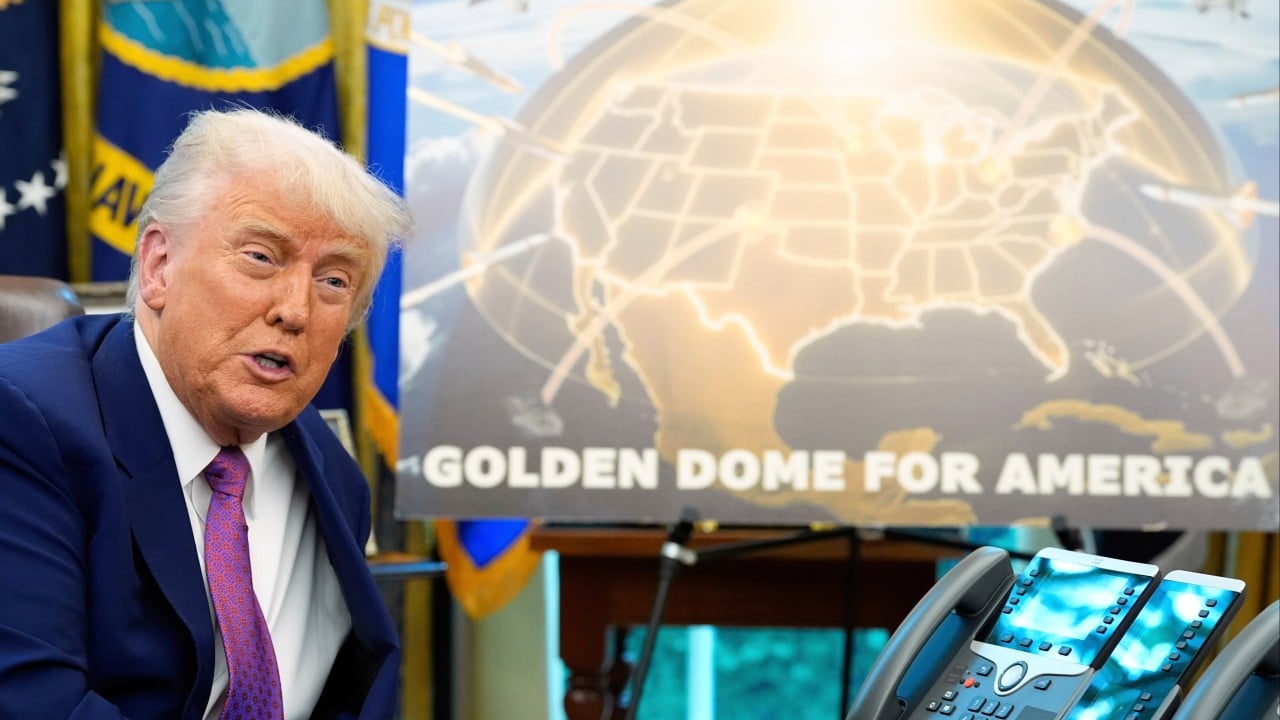
The catalyst for this quiet panic is a defense initiative the Pentagon calls the Golden Dome. To its architects in Washington, it is the ultimate shield—a planetary network of space-based interceptors, ground-based tracking stations, and automated tracking systems designed to render missile strikes obsolete. It is marketed as the definitive end to the anxiety of the nuclear age.
But innocence depends entirely on which side of the shield you stand. To understand the complete picture, we recommend the detailed report by Mashable.
To Moscow and Beijing, this dome is not a umbrella. It is a chokehold.
The Illusion of the Perfect Shield
To understand why a defensive system can provoke a world war, you have to understand the delicate, terrifying math that has kept the peace since 1945. It is a concept known as Mutually Assured Destruction. The logic is brutal but effective: I will not shoot you, because even if I mortally wound you, you will have enough strength left before you die to pull your own trigger.
It is a Mexican standoff frozen in time. It relies on vulnerability.
Now, imagine one party in that standoff suddenly pulls a bulletproof vest over their chest. The equilibrium shatters. The vulnerable party no longer looks at the vest as a defensive measure; they look at it as the preparation for an unanswerable first strike. If you can stop my retaliation, you can attack me with impunity.
This is the psychological fault line that cracked open this week. In a rare joint statement that carried the heavy, synchronized cadence of the Cold War, Beijing and Moscow warned that the deployment of the Golden Dome poses a "clear and destabilizing threat" to global security.
They are not reacting to an act of aggression. They are reacting to an act of protection.
The technology behind the Golden Dome is staggering. Unlike legacy defense systems that rely on intercepting missiles as they re-enter the atmosphere, this architecture aims to strike them during their "boost phase"—the vulnerable minutes right after launch when the rockets are burning bright and moving relatively slowly. To achieve this, the system relies on a constellation of low-Earth-orbit satellites equipped with high-energy lasers and hyper-velocity kinetic kill vehicles.
It is automated. It is instantaneous. It operates at a speed that eliminates human deliberation from the loop.
Consider the reality of a command center in eastern Russia or western China. A training exercise goes wrong, or a civilian research rocket suffers a telemetry error and veers off course. In the past, hotline channels and human intuition offered a buffer. Minutes existed to de-escalate.
With the Golden Dome overhead, those minutes evaporate. The system’s algorithms are programmed to perceive a launch and neutralize it within seconds. The machine does not negotiate. It does not call the Kremlin to verify intentions. It acts.
The View from the Steppe
Let us step away from the briefing rooms of the Pentagon and look at a hypothetical, yet entirely accurate, analog.
Picture a young radar technician named Alexei, stationed at a remote tracking outpost in the windswept plains of Siberia. His grandfather stood watch in a concrete bunker during the Cuban Missile Crisis, watching green phosphor screens, knowing that survival meant waiting for orders.
Alexei’s reality is different. He looks at a terminal that is constantly communicating with artificial intelligence arrays. He knows that directly above his airspace, moving at seventeen thousand miles per hour, are American sensors that can read the heat signature of a truck engine starting on the ground.
When the Golden Dome achieves full operational capacity, Alexei’s country loses its second-strike capability. The strategic depth that protected Russia for centuries—its vast, unforgiving geography—becomes meaningless. The sky above them is no longer sovereign; it belongs to the network.
For China, the anxiety is even more acute. Beijing’s nuclear strategy has historically relied on a "minimum deterrence" posture. They maintained a relatively small, highly secure arsenal designed purely to dissuade an adversary from taking a reckless gamble.
The Golden Dome changes the math entirely. A small arsenal is easy to neutralize. If an defense system can intercept a hundred missiles, a nation with only eighty missiles loses its seat at the table of global powers.
This explains the fury behind the recent diplomatic dispatches. The language used by Chinese officials was devoid of the usual bureaucratic euphemisms. They spoke of an "unacceptable encirclement," a technological blockade that forces their hand.
The Paradox of Security
The great tragedy of modern geopolitics is that both sides are acting with flawless logic.
The United States is pursuing what any nation state desires: absolute security. If the technology exists to protect your citizens from nuclear annihilation, what leader could look the public in the eye and refuse to build it? The motivation is fundamentally defensive, born of a desire to transcend the terrifying vulnerability of the atomic age.
But in the arena of high-stakes diplomacy, intentions matter far less than capabilities.
When you build a wall that your neighbor cannot scale, you have changed the nature of the neighborhood. The neighbor has two choices: accept their permanent subordination, or find a hammer heavy enough to smash the wall.
We are already seeing the first swings of that hammer.
Neither Russia nor China is going to sit idly by while their strategic leverage evaporates. Instead of halting the arms race, the Golden Dome is accelerating it into terrifying new territories. The response is not more traditional missiles, but weapons designed specifically to render the dome useless.
This is the driving force behind the frantic development of hypersonic glide vehicles. These weapons do not fly in the high, predictable arcs of traditional ballistic missiles, which the Golden Dome is designed to catch. Instead, they skim the upper edges of the atmosphere, maneuvering unpredictably at speeds exceeding Mach 5. They fly beneath the radar coverage and above the traditional anti-missile batteries. They are designed to be too fast for the algorithms to process, too agile for the lasers to track.
At the same time, both Moscow and Beijing are investing heavily in anti-satellite operations. The vulnerabilities of the Golden Dome are its eyes and its nervous system—the satellite constellations in low Earth orbit. The next conflict will not begin with an explosion on land or sea. It will begin with the silent blindness of skipped telemetry, as directed-energy weapons and kamikaze satellites disable the orbital grid.
The pursuit of absolute security has created absolute instability.
The Human Factor in an Automated Sky
It is easy to get lost in the nomenclature of this new confrontation. We speak of kinetic interceptors, orbital planes, and boost-phase algorithms as if we are discussing a simulation or a video game.
The danger is that the people making the decisions might begin to view it that way too.
When strategic stability is handed over to automated systems, the space for human judgment shrinks to nothing. The Golden Dome relies on split-second execution. If a commander must wait for presidential authorization to counter a perceived threat, the window closes. Therefore, authority must be delegated upward to the software.
We have been here before, and history warns us how easily the machine can fail.
In 1983, a Soviet officer named Stanislav Petrov sat in a bunker very much like the one Alexei occupies today. His computers flashed a warning: five American intercontinental ballistic missiles had been launched. The system was definitive. The protocol demanded an immediate retaliatory strike.
Petrov hesitated. He looked at the flashing red lights, trusted his gut, and judged it a false alarm. He was right. A satellite had mistaken the sun's reflection off the tops of clouds for the thermal signatures of missile launches.
If Petrov had been an algorithm, the world would look very different today.
The Golden Dome leaves less room for the Stanislav Petrovs of the world. It is designed to remove the hesitation, the doubt, the human friction that has accidentally saved civilization more than once. It replaces the agonizing weight of human conscience with the cold, unblinking efficiency of code.
The Price of the Canopy
The diplomatic protests we are witnessing are the opening salvos of a new epoch. The Golden Dome is no longer a blueprint; it is an active deployment. Shutter facilities are opening in Alaska; tracking telemetry installations are being bolted into the bedrock of allied nations; the launch schedules for low-Earth-orbit satellites are accelerating.
The international community watches this with a sense of quiet dread. The treaties that once provided boundaries for this competition—the Anti-Ballistic Missile Treaty, the Intermediate-Range Nuclear Forces Treaty—lie in tatters, casualties of a deeper mistrust that has been building for twenty years.
We are entering an era where the sky above us is contested territory. The space directly above our heads is becoming the most volatile front line on Earth.
Tomorrow morning, the sun will rise, its light striking the solar panels of hundreds of defense satellites as they pass over the continents. They will look down at cities full of people going to work, buying groceries, living their lives in the comfortable assumption that the world is stable.
But high above them, the silent sentinels will continue their endless, automated vigil, tracking every flicker of heat, every shift in energy, waiting for a signal that must never come. The shield is being raised, piece by piece, and beneath its heavy, invisible shadow, the rest of the world holds its breath.