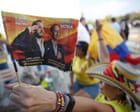
International mainstream media is suffering from collective amnesia. They are running the exact same headline they ran for Argentina in 2023, El Salvador in 2019, and the United States in 2016. The lazy consensus says that Abelardo de la Espriella’s first-round victory with 43.7% of the vote is a sudden, shocking far-right lurch by an unstable electorate. They paint him as an eccentric caricature—a flamboyant, opera-singing, rum-selling millionaire lawyer nicknamed "El Tigre" who just happened to ride a wave of populist anger into a June 21 runoff against the left’s Iván Cepeda.
This narrative is completely wrong.
The media missed the real story because they rely on broken polling methodologies and surface-level aesthetics. I have watched political analysts misread Latin American risk cycles for fifteen years. They treat Bukele-style mano dura platforms or Milei-style libertarian rhetoric as sudden anomalies rather than predictable reactions to structural economic failure.
Espriella didn't win the first round because he wears baseball caps, brags about his anatomy on the radio, or mimics Donald Trump. He won because the progressive establishment under Gustavo Petro completely broke the state's monopoly on violence, and the institutional right collapsed under its own irrelevance.
The Mathematical Collapse of the Centrist Mirage
Look at the hard data from Sunday's vote instead of the hand-wringing op-eds. For months, pollsters showed Iván Cepeda coasting with a comfortable lead, while establishment conservative Senator Paloma Valencia hovered as the primary challenger.
On election day, Valencia’s support did not just drop; it disintegrated to a pathetic 6.9%. Sergio Fajardo and Claudia López didn't even combine for 6%. What the mainstream press labels a "shocking upset" was actually a highly rational consolidation. The institutional, polite right-wing elite in Colombia is dead.
When a society faces a security crisis, voters do not look for nuanced, centrist compromise. They look for a hammer. Espriella did not create this appetite; he merely inherited the ruins of Valencia's base.
Consider the mechanics of the upcoming runoff. Cepeda finished at 40.9%. Espriella took 43.7%. The media claims this neck-and-neck result spells trouble for the right-wing newcomer. This is basic mathematical illiteracy. In a two-man race, the anti-Petro, anti-Cepeda vote has nowhere else to go. Valencia's 7% and the remaining fragmented conservative factions will break heavily toward Espriella out of pure survival instinct. Cepeda is already at his absolute ceiling. He cannot expand his coalition because his brand is inextricably tied to the failure of "Total Peace."
Why Total Peace Failed the Market and the Streets
To understand why a country elects a man who advocates for mega-prisons and military alliances with foreign powers, you have to look at the balance sheets of Colombia's regional economies.
The current administration's "Total Peace" strategy—widely recognized as Cepeda's intellectual brainchild—was built on a flawed premise: that criminal syndicates and transnational drug cartels act as political insurgents willing to negotiate in good faith.
Imagine a scenario where a state explicitly pulls back its military pressure, offering judicial leniency to highly profitable criminal enterprises in exchange for vague promises of disarmament. The predictable result isn't peace; it is a rapid corporate expansion of the illicit economy.
- The Extortion Tax: Small and medium-sized enterprises in regions like Antioquia and Valle del Cauca have seen their security overhead skyrocket. Extortion is no longer an occasional hazard; it is a fixed cost of doing business in Colombia.
- The Coca Boom: Colombia remains the world's largest producer of cocaine. The suspension of aerial fumigation under the guise of environmental progressivism did not lift farmers out of poverty. It merely optimized the supply chain for cartels, driving localized violence as factions fight over newly unregulated transit corridors.
- The Investment Flight: Capital is a coward. When a state cannot guarantee territorial control, foreign direct investment evaporates. Long-term infrastructure projects require physical security, not theoretical peace treaties signed in foreign capitals.
Espriella’s rise is a direct capital strike against this administrative vacuum. Business owners are backing a man who wears a bulletproof vest over his tailored suits because they are tired of paying a double tax: one to the DIAN in Bogotá, and another to the local gang commanding the highway.
The Flawed Premise of the "Outsider" Label
The press loves to call Espriella an outsider because he has never held public office. This is a fundamental misunderstanding of Colombian power structures.
An outsider does not spend decades defending the nation’s most powerful figures, including former President Álvaro Uribe. An outsider does not grow up in the elite social circles of Montería alongside magistrates and major landowners. Espriella is an insider who understands exactly how the country’s legal and political machinery operates, but he possesses the marketing savvy to package himself as an anti-establishment wrecking ball.
This duality is his greatest asset—and his most dangerous trait. The true risk of an Espriella presidency isn't that he is an unpredictable rogue who will dismantle the state from the outside. The risk is that he knows exactly which institutional levers to pull to centralize authority under the guise of an emergency.
His proposed policies are brutal, clear, and economically volatile:
- Authorized Lethal Force: Allowing police to fire directly on protesters deemed violent.
- Militarized Interdiction: Direct air and sea strikes on suspected narco-vessels without protracted legal verification.
- The Bukele Model: Mass incarceration that ignores international human rights frameworks in favor of immediate domestic optics.
Will this approach crater Colombia’s relations with progressive international bodies? Absolutely. Will it lead to structural human rights abuses? Almost certainly. But the mainstream media's insistence on lecturing voters about democratic norms completely misses the point. When a citizen's daily reality consists of micro-extortion and the threat of kidnapping, academic warnings about constitutional overreach carry zero weight.
The Runoff Reality
The next three weeks will feature an escalation of polarizing rhetoric. The Historic Pact will raise alarms about fascism, security software flaws, and alleged electoral fraud. They will attempt to scare the electorate back into the progressive tent.
It will not work.
The structural momentum is entirely behind the right-wing consolidation. Mainstream analysis will continue to treat this election as a bizarre, localized aberration driven by a colorful character named "The Tiger." They will ignore the reality that Colombia is simply following a well-documented economic and security flywheel.
If you destroy security, you destroy the economy. If you destroy the economy, the electorate will eventually hire a dictator, an authoritarian, or a millionaire lawyer with a hot temper to fix it. Stop asking how Colombia arrived at this point. The real question is why anyone expected a different outcome.