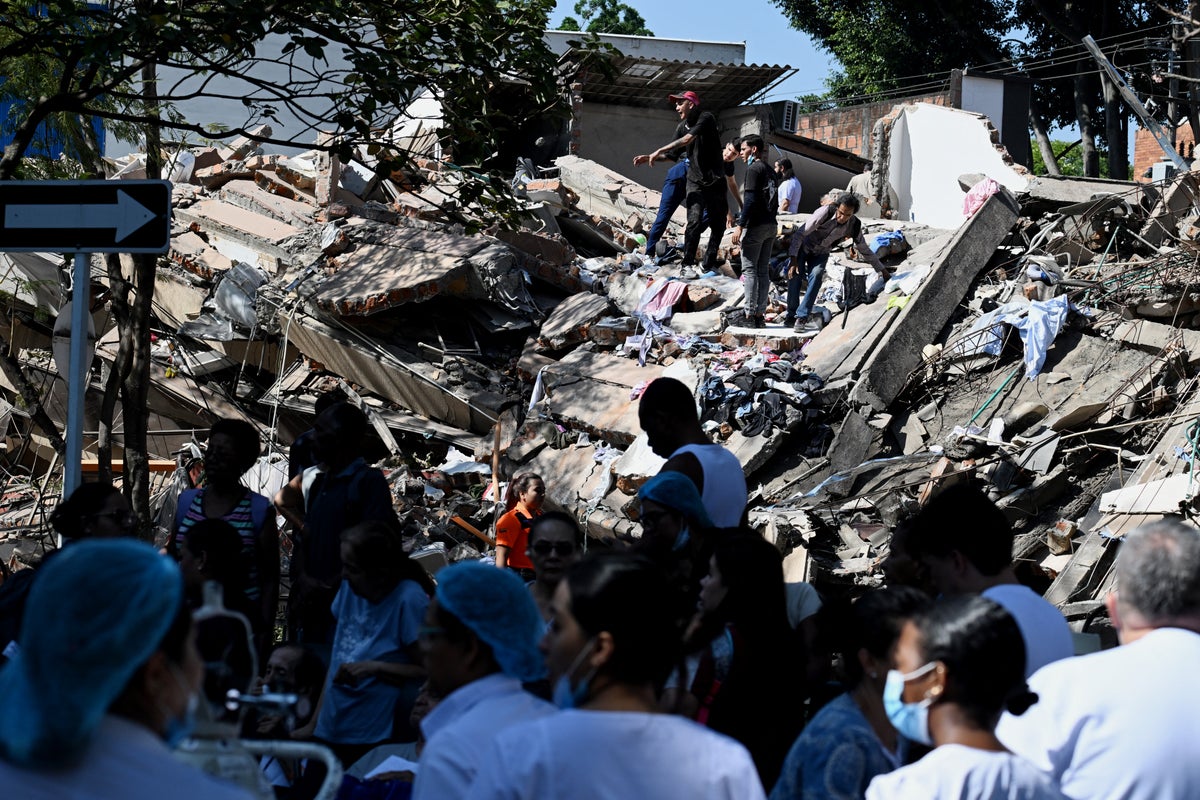
Ground zero sits deep in the western department of Chocó, where a violent 7.4-magnitude tremor shattered the morning calm. When the earth violently split and shook near San José del Palmar, it didn't just damage infrastructure. It instantly tested a brand-new administration and left dozens dead across multiple urban centers.
The disaster struck just days after President Abelardo de la Espriella took office, turning an administrative transition into an immediate national emergency. Official death counts quickly climbed past 100 as rescue crews scrambled through concrete dust in cities like Pereira and Cali. If you liked this article, you should look at: this related article.
The Epicenter and the Immediate Toll
The earthquake hit at a depth of roughly 107 kilometers, according to the U.S. Geological Survey, sending powerful shockwaves far beyond the sparsely populated Pacific coast. Major cities felt the jolt, but the coffee-growing region of Risaralda and the industrial hub of Valle del Cauca absorbed the worst of the destruction.
In Pereira, Governor Juan Diego Patiño confirmed that fatalities spiked into the dozens as buildings buckled under the seismic strain. Social media footage showed entire facades shearing off commercial structures and crashing into busy streets. Meanwhile, in Cali, Mayor Alejandro Eder reported that at least 20 buildings collapsed entirely, trapping residents underneath heavy rubble. Hospitals had to wheel patients straight out into the streets on beds as structural integrity checks failed. For another angle on this story, refer to the recent coverage from Reuters.
Airports across the western zone—including terminals in Pereira, Manizales, Quibdó, Cartago, Armenia, and Buenaventura—suspended operations immediately after sustaining severe damage to roofs and control infrastructure.
Regional Anxiety and Neighboring Trauma
This catastrophe didn't happen in a vacuum. South America's seismic belt remains fiercely active, but the timing feels particularly brutal given recent regional events. Just weeks prior, catastrophic twin earthquakes rocked neighboring Venezuela, killing thousands and stretching regional rescue capabilities to their absolute limits. In fact, some Colombian civil defense units were still assisting across the border when the ground ruptured at home.
Panic stretched all the way to Bogotá, where thousands poured out of high-rise office buildings into public squares. While the capital escaped major structural damage, minor surface cracks served as a terrifying reminder of how vulnerable major metropolitan areas are to deep-focus inland tremors.
Emergency Response and What Happens Next
President de la Espriella moved quickly to establish a unified command post, pledging to oversee recovery efforts directly from the impacted zones. Heavy machinery and specialized canine search squads rolled out from Medellín and Bogotá to assist local municipal teams already overwhelmed by the scale of the wreckage.
Authorities continue to urge residents in affected provinces to stay clear of compromised structures. Aftershocks remain an immediate danger, threatening already unstable walls in historic districts like Manizales, where the neo-Gothic cathedral lost part of its tower.
Check your local municipal alerts if you have family in the region, and avoid traveling to the western transit hubs until structural engineers greenlight the terminals.