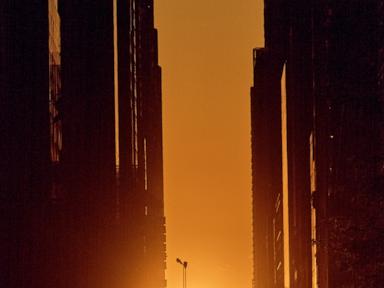
For a few fleeting minutes every May and July, Manhattan throws itself into a state of collective, gridlocked hysteria. Thousands of people abandon the sidewalks, dodge oncoming yellow cabs, and crowd into the exact middle of major cross streets like 42nd, 34th, and 14th. They are chasing Manhattanhenge, a biannual celestial event where the setting sun aligns flawlessly with the borough’s east-west street grid. The phenomenon bathes the city’s high-rises in a blinding, cinematic golden glow, offering a striking intersection of cosmic predictability and raw urban density.
Yet, the standard narrative framing this spectacle as a poetic triumph of urban design gets the story entirely backward. The perfect alignment of the sun with the New York City street grid was never a deliberate nod to ancient monuments like Stonehenge. It was the unintended byproduct of aggressive 19th-century real estate speculation, economic pragmatism, and a flat refusal to let the natural topography of Manhattan island interfere with the monetization of land.
The Commissioners Report of 1811 and the Birth of the Grid
To understand why the sun drops perfectly between the buildings of Midtown today, one must look back to the Commissioners’ Plan of 1811. At the start of the 19th century, New York was growing rapidly, its population choking on the chaotic, winding streets of lower Manhattan. A trio of state-appointed commissioners—Gouverneur Morris, John Rutherfurd, and Simeon De Witt—was tasked with designing a blueprint for the island’s northward expansion.
The commissioners faced a choice. They could have designed a city with grand, diagonal boulevards, circular plazas, and sprawling parks modeled after London or Paris. Instead, they chose an uncompromising, rigid grid iron.
"A city is to be composed of the habitations of men, and that straight-sided and right-angled houses are the most cheap to build, and the most convenient to live in."
— The Commissioners’ Plan of 1811
The decision was driven by unvarnished capitalistic efficiency. Right-angled lots were easier to buy, sell, subdivide, and build upon without wasting precious square footage. The grid was laid out with 12 primary north-south avenues and 155 east-west streets.
Crucially, the commissioners did not align their new grid with true geographic north. Doing so would have cut diagonally across the narrow, elongated shape of Manhattan island, creating thousands of awkward, triangular lots that would be difficult to monetize. Instead, they rotated the entire grid approximately 29 degrees east of true north to mirror the natural orientation of the island’s shoreline.
This 29-degree tilt is the exact mechanism that dictates the modern spectacle. If the grid had been aligned to true north, the sun would line up with the streets only on the spring and autumn equinoxes. Because of the tilt, the alignment is pushed roughly three weeks before and three weeks after the summer solstice, landing the dates squarely in late May and mid-July.
The Math Behind the Magic
The alignment is a precise, predictable consequence of orbital mechanics. The sunset point along the western horizon is not static. It constantly shifts throughout the year due to the 23.5-degree tilt of the Earth’s axis as it orbits the sun.
During the winter solstice in December, the sun sets at its southernmost point on the horizon. As spring progresses, the sunset point migrates steadily northward. By late May, the path of the setting sun matches the exact 29-degree inclination of Manhattan’s cross streets.
The event unfolds in pairs across four specific evenings each year.
| Date | Time (Approximate) | Sun Position on Grid |
|---|---|---|
| May 28 | 8:14 PM EDT | Half-Sun on the Horizon |
| May 29 | 8:13 PM EDT | Full-Sun above the Horizon |
| July 11 | 8:20 PM EDT | Full-Sun above the Horizon |
| July 12 | 8:21 PM EDT | Half-Sun on the Horizon |
On the "Full-Sun" days, the entire orb of the sun sits balanced directly on the asphalt horizon, framed cleanly by the buildings on either side of the street. On the "Half-Sun" days, the top half of the sun rests on the horizon while the bottom half dips below it.
The process reverses itself six months later in winter. Known colloquially as Reverse Manhattanhenge, the rising sun aligns with the grid during the morning commute in late November and early January. However, this winter iteration rarely draws the same massive crowds, largely due to freezing temperatures and the fact that a 7:00 AM sunrise lacks the romantic appeal of a summer dusk.
From Academic Footnote to Pop Culture Phenomenon
The term Manhattanhenge is a relatively recent addition to the lexicon of the city. For nearly two centuries, the alignment occurred in relative obscurity, noticed only by bus drivers, commuters, and delivery workers who found themselves momentarily blinded while driving west.
That changed in the late 1900s when astrophysicist Neil deGrasse Tyson, the director of the Hayden Planetarium at the American Museum of Natural History, visited Stonehenge as a teenager. Tyson wondered what future anthropologists would think if they excavated the ruins of New York City thousands of years from now. He surmised they would assume the grid was built to honor a cosmic deity, much like the ancient stone circles of England.
Tyson began calculating the exact dates of the alignment, photographing the phenomenon, and publishing the data in the museum's magazine. By the early 2000s, the term had entered the public consciousness.
What started as an astronomical curiosity quickly evolved into a massive cultural event, fueled entirely by the rise of smartphone photography and social media platforms. The narrow corridors of light became prime digital currency, turning a collective scientific observation into a competitive, crowded scramble for the perfect shot.
Anatomy of the Perfect Viewing Location
Capturing or simply observing the event requires understanding how New York's specific geography influences the view. The phenomenon is not equally visible across every street on the island. To see the sun hit the horizon, an observer needs a clear, unobstructed path all the way to the Hudson River and the New Jersey palisades beyond.
The ideal streets are wide, two-way cross streets located in midtown, where the buildings are tall enough to create a distinct, dramatic framing effect.
- 42nd Street: The absolute epicenter of the event. It offers iconic architectural framing via the Chrysler Building, the Tudor City Overpass, and Grand Central Terminal.
- 34th Street: Provides excellent framing with the Empire State Building towering over the corridor.
- 14th Street: A wide thoroughfare that offers a clean shot across the island, though with slightly lower architectural profiles than midtown.
- 23rd Street: Offers a wide view, heavily trafficked but highly effective for catching the low-angle light.
The Tudor City Overpass, an elevated pedestrian bridge crossing 42nd Street near First Avenue, has become notorious among photographers. Crowds begin positioning their tripods on the bridge hours before sunset, creating a dense wall of human bodies.
For a cleaner, less chaotic experience, seasoned observers frequently head across the East River to Gantry Plaza State Park in Long Island City, Queens. From this vantage point, the setting sun can be seen shining directly through the canyons of the midtown streets from the outside looking in.
The Industrial Reality of a Celestial Illusion
While the visual payoff of Manhattanhenge is undeniable, the physical reality of experiencing it on the ground is far from serene. The event turns major thoroughfares into active safety hazards.
Local police precincts routinely deploy additional officers to midtown intersections during the peak fifteen minutes of the alignment. Pedestrians frequently spill off the curbs and into active traffic lanes, ignoring green lights and oncoming buses to snap a photo before the sun disappears.
The atmosphere is a chaotic mix of collective awe and urban frustration. Horns blare continuously as drivers find themselves trapped behind hundreds of amateur photographers standing directly in the crosswalks.
Cloud cover is the ultimate arbiter of success. Because the alignment relies on a perfectly clear view of the distant horizon across the river, even a thin layer of low-lying fog or seasonal smog over New Jersey can instantly nullify the effect, turning a highly anticipated celestial event into an ordinary, overcast Thursday evening.
The enduring appeal of the event lies in this volatile mix of cosmic permanence and urban fleetingness. The sun will always arrive precisely on schedule, indifferent to the traffic, the pollution, and the millions of people waiting below. It is a stark reminder that even the most heavily engineered, artificially constructed landscape on Earth remains entirely subservient to the unyielding geometry of the solar system.