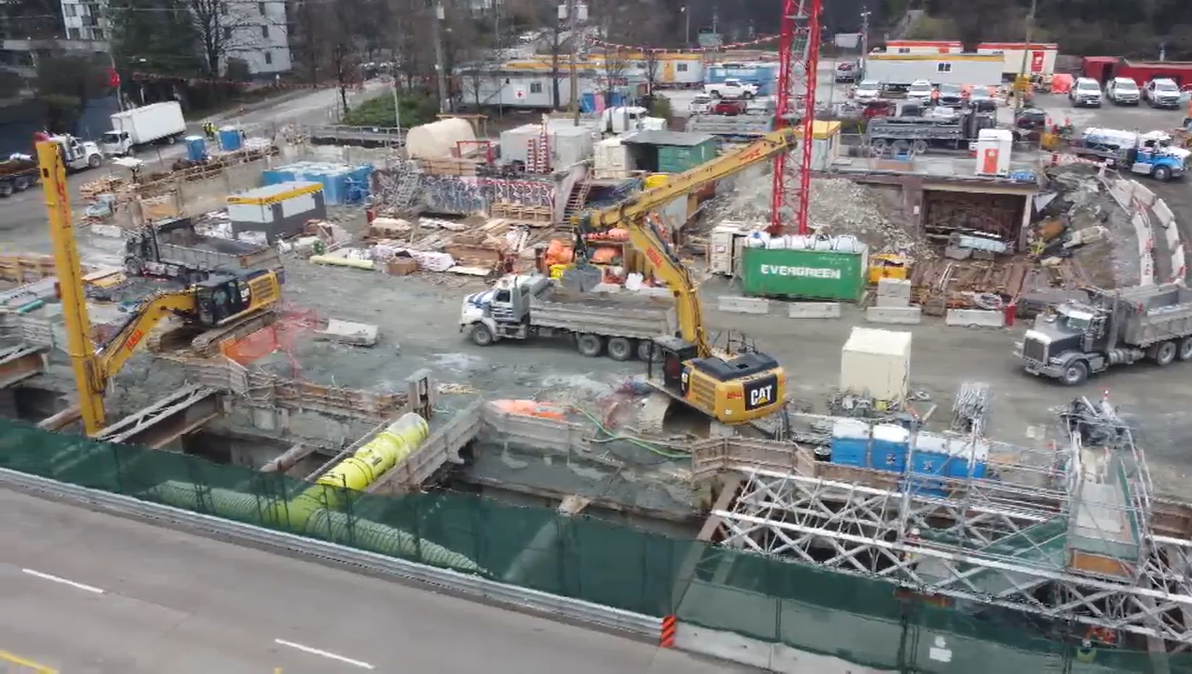
Concrete does not care about your morning coffee. It does not care that you have lived in the same neighborhood for thirty years, or that your corner bakery relies on the steady, chaotic flow of delivery trucks to survive until Tuesday. Concrete arrives with a heavy, indifferent hum, unspooling down the asphalt like a gray ribbon designed to slice a city clean in half.
Stand at the corner of Broadway on a rainy Tuesday morning, and you can smell it long before you see the barricades. Dust hangs in the air, a fine grit that settles on coat collars and coats the tongues of pedestrians rushing past orange mesh fencing. This is not just civil engineering. This is an argument carved into the ground.
When Gregor Robertson faced the storm over the Broadway Construction project, the spreadsheets in City Hall told one tidy story. Officials pointed to density models, transit optimization, and the long-term mathematical inevitability of a growing metropolis. Numbers are comforting. They sit quietly on white paper, refusing to talk back, refusing to look you in the eye and tell you that their rent just went up.
But outside the municipal boardroom, the reality was entirely different.
Consider Elena. (This is a composite portrait, drawn from the dozens of shopkeepers whose storefront windows rattled day after day as the heavy drills bit into the earth). Elena ran a small print shop halfway down the corridor. For two decades, her door had been a revolving calendar of neighborhood gossip, local art flyers, and the familiar chime of the bell above the frame. When the Broadway corridor transformation broke ground, the city promised minimal disruption. They used words like phase and mitigation.
None of those words paid her electricity bill when foot traffic dropped by sixty percent overnight.
The trouble with grand urban visions is the gap between the blueprint and the pavement. Leaders like Robertson often view a city from a helicopter perspective, where entire neighborhoods are reduced to colored polygons on a digital map. From up there, a transit line is a stroke of progress, a clean line connecting point A to point B. Down here, in the noise and the diesel fumes, that same line is a wall of steel blocking the entrance to your livelihood.
Citizens were not merely challenging a construction schedule; they were challenging an ideology. They were asking a fundamental, uncomfortable question that every modern city eventually has to face: Who is the metropolis actually for? Is it for the commuter of tomorrow, flashing past on a frictionless rail line, or is it for the person standing in the dust today, wondering if their business will survive until the ribbon-cutting ceremony?
The friction escalated quickly. Public meetings turned into theaters of grievance. Microphones hissed with the static of accumulated frustration. Residents brought historical photographs, financial statements, and personal pleas. They did not speak the sterile language of municipal planning. They spoke in the idiom of survival.
Robertson found himself caught in the classic trap of the visionary technocrat. He believed so deeply in the destination that he grew blind to the toll of the journey. In political battles of this magnitude, the danger is rarely malice; it is tunnel vision. A mayor staring thirty years into the future often fails to notice the grandmother tripping over an unpadded plywood walkway right outside municipal chambers.
Yet, to look only at the friction is to miss the deeper transformation happening underneath the pavement. Cities are violent, messy organisms. They do not grow gently. Every subway line, every widened sidewalk, every major infrastructure overhaul leaves scars before it heals into something resembling grace.
Think of it as setting a broken bone. The process hurts. It requires tearing open what has already healed incorrectly, inserting steel pins, and holding the limb rigid while the calcium hardens around the break. No one enjoys the cast. Everyone complains about the itch.
The Broadway project was that kind of violent repair. The corridor was congested, fractured, and straining under the weight of an era it was never designed to hold. The status quo was failing quietly every afternoon during rush hour, long before the first excavator tore up the turf. Robertson’s administration saw the cliff ahead and slammed on the steering wheel, but they forgot to warn the passengers in the backseat.
That oversight became the battleground.
When leaders fail to bring people along emotionally, logical arguments sound like insults. When you tell a shopkeeper whose revenue has plummeted that their sacrifice is necessary for the greater good, you are asking them to subsidize tomorrow with today’s panic. That is a hard sell over the roar of a pneumatic drill.
The protests and the fierce political pushback forced a recalibration, however clumsy it felt in real time. City planners began to listen—really listen—to the rhythm of the street. They adjusted access ramps, altered truck routes, and introduced localized relief funds that kept a few more doors from locking for good. The concrete kept pouring, but the dialogue changed.
Progress is rarely a clean arc. It is a jagged line, drawn by tired people arguing in fluorescent-lit rooms, tracked in mud across linoleum floors, and measured in the stubborn resilience of communities that refuse to be paved over without a fight.
The yellow tape has long since come down from some sections of Broadway, replaced by slick glass, modern transit stops, and the clean gleam of newly poured concrete. The commuters ride smoothly beneath the surface now, scrolling on their phones, entirely unaware of the dust that settled on Elena’s shelves years ago.
And if you walk down that same stretch at dusk, just as the streetlights flicker on and the evening rush begins to quiet down, you can still hear the faint, residual echo of the argument. It lives in the spaces between the buildings, a reminder that every city is built twice: first in the ambitions of its leaders, and then, much more painfully, in the lives of the people who have to live there while the dust settles.


