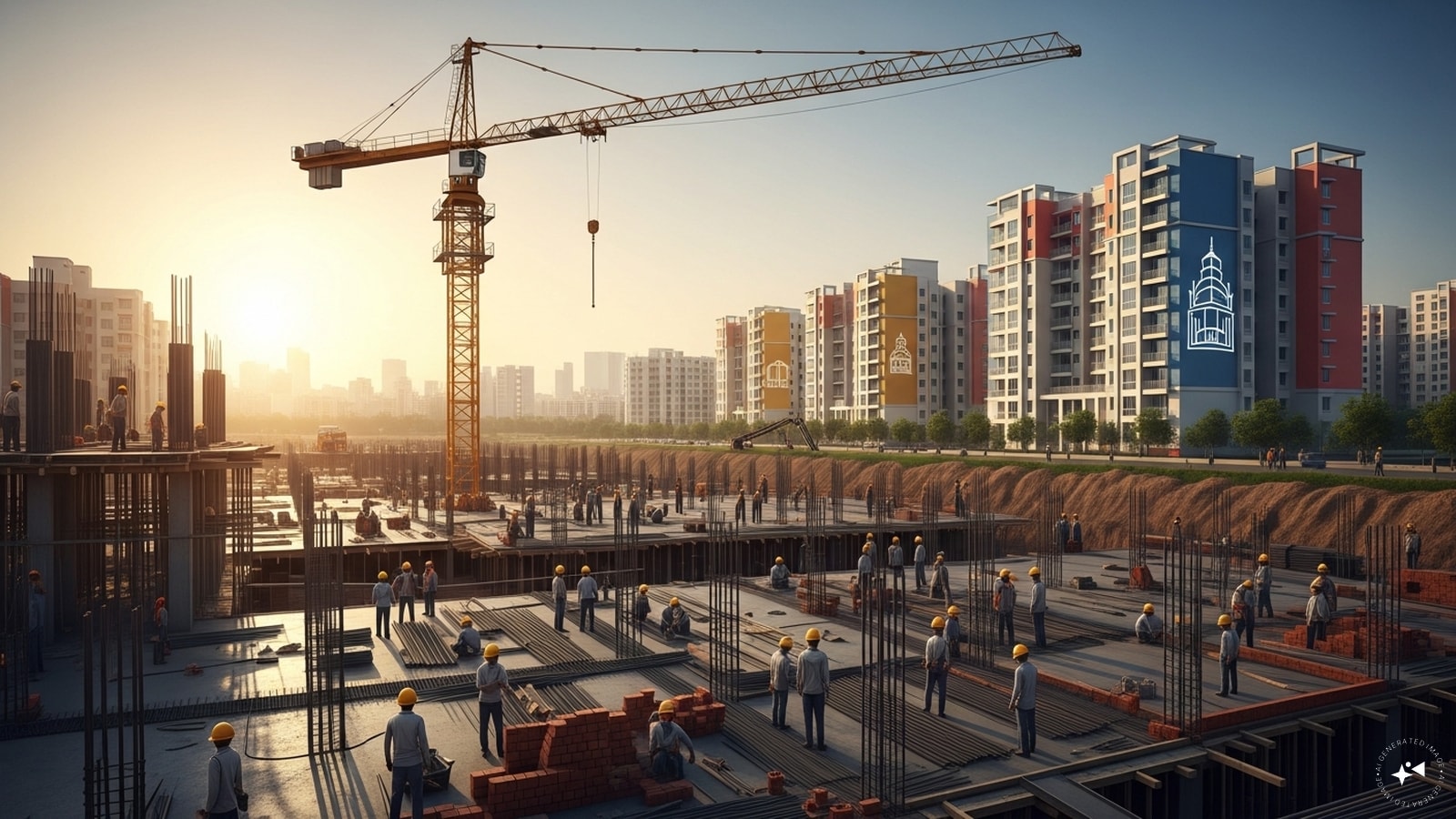
The dust in Gurgaon doesn't settle; it just hangs suspended in the afternoon heat, waiting for the next truck to pass. If you stand on the edge of Sector 82, where the manicured corporate parks bleed into the raw, upturned earth of rapidly expanding residential corridors, the sound is deafening. It is the sound of steel meeting concrete. It is the sound of a nation rewriting its own geography.
For a young professional like Aarav, a 28-year-old software analyst who moved to Delhi’s outskirts from a small town in Bihar, this dust is the smell of ambition. It is also the smell of anxiety. Every month, more than half of his paycheck vanishes into the bank account of a landlord who increases the rent with predictable, clockwork cruelty. Aarav wants a home. Not a luxury penthouse with an infinity pool, but a simple, two-bedroom apartment where the plumbing works, the electricity doesn't blink out twice a day, and the EMI doesn't choke his ability to buy groceries.
He is one of millions. India’s urban population is exploding, expanding by thousands of people every single hour. Yet, for a long time, the money required to build the homes these people actually need has been trapped behind a wall of caution. Local banks are stretched thin. Domestic developers are buried under previous debts.
Then, a massive shift occurred, quiet but monumental, thousands of miles away in Tokyo.
The Development Bank of Japan (DBJ) decided to bridge the ocean, committing substantial capital to HDFC Capital’s affordable housing platform. This isn't just a ledger entry or a routine corporate handshake. It is a financial lifeline thrown across Asia, linking the stagnant, low-interest capital of an aging, disciplined economy with the hyper-velocity, high-demand reality of a young, urbanizing superpower.
The Problem of the Missing Middle
Money is a coward. It likes safe, predictable paths. For years, international real estate investment in India poured into commercial office spaces in Bengaluru or ultra-luxury high-rises in Mumbai. Why? Because luxury is easy to quantify. Wealthy buyers pay upfront, and multinational corporations sign ten-year leases.
The middle class, however, is a messy proposition for global financiers.
Building mid-income and affordable housing requires scale, deep local knowledge, and an immense tolerance for regulatory navigation. If a developer miscalculates the cost of steel by five percent, an affordable housing project can stall for years, leaving behind a skeletal ghost town of gray concrete. For an overseas investor looking at India from a skyscraper in Marunouchi, that risk looked too high.
But while the international money hesitated, the crisis on the ground worsened.
Consider the mathematics of a young family in Hyderabad or Chennai. They earn enough to dream, but not enough to compete with speculative investors. When affordable housing isn’t built, these families are forced into informal settlements or pushed so far out to the periphery of cities that their daily commute devours four hours of their lives. The social fabric frays from the edges.
The gap wasn't a lack of desire to build; it was a lack of patient capital. Developers needed money that didn't demand astronomical returns within twenty-four months. They needed partners who understood that building a nation's infrastructure is a marathon, not a sprint.
Why Tokyo Looked West
To understand why the Development Bank of Japan stepped into this specific arena, you have to look at the economic reality of Japan itself. Japan is a nation of incredible wealth, but it is also a nation facing an unprecedented demographic contraction. Its population is shrinking, interest rates have hovered near zero or in negative territory for years, and domestic growth opportunities are finite.
For institutions like the DBJ, keeping money inside Japan is an exercise in managing slow decline. They need growth. They need yield.
Now, look at India through that same lens.
It is the world’s most populous nation, with a median age under thirty. It is a country where tens of millions of people are entering the formal workforce every year, seeking their first apartments, their first mortgages, their first stakes in the modern world. The demand is structural, generational, and entirely unavoidable.
When DBJ partnered with HDFC Capital, they weren't just picking a random real estate fund. They chose HDFC, an entity that practically invented the modern housing finance ecosystem in India. HDFC Capital's platform, specifically the HDFC Capital Affordable Real Estate Fund-3 (H-CARE 3), was built precisely to solve the scale problem. It acts as a massive clearinghouse that channels institutional money directly into the hands of vetted, capable local developers who are building for the middle class.
The Japanese commitment brings more than just Yen converted to Rupees. It brings validation. When a state-backed institution like the DBJ signs on the dotted line, it signals to the rest of the global financial community that the Indian affordable housing sector is no longer a wild-west gamble. It is a legitimate, institutional-grade asset class.
The Mechanics of the Pipeline
How does a decision made in a boardroom in Tokyo actually turn into a roof over Aarav’s head in Gurgaon? The process is a complex, multi-tiered pipeline designed to filter out risk while accelerating construction.
First, the capital is pooled into the H-CARE 3 fund. This fund doesn't just buy land and hope for the best. It operates as a disciplined credit provider and equity partner. It targets developers who have a proven track record of delivering projects on time, focusing strictly on affordable and mid-income residential developments across India’s top fifteen cities.
[Tokyo: Institutional Capital (DBJ)]
               │
               ▼
[Mumbai: HDFC Capital Management (H-CARE 3 Fund)]
               │
               ▼
[Top 15 Indian Cities: Vetted Regional Developers]
               │
               ▼
[On-the-Ground: Affordable & Mid-Income Housing Projects]
The fund provides flexible financing structures. In the past, Indian developers relied heavily on expensive short-term loans from local shadow banks, which forced them to price their apartments out of reach of the average consumer just to cover the interest. HDFC Capital’s platform changes that equation. By providing long-term, lower-cost capital, developers can afford to buy materials in bulk, plan larger phases of construction, and keep the final price tag of the apartments within the budget of a salaried worker.
Furthermore, the partnership focuses heavily on technology and sustainability. The construction industry is one of the world's largest carbon emitters. By tying institutional capital to specific development benchmarks, the fund encourages developers to use monolithic concrete casting, pre-fabricated components, and water-recycling systems.
This isn't out of pure altruism. It is a matter of long-term economic survival. A building that uses thirty percent less water and energy is cheaper to maintain, less prone to municipal supply failures, and inherently more valuable to the family living inside it over a thirty-year mortgage.
The Unseen Ripple Effects
The true impact of this partnership will not be found in the quarterly financial reports of the Development Bank of Japan or HDFC. It will be found in the economic ripple effects that occur when a construction site opens up.
Real estate is the second-largest employer in India after agriculture. When a single affordable housing project breaks ground, it creates a massive demand for local labor. It employs the bricklayer from Rajasthan, the electrician from Kerala, the steel fabricator from Odisha. It creates a localized economic engine that distributes wealth long before the first resident ever moves in.
But the deeper, more profound transformation is psychological.
Security changes a person. When an individual transition from the precarity of renting from an arbitrary landlord to owning a home, their entire relationship with the future shifts. They begin to invest in their community. They care about the local school, the state of the roads, the reliability of the municipal grid. They stop living in survival mode and start planning for generations.
The entry of Japanese institutional capital into this specific niche is a testament to the changing nature of global finance. The era of Western pension funds dominating every major cross-border deal is giving way to a more interconnected, Asian-centric capital flow. It is a realization that the future of global economic stability is directly tied to the stability of the Indian middle class.
Beyond the Blueprint
The wind picks up again in Gurgaon, blowing a fine layer of red dust across the blueprints laid out on a temporary table inside a construction shack. The engineer overseeing the site doesn't know the names of the executives at the Development Bank of Japan. He doesn't need to.
He knows that the concrete mixer is turning because the funding secured six months ago arrived on time. He knows that the foundations are deep, the pillars are true, and forty-eight families will move into this specific block before the next monsoon arrives.
The partnership between Tokyo and Mumbai is an admission of mutual need. Japan has the capital but lacks the growth; India has the growth but lacks the capital. By locking arms, they are building something far more resilient than just residential towers. They are constructing the financial architecture that allows a young nation to house its dreams, one concrete floor at a time.