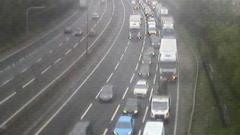
The asphalt doesn’t care about your promotion. It doesn’t care that your suitcase is packed with sunscreen and a paperback thriller, or that you’ve spent six months counting down the days until the departures board flashes a green "Boarding" next to your flight number. On the M1 near Luton, the road is a cold, grey indifferent beast. It waits.
At the junction for Luton Airport, there is a specific kind of silence that only exists in the wake of a collision. It starts with the screech—that high-pitched, metallic scream of rubber losing its grip on reality—and ends with the dull, heavy thud of physics asserting its dominance over steel. Then, the sirens.
On this particular morning, the stretch of the M1 north of London didn't just slow down. It died.
A multi-vehicle crash between Junction 10 and Junction 11 became the invisible wall that thousands of travelers hit at sixty miles per hour. One moment, the rhythm of the commute was a steady, humming baseline. The next, the brake lights blossomed like a field of artificial poppies, stretching back toward the horizon.
Consider a driver we’ll call David. He is not a statistic. He is a man with a 10:15 AM flight to Malaga. He has the boarding pass pulled up on his phone, the battery sitting at 42 percent. He is watching the digital clock on his dashboard flick forward with agonizing precision. 10:15 is no longer a departure time; it is a ghost.
David represents the invisible stakes of a motorway closure. When the National Highways officers and the Bedfordshire Police close the lanes, they aren't just managing traffic. They are presiding over a graveyard of plans.
The M1 is the artery of England. It pumps life, commerce, and weary families from the heart of London up into the rugged spine of the north. But Junction 10 is a specialized valve. It’s the gate to the sky. When that valve sticks, the pressure builds instantly. You can see it in the faces of the people leaning out of their stationary cars, looking for a shimmer of movement that never comes. They check their watches. They check Google Maps. They look at the person in the passenger seat and see their own frustration mirrored back.
The emergency services arrive with a practiced, somber urgency. For them, this isn't a delay. It’s a puzzle of glass and twisted frames. They have to work in the "sterile" zone, a term that feels cruelly clinical when you realize it refers to a patch of road where life was nearly extinguished. They sweep the debris. They document the skid marks. They wait for the recovery trucks to haul away the wreckage, which always looks smaller and more fragile than it did when it was moving.
While the police work, the rest of the world stalls.
The ripple effect of a crash near an airport is unique. Usually, a traffic jam is just lost time. Near Luton, it’s lost money, lost holidays, and lost reunions. There are people in those idling cars who haven't seen their parents in three years. There are entrepreneurs whose entire fiscal quarter depends on a meeting in Edinburgh that they are currently missing.
The physics of a traffic jam is a strange, liquid thing. When the front of the queue finally starts to move, the tail stays frozen for miles. It’s called a shockwave. A single car taps its brakes, and three miles back, a truck comes to a dead stop. On the M1 today, that shockwave was a tidal wave.
By the time the lanes finally began to breathe again, the damage was done. Not just the physical damage to the cars—the crumple zones and the shattered headlights—but the emotional erosion of a thousand small tragedies. The missed birthdays. The stressful phone calls to airline customer service lines that only offer automated apologies. The realization that a holiday meant to start with a sunset will now start in a crowded terminal, begging for a standby seat on the midnight flight.
We treat the motorway like a utility, something as guaranteed as gravity or the sunrise. We forget that we are hurtling through space in metal boxes at speeds our ancestors would have found terrifying. We forget that the margin between a smooth trip and a total life-interruption is often less than the width of a tire tread.
The road is open now. The glass has been swept. The blue lights have faded into the distance, heading toward the next call. Traffic flows again, a river of steel returning to its banks. But if you look closely at the shoulder near Junction 10, you can still see the faint, dark scars on the tarmac.
David is likely sitting in a terminal chair now, his phone plugged into a communal charging station, staring at a screen that says "Gate Closed." He is part of the hidden cost of the M1, a man whose journey ended before it even reached the clouds.
The road doesn't apologize. It just waits for the next set of tires to hum across its surface, indifferent to where they are going or what they are leaving behind.