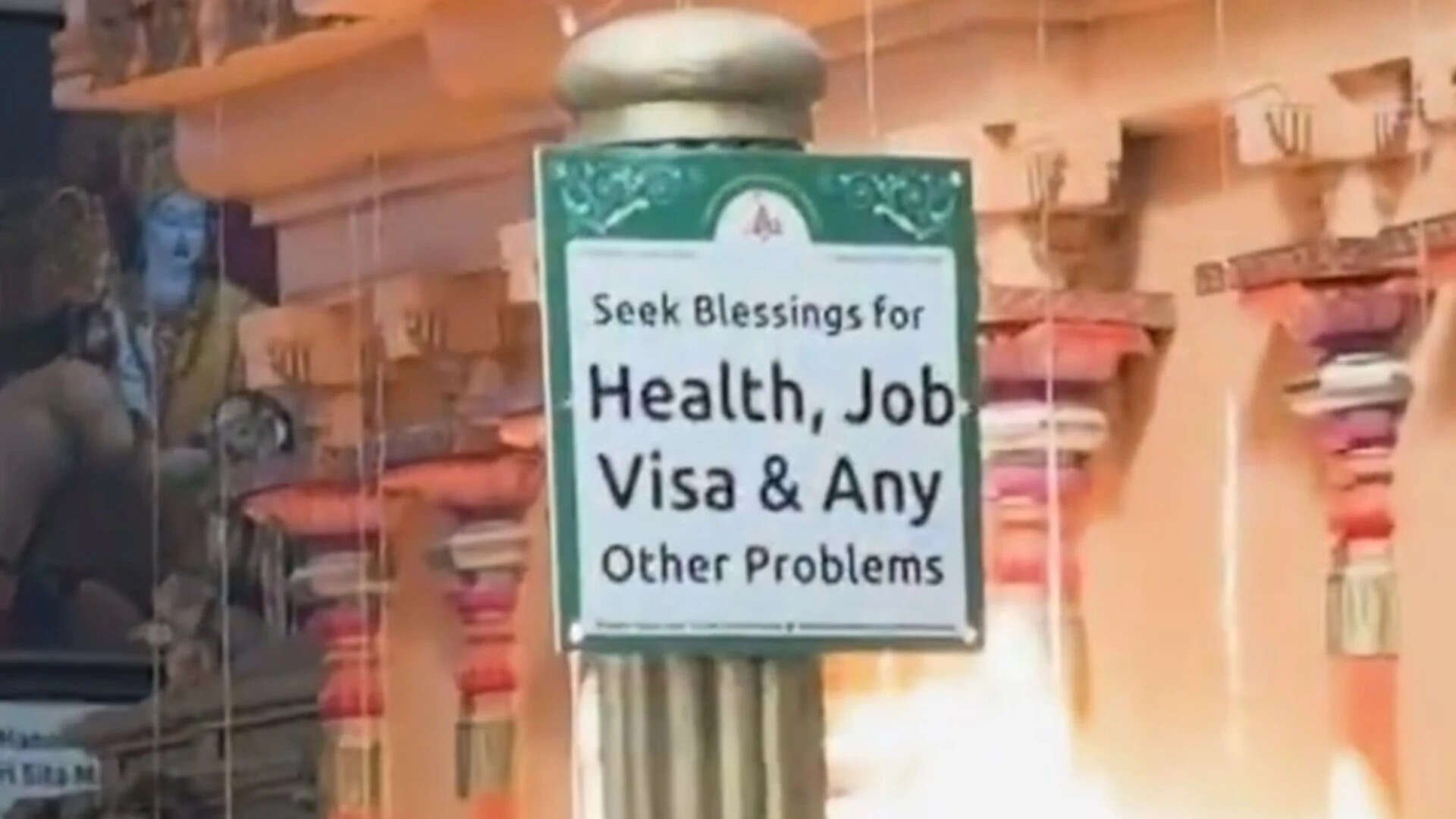
Why would a sign about paperwork cause a national stir? If you’ve been following the viral clips from North Texas lately, you’ve likely seen Savannah Hernandez, a reporter for Turning Point USA, standing in front of the Karya Siddhi Hanuman Temple in Frisco. She wasn’t there for the architecture. She was there to document what she called a "shocking" sight: a sign inside the temple explicitly offering blessings for "job visas."
For some, it's a sign of a community integrating their faith with their daily struggles. For others, like Hernandez and her followers, it's a flashing neon light signaling a cultural takeover. But if we pull back the curtain, this isn’t just about a temple in a Dallas suburb. It’s about how high-skilled immigration, religion, and the changing face of Texas are colliding in ways that make people deeply uncomfortable. Discover more on a connected subject: this related article.
The sign that sparked a thousand tweets
The Karya Siddhi Hanuman Temple is massive. It’s intricate. It sits in a quiet residential neighborhood where, as Hernandez put it, "you would not expect it." Inside, among the traditional deities and the smell of incense, a sign lists various reasons to seek blessings: health, family, and notably, "job visas."
Hernandez’s reaction was immediate. She posted to X (formerly Twitter) that she was "still in shock." The clip quickly racked up millions of views, feeding into a larger narrative about "Mini-India" taking over the Lone Star State. But here’s the thing: seeking divine help for a visa isn’t a political statement for the people inside that temple. It’s a survival tactic. More journalism by The Washington Post highlights similar views on this issue.
If you’re an H-1B holder in 2026, your entire life—your home, your kids’ schools, your bank account—hangs by a bureaucratic thread. When the federal government holds the power to uproot your life on a whim, where else do you go but to a higher power?
Why North Texas is the new cultural battleground
This isn’t happening in a vacuum. Frisco, Plano, and Irving have seen an explosion in the Indian-American population over the last decade. We aren’t just talking about a few new families; we’re talking about entire neighborhoods where cricket fields have replaced baseball diamonds and streets bear names like Ali Akbar.
To the critics, this is an "invasion." To the tech companies in the Silicon Prairie, it’s the engine of the economy. The friction comes from the speed of the change.
- Rapid Demographics: Frisco’s Asian population has surged, making them a significant part of the local fabric.
- Visible Faith: Large temples and 90-foot statues, like the Hanuman statue in Sugar Land, aren't tucked away. They're prominent landmarks.
- Economic Tension: There’s a persistent, often unfounded, fear that H-1B workers are "replacing" American tech talent, despite the rigorous requirements for these visas.
When Hernandez points to a "huge pile of shoes" outside the temple as if it’s an alien artifact, she’s tapping into a nativist anxiety that has been simmering in Texas for years. It’s the same energy that led masked protesters to carry "Don’t India My Texas" signs in Irving last year.
Understanding the visa blessing tradition
To understand why that sign exists, you have to understand the specific deity it’s associated with. Lord Hanuman is often turned to by Hindus in times of trouble or for the "attainment of difficult tasks." In the world of US immigration, getting a green card or a visa extension definitely qualifies as a difficult task.
There’s even a famous "Visa Balaji" temple in India (the Chilkur Balaji Temple) where thousands of software engineers flock to pray before their embassy interviews. The Frisco temple is simply providing a local version of that spiritual support. It’s pragmatic. It’s about people trying to navigate a broken immigration system.
The "shock" expressed by reporters like Hernandez often stems from a lack of familiarity with how Hinduism operates. It’s a faith that doesn't separate the "secular" from the "sacred" as strictly as some Western traditions do. If you need a job to feed your family, you pray for the job. If you need a visa to keep that job, you pray for the visa.
The fallout of viral outrage
The problem with these viral moments is that they rarely lead to a nuanced discussion. Instead, they trigger a flood of hate. Since the video dropped, online rhetoric against Indian immigrants has spiked. Some users on social media have gone as far as calling the presence of the temple a "conquest" of Texas.
This rhetoric ignores a few inconvenient facts. The Indian-American community in North Texas is one of the most affluent and highly educated demographics in the country. They pay taxes, they start businesses, and they've turned formerly sleepy suburbs into global tech hubs.
But for those who feel the culture they grew up with is slipping away, those contributions don't matter as much as the "unrecognizable" street signs. The controversy isn’t really about the visa sign; it’s about the visibility of a group that used to be seen but not heard.
How to navigate the changing landscape
If you live in these communities or are watching this from afar, it’s easy to get caught in the "us vs. them" loop. But there are better ways to handle the cultural shift.
- Distinguish between culture and policy: You can have opinions on H-1B visa caps without attacking a religious institution.
- Visit the space: Most Hindu temples are open to the public. If a "pile of shoes" or a "visa sign" seems shocking, go inside and talk to someone. You’ll find that the "problems" they’re praying about—health, jobs, family—are the same ones you have.
- Check the data: Before buying into "invasion" narratives, look at the actual economic impact of the Indian community in Texas. The growth in the Dallas-Fort Worth area is largely driven by the very industries these immigrants support.
The sign in the Frisco temple will probably stay. People will keep praying for their visas because the US immigration system isn't getting any easier to navigate. Whether Texas continues to be a "big tent" or becomes a fortress of resentment depends on whether we choose to see these neighbors as "aliens" or as fellow residents just trying to make a life in the sun.