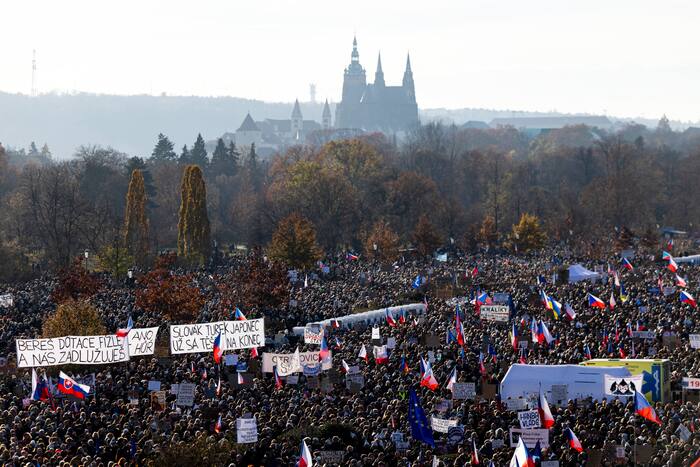
Tens of thousands of protesters recently flooded the streets of Prague to defend the status quo of Czech public media funding. Mainstream news coverage framed the demonstrations as a straightforward battle between brave defenders of press freedom and a government trying to dismantle democratic institutions. That framing is lazy. It relies on an emotional binary that completely ignores the structural reality of how modern media actually survives.
The prevailing consensus among conventional commentators goes like this: moving Czech Television (ČT) and Czech Radio (ČRo) away from direct household license fees and into the state budget automatically turns them into government mouthpieces. Protesters held signs warning against the "Slovak scenario" or the "Hungarian model," assuming that any change to the collection mechanism equals instant editorial capture.
Here is the uncomfortable truth nobody chanting in Old Town Square wants to admit. The traditional TV and radio license fee is a dead man walking. Fighting to preserve a legacy tax tied to physical broadcast receivers in an era of smartphones and on-demand streaming does not protect journalistic independence. It slowly starves the very institutions the protesters claim to love.
The Myth of the Bulletproof License Fee
Conventional wisdom treats the direct license fee—the koncesionářský poplatek—as an impenetrable shield against political interference. The theory sounds clean on paper. Citizens pay a monthly fee directly to the broadcaster, bypassing the Ministry of Finance, so politicians cannot hold the newsroom hostage during annual budget negotiations.
In practice, that shield has been rusting for two decades.
First, the Czech Republic kept its TV and radio fees frozen at 135 CZK and 45 CZK per month for over fifteen years, from 2008 until recent attempts to adjust them. Why did those rates stay frozen while inflation gutted purchasing power? Because raising the fee requires parliamentary approval. Politicians never had to cut the budget directly to weaken public media; they simply refused to pass inflation adjustments, forcing ČT and ČRo into slow-motion austerity.
Second, a fee based on owning a television or radio receiver becomes absurd when media consumption migrates to laptops, tablets, and phones. Previous legislative attempts to expand the fee to anyone with an internet connection triggered massive backlash, proving that the public hates paying a direct, visible tax for content they might not watch. When enforcement requires costly bureaucratic tracking of household devices, administrative overhead eats away at the very funds meant for investigative reporting.
I have watched European media executives burn millions of euros trying to modernize legacy collection systems that citizens actively evade. You cannot enforce a 20th-century broadcast tax on a 21st-century digital population without turning public broadcasters into despised debt collectors.
What the Mainstream Coverage Misses About Editorial Independence
The competitor coverage assumes that funding source equals editorial control. That is a fundamental misunderstanding of institutional governance.
Look across Europe. Germany’s Rundfunkbeitrag—a mandatory household levy—generates over eight billion euros annually, yet German public broadcasters still face constant political pressure over board appointments and programming mandates. Meanwhile, countries like Finland and Sweden transitioned away from traditional device fees toward earmarked taxes collected through the state revenue system, and both nations consistently rank at the very top of the Reporters Without Borders World Press Freedom Index.
The mechanism of collection is not what protects a newsroom. Governance rules do.
Specifically, three structural safeguards determine whether a public broadcaster stays independent or collapses into state propaganda:
- Multi-year statutory funding formulas: When funding is locked into a multi-year cycle indexed automatically to inflation or GDP, ruling parties cannot punish critical journalism in next year's budget vote.
- Depoliticized supervisory boards: In the Czech system, members of the Czech Television Council and Czech Radio Council are elected by parliament. Even under the old license fee model, hostile parliamentary majorities repeatedly stacked these councils with political loyalists who threatened the director general's job.
- Strict constitutional and legal firewalls: Clear statutory mandates prohibiting ministerial interference in editorial decisions matter far more than whether the money arrives via a postal money order or a treasury transfer.
By focusing entirely on the abolition of the household fee, the protest movement and the media covering it are fighting the wrong war. They are defending an archaic payment method while ignoring the parliamentary appointment system that actually gives politicians leverage over newsroom leadership.
Answering the Questions Nobody Wants to Ask
When people search for why Czechs are protesting the media overhaul, they usually look for simple answers about democracy versus authoritarianism. Let us dismantle the flawed premises behind those common questions.
Does state-budget funding automatically turn public media into state propaganda?
No. State propaganda happens when the government controls who runs the newsroom, who gets hired, and what stories get killed. If a broadcaster receives funds from the general budget under a rigid, multi-year legal formula that the government cannot alter mid-cycle, editorial independence remains intact. Conversely, a broadcaster funded by direct citizen fees can still be captured overnight if a parliamentary majority replaces its supervisory board with partisan hacks. Money is only one lever of power; appointment authority is the sharper blade.
Why are Czech citizens so fiercely attached to the current system?
Memories of pre-1989 state censorship run deep, and recent events in neighboring Slovakia—where the government overhauled leadership at RTVS—created legitimate anxiety across Central Europe. Protesters see the abolition of the license fee not as a technical fiscal reform, but as the first domino in a broader political takeover. That emotional reaction is understandable, especially given the polarizing rhetoric surrounding Czech politics. However, emotional solidarity in the streets does not fix a broken balance sheet.
What happens if the government keeps the license fee exactly as it is?
Slow decay. Without structural reform, public media either relies on periodic, politically toxic fee hikes approved by reluctant lawmakers, or it shrinks its programming, closes regional bureaus, and loses top investigative talent to private outlets. Keeping the old system frozen in amber guarantees long-term irrelevance.
The Real Threat Hidden Inside the Overhaul
Critics of the government's plan are right about one critical vulnerability, even if they misdiagnose the cause. Moving public media into the state budget becomes genuinely dangerous if—and only if—the legislation leaves funding levels up to the annual discretion of the finance minister and ruling coalition.
If a government can trim public media funding by ten percent every autumn during standard budget negotiations, self-censorship sets in immediately. Editors do not need a phone call from the prime minister to soften a story; they just look at the upcoming appropriations calendar and pull their punches to avoid budget cuts.
Imagine a scenario where a public broadcaster uncovers a major procurement scandal involving a cabinet minister two weeks before the annual budget reading. Under a discretionary state-budget model, the broadcaster's survival depends on the goodwill of the very people it just exposed. That is an intolerable conflict of interest.
The solution, however, is not clinging to a regressive, flat-rate household tax that charges a retired pensioner the exact same amount as a billionaire tech executive. A flat fee is inherently unfair, expensive to administer, and structurally obsolete.
How to Actually Bulletproof Public Media
If reformers and protesters actually cared about long-term journalistic survival rather than scoring political points, they would abandon the license fee and demand a modern, ironclad funding architecture.
- Replace the flat fee with an earmarked progressive levy: Collected automatically through the existing tax system, tied directly to income or a fixed percentage of national tax revenue, and deposited straight into an independent trust account outside the finance minister's reach.
- Lock funding into five-year cycles: Align budget terms so they do not coincide with parliamentary election cycles, preventing incoming governments from immediately starving the broadcaster.
- Strip parliament of exclusive board appointment powers: Require nominations from civil society, universities, professional journalism associations, and cultural institutions, with staggered terms that prevent any single ruling coalition from capturing a board majority.
There is an obvious downside to this approach, and ignoring it would be dishonest. Even an earmarked tax collected by the state creates a psychological link between the government and the broadcaster. In times of severe economic recession or fiscal crisis, politicians face intense pressure to raid earmarked funds or temporarily suspend automatic inflation indexing. A statutory firewall is only as strong as the political culture willing to respect it, and during periods of populist backlash, laws can be rewritten by a simple parliamentary majority.
Yet that risk already exists under the current license fee system. Parliament wrote the license fee law, and parliament can amend or repeal it whenever a coalition holds enough votes. Pretending the current fee structure sits safely outside politics is pure fantasy.
Stop Defending the Plumbing
Protesting in the streets feels noble. It generates dramatic photographs, comforting headlines, and a sense of civic virtue. But marching to preserve a 20th-century broadcast tax is like protesting to save payphones because you distrust mobile carriers.
The technology has changed. Media consumption has changed. Public finance has changed.
If defenders of Czech public media spend all their political capital protecting an outdated collection fee, they will win a symbolic victory while leaving the real levers of political control—parliamentary board appointments and discretionary legislative oversight—completely untouched. Stop fighting over how the money is collected and start locking down who controls the boardroom.