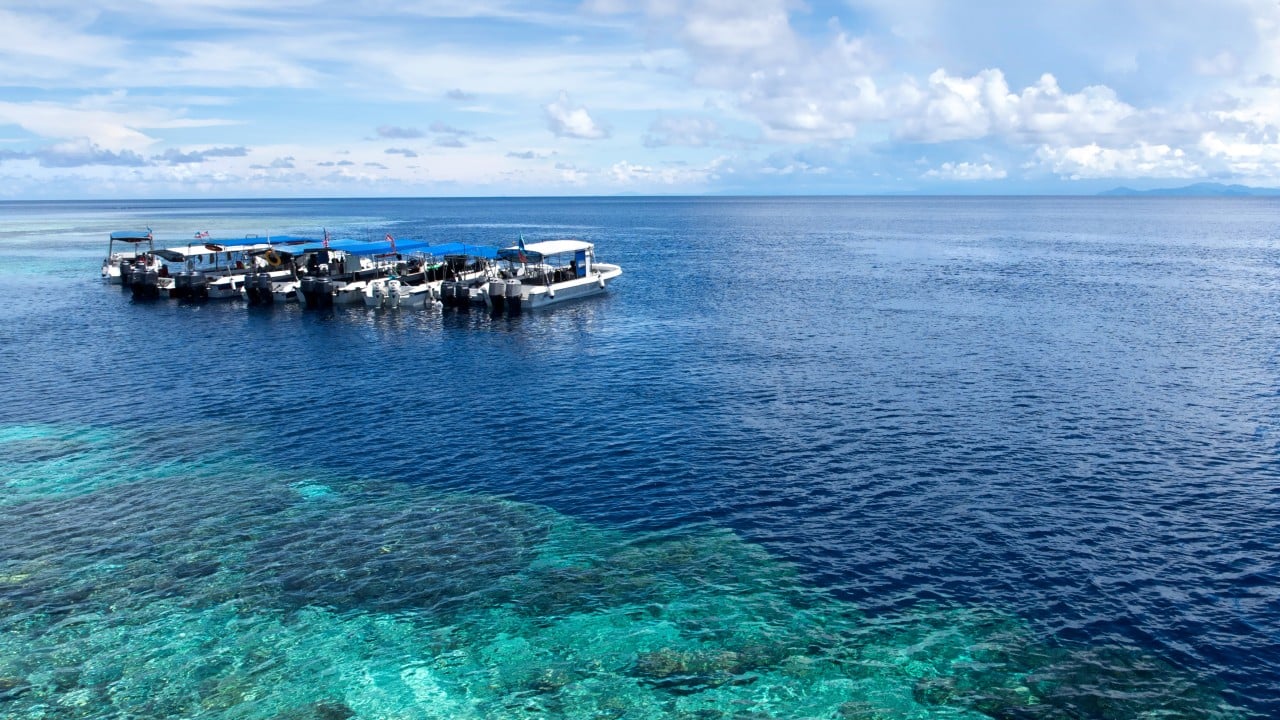
The water off the coast of Sabah does not just look blue. It feels heavy, thick with life, shifting from a bright, sun-bleached turquoise near the shallows to an ink-black abyss just a few miles out. If you dip your face beneath the surface at Layang-Layang or Sipadan, the noise of the human world vanishes. It is replaced by a low, rhythmic clicking—the sound of thousands of parrotfish scraping algae off calcium skeletons, the frantic darting of clownfish, the slow, ancient glide of green sea turtles.
This is the Coral Triangle. Marine biologists call it the Amazon of the seas. For the people who live along the coast of East Malaysia, it is simply home.
But fifty miles away, out where the turquoise gives way entirely to the deep navy of the South China Sea, a different kind of noise dominates. It is the deep, metallic thrum of a diesel generator. A massive steel tower sits anchored to the seabed, its drill bit biting thousands of feet into the Earth's crust.
Malaysia is standing at a literal crossroads on the water. On one hand, the nation possesses some of the most pristine, biodiverse coral reefs left on the planet. On the other hand, it sits on billions of barrels of unextracted crude oil and natural gas. The pressure to drill deeper, faster, and further offshore has never been higher.
The story of modern Malaysia is often told through its towering skyscrapers and booming tech sectors. Yet, the real drama is unfolding out in the open ocean, where an invisible line is being drawn between immediate economic survival and the permanent destruction of a global treasure.
The Fisherman and the Flame
To understand what is truly at stake, you have to leave the air-conditioned boardrooms of Kuala Lumpur and sit on the wooden pier of a stilt village in Semporna. Let us call the man sitting there Zainal. He is forty-six, though the equatorial sun has carved lines into his face that make him look sixty. His hands are rough from decades of handling nylon fishing nets.
For generations, Zainal’s family has relied on the reef. The corals act as a nursery for the groupers, snappers, and mackerel that feed his village and supply local markets.
"The sea used to be predictable," Zainal says, pointing out toward the horizon where the sky meets the water. "Now, we go further out. Sometimes we see the slick. A thin film on the water that smells like a mechanic's shop. The fish don't stay where the water smells like that."
The slick he refers to isn't always from a catastrophic oil spill. Those make global headlines. The real damage often comes from chronic, low-level pollution—the routine discharge of "produced water" from drilling platforms, which contains trace amounts of heavy metals, hydrocarbons, and chemical additives used in the extraction process.
To a massive oil conglomerate, a few parts per million of oil in discharged water falls safely within regulatory limits. To a fragile coral polyp, which requires pristine, nutrient-poor water to survive, it can be a slow death sentence.
When oil platforms are constructed, the immediate physical disruption is immense. Heavy anchors tear through seafloor ecosystems. Drilling muds—dense mixtures of clay and chemicals used to lubricate the drill string—can smother nearby reefs, blocking out the sunlight that the symbiotic zooxanthellae algae need to photosynthesize. If the algae die, the coral bleaches. If the bleaching lasts too long, the reef turns into a ghostly, brittle graveyard.
The Economic Paradox of Black Gold
It is easy to paint the energy sector as a monolithic villain. But the reality is far more complicated, far more human, and deeply tied to the welfare of millions of Malaysian citizens.
Malaysia’s national oil company, Petronas, is not just a commercial enterprise; it is the financial backbone of the state. Oil and gas revenues fund schools, build highways, subsidize healthcare, and drive the nation’s infrastructure forward. For a developing country striving to elevate its population into high-income status, turning your back on billions of dollars in offshore reserves feels like economic suicide.
Consider the numbers that keep policymakers awake at night. The energy sector contributes a massive chunk of Malaysia's gross domestic product. As older onshore and shallow-water fields inevitably dry up, the only way to maintain production levels is to push into deep-water territory.
This brings the drills closer than ever to protected marine environments and migratory routes for megafauna like whale sharks and dugongs.
The argument for expansion is always framed around national security and economic independence. Without local oil, Malaysia would become dependent on foreign imports, exposing its citizens to the volatile swings of global energy markets. Every time a new offshore block is auctioned off, it represents thousands of jobs, billions in investment, and a guarantee that the lights stay on in the cities.
Yet, this creates a profound paradox. The very resource driving Malaysia’s economic development threatens the natural infrastructure that protects its coasts. Coral reefs are not just pretty backdrops for scuba divers; they are living wave barriers. They absorb up to ninety-seven percent of wave energy, protecting coastal villages like Zainal’s from the increasingly violent tropical storms fueled by a changing climate.
The Invisible Threat of the Acoustic Wilderness
When we think of pollution, we think of things we can see and touch: plastic bags, oil slicks, black smoke. But beneath the waves, the most terrifying weapon deployed by offshore exploration is completely invisible.
It is sound.
Before a single drill bit touches the ocean floor, oil companies must map the geology beneath the seabed. They do this using seismic airguns. These devices towed behind ships fire incredibly powerful blasts of compressed air into the water every few seconds, sending acoustic shockwaves deep into the Earth's crust to map oil reservoirs.
The sound of a seismic airgun can reach two hundred and fifty decibels. To put that in perspective, a rock concert is about one hundred and twenty decibels; a jet engine taking off is around one hundred and forty. Sound travels five times faster in water than in air, and it travels much further.
For marine mammals and fish, the ocean is a world of sound. They use echolocation and acoustic cues to find food, avoid predators, and navigate the trackless blue.
A seismic blast can blow out the hearing of a whale miles away, leaving it disoriented, unable to feed, and prone to beaching itself on the shore. For smaller organisms, like the tiny zooplankton that form the absolute base of the marine food web, the impact is even more immediate. Studies have shown that a single seismic blast can cause a massive drop in zooplankton populations for a radius of over a kilometer.
If you kill the plankton, you starve the small fish. If you starve the small fish, the reef ecosystem collapses from the bottom up.
Finding a Third Way on the High Seas
Must the future always be a zero-sum game between prosperity and preservation?
Some marine scientists and progressive economists argue that Malaysia is drastically undervaluing its living assets. Tourism is a massive economic driver for Sabah and Sarawak. A healthy coral reef attracts high-value eco-tourism that pours money directly into local communities, providing sustainable livelihoods that can last for generations. An oil well, by contrast, has a lifespan of a few decades before it runs dry, leaving behind a rusted steel skeleton and a compromised ecosystem.
There is a growing movement to enforce stricter, legally binding marine spatial planning. This would involve drawing definitive, unalterable borders around ecological hotspots, declaring them entirely off-limits to seismic testing and drilling, regardless of how much oil lies beneath them.
At the same time, the concept of "Rig-to-Reef" is being explored. When an offshore platform reaches the end of its productive life, instead of completely dismantling it at a massive environmental and financial cost, the upper structure is removed while the massive steel jacket is left underwater. Over time, corals colonize the steel, turning an industrial relic into an artificial reef that teems with life.
But this is a bandage, not a cure. It does not erase the carbon emissions generated by the oil extracted during the platform’s lifetime, nor does it undo the decades of acoustic stress inflicted on the surrounding ocean.
The Gathering Dusk
As the sun begins to set over the Celebes Sea, the water shifts from dark navy to a brilliant, bruised purple. On the pier in Semporna, Zainal watches his youngest son help haul a modest catch of mackerel out of a small fiberglass boat. The boy is fourteen, quick-moving, and laughs as he counts the fish.
"I don't want him to have to leave for the city," Zainal says softly, watching the boy. "If the reefs die, there is nothing for him here. He will have to go to Kota Kinabalu or Kuala Lumpur to work in a factory or drive a delivery bike."
Far out on the horizon, just past the curvature of the Earth, a lone gas flare ignites on an offshore platform. It burns bright and steady against the darkening sky—a tiny, artificial star fueled by the ancient wealth of the seabed, casting a long, trembling orange reflection across the water toward the shore.