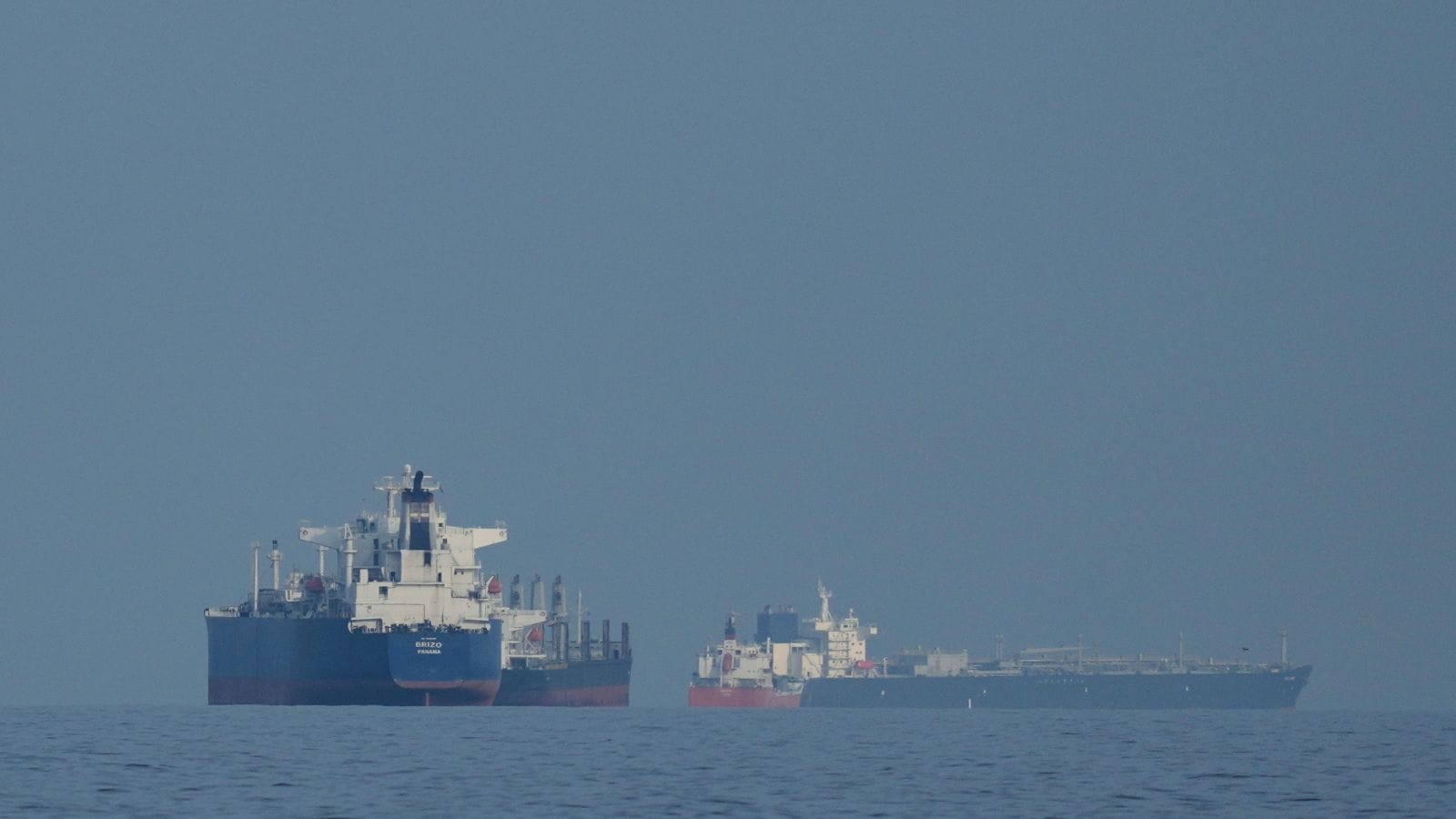
The captain of a VLCC supertanker—a Vessel of Large Crude Carrier—doesn’t see the water the way you or I do. To a man standing on a bridge three hundred meters long, the Persian Gulf isn't a vacation spot or a scenic vista. It is a mathematical equation of displacement, draft, and anxiety. Below the keel lies a pressurized silence, and somewhere within that silence, the Iranian Navy has lost its memory.
Specifically, they have lost their mines.
The Strait of Hormuz is the world’s most important windpipe. Twenty percent of the planet’s petroleum flows through a gap so narrow that the shipping lanes are barely two miles wide in each direction. It is a choke point by definition. In the late 1980s, during the "Tanker War," the waters became a graveyard of iron and fire. Today, the tension has returned, but it is accompanied by a terrifying technical incompetence. Iran has spent decades seeding these waters with naval mines—contact mines, acoustic mines, magnetic sensors—but the sea is a chaotic record-keeper.
Imagine a warehouse where the floor is constantly moving, the lights are off, and someone has hidden a thousand live grenades. Now, imagine that same person has lost the map.
The Anchor and the Abyss
Naval mines are the ultimate asymmetric weapon. They are cheap, they are patient, and they are terrifyingly effective. A standard moored contact mine, like the Iranian-produced Sadaf-02, costs less than a used car but can break the back of a billion-dollar destroyer.
But the ocean is not a static environment.
When the Islamic Revolutionary Guard Corps (IRGC) Navy drops a mine, they aren't placing a trophy on a shelf. They are tethering a volatile explosive to a seabed defined by shifting sands, brutal currents, and tectonic instability. A hypothetical officer—let’s call him Hamid—stationed on a fast-attack craft near Bandar Abbas, might be ordered to "salt" a specific sector of the strait during a period of high geopolitical friction. He rolls the spiked spheres off the deck. He records the coordinates. He feels a sense of strategic accomplishment.
Then, the tide turns.
The Strait of Hormuz is notorious for its "Shamals," powerful northwesterly winds that whip the sea into a frenzy. Beneath the surface, the currents are even more treacherous. Over months and years, the heavy weights that anchor these mines to the floor begin to "walk." They drag across the silt. They tumble into deeper trenches where the pressure might crush their internal sensors, or they snap their moorings entirely.
A snapped mooring creates a "drifter." This is the nightmare scenario for every merchant mariner. A drifter is a blind, floating killer that follows the current wherever it leads. It doesn't care about territorial waters. It doesn't care about the difference between a neutral cargo ship and an enemy frigate. It simply waits for a hull to provide the necessary spark.
The Physics of Forgetting
There is a specific reason why Iran can't find its own toys. It isn't just poor record-keeping; it's a conflict between 19th-century hardware and 21st-century oceanography.
Most of the mines in the Iranian inventory are based on aging Soviet designs. These are simple machines. They use chemical horns—lead tubes containing glass vials of sulfuric acid. When a ship strikes the horn, the glass breaks, the acid completes a battery circuit, and the detonator fires. It is a reliable, low-tech way to blow a hole in a ship.
However, these mines lack "smart" recovery systems. Modern Western mines often feature acoustic "kill switches" or timed self-destruction mechanisms. They are designed to be temporary. Iranian mines, by contrast, are "dumb." Once they are in the water, they stay live until the internal components corrode into uselessness—a process that can take decades.
The technical challenge of relocation is immense. The Persian Gulf is surprisingly shallow, but it is also incredibly "noisy" in a sonar sense. The water is thick with salt, varying temperature layers (thermoclines), and a seafloor littered with shipwrecks, discarded shipping containers, and rock formations. To a sonar operator, a Sadaf-02 mine looks almost identical to a rounded boulder or a piece of junk.
The IRGC often deploys these weapons from civilian-style dhows or small patrol boats to avoid detection by U.S. satellite surveillance. This "stealth" deployment comes at a cost: precision. When you are tossing explosives off the side of a boat in the middle of the night while trying to avoid a MQ-9 Reaper drone overhead, your GPS logging isn't going to be surgical. You are lucky if you are within a half-mile of your target.
The Human Cost of the Invisible
Consider the perspective of a merchant sailor.
Let's look at Elias, a third mate on a Panamanian-flagged tanker. He is twenty-four years old, far from home, and responsible for a cargo that could incinerate a city block. As his ship enters the Strait of Hormuz, he isn't looking for pirates or missiles. He is staring at the water’s surface, looking for a shadow.
The psychological weight is suffocating. Unlike a missile attack, which is a discrete event with a beginning and an end, a minefield is a permanent state of dread. You don't know the danger is there until the floor disappears beneath your feet.
In 1988, the USS Samuel B. Roberts struck an Iranian M-08 mine. The explosion blew a fifteen-foot hole in the hull, ignited fires, and nearly sank a ship that was the pinnacle of naval engineering. The mine that did it was a design from World War I. It cost about $1,500. The repairs to the "Sammy B" cost $96 million.
That disparity is why Iran continues to play this dangerous game. It is the "war of the poor." If you cannot outproduce the American Fifth Fleet, you simply make the water too dangerous for them to swim in. But the strategy assumes you can control the beast you’ve unleashed.
The reality is that Iran has created a "ghost fleet" of explosives that even they can no longer track. During various naval exercises, Iranian divers have been tasked with recovering practice mines, only to find that half of them had vanished. If they can’t find the bright orange ones used for training, how can they find the black, barnacle-encrusted ones meant for war?
The Salinity Trap
The Persian Gulf is one of the saliniest bodies of water on Earth. High evaporation rates leave behind a dense, caustic brine. This environment is hell for electronics and metal.
When a mine stays submerged for years, the mooring cables undergo "stress-corrosion cracking." The salt eats the steel. Eventually, the tension of the buoy—the explosive part—pulls the weakened cable apart.
Now, the mine is no longer a strategic barrier. It is a wanderer.
The currents in the Strait of Hormuz generally flow inward along the Iranian coast and outward along the Omani coast. This means an Iranian mine that breaks free doesn't just stay in Iranian waters. It drifts toward the United Arab Emirates. It drifts toward the deep-water ports of Oman. It drifts into the very paths used by the ships carrying the fuel that keeps the lights on in London, Tokyo, and New York.
The IRGC’s "lost" mines are a form of environmental and economic pollution. They are the litter of a cold war that never quite turns hot, yet never cools down.
A Failure of Mapping
In the digital age, we assume everything is mapped. We have Google Earth; we have transponders; we have persistent surveillance. But the bottom of the ocean remains a frontier of ignorance.
The Iranian military's map of their minefields is likely a collection of disparate, handwritten logs, hurried GPS coordinates from vibrating handheld units, and the fading memories of officers who have since been reassigned or retired. There is no central, high-fidelity database that accounts for the "walking" of anchors or the snapping of cables.
This isn't just a technical failure. It is a strategic liability.
If Iran ever wanted to truly "clear" the Strait to signal a de-escalation of tensions, they couldn't. They lack the advanced Mine Countermeasures (MCM) technology possessed by the U.S. or the Royal Navy. They are better at breaking things than fixing them. They can sow the seeds of chaos, but they have no harvester.
The danger is that a "ghost mine" will eventually do what it was built to do. It will find a hull. When that happens, the world will demand answers. Was it a deliberate act of aggression? Was it a rogue commander?
The truth might be much more pathetic: it was just a piece of forgotten trash from a decade ago, finally finding its mark.
The Silent Sentinel
The sun sets over the Musandam Peninsula, casting long, golden shadows across the narrowest part of the Strait. On the radar screens of the warships patrolling these waters, the world looks orderly. Green blips represent tankers; blue blips represent allies. Everything is accounted for.
But radar doesn't see through the water.
Underneath the waves, a rusted iron sphere sways gently in the current. Its spikes are covered in algae. Its internal acid vial is still intact, the fluid waiting to touch the lead plates and wake the sleeping giant within. It has been there for five years. Or maybe ten. The men who put it there are long gone, and the records of its existence have been lost in a filing cabinet in Tehran or deleted from a corrupted hard drive.
It is a blind, patient predator. It doesn't need instructions. It doesn't need a mission. It only needs a moment of contact.
The Strait of Hormuz remains the world’s most dangerous paradox: a highway for the modern world built over a graveyard of forgotten, live ammunition. We sail over it every day, hoping that the sea’s memory remains as fractured as the men who tried to master it.
The ship moves on. The water closes behind it. And in the dark, the mine continues to wait for a master who will never come back to find it.