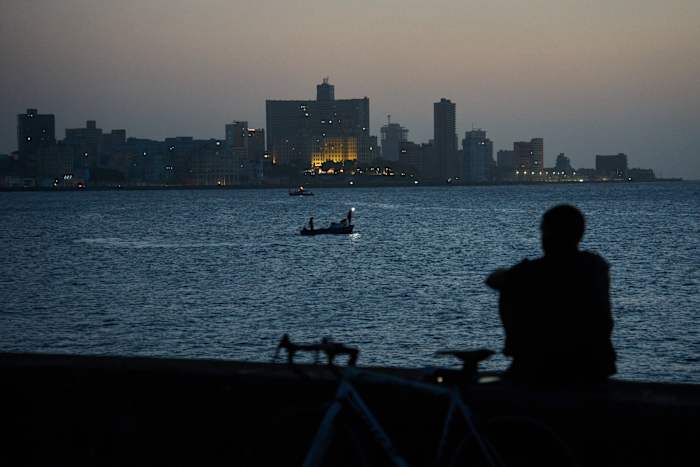
Cuba is running out of light. When the sun sinks below the horizon in Havana, the heat does not break. Instead, it presses down on the city like a wet wool blanket, trapping millions of residents in concrete boxes devoid of airflow. The electricity grid fails again. Transformers pop with muffled thuds in the dark, and refrigerators grow warm, spoiling what little food families managed to acquire.
Desperation forces people out of their suffocating apartments and onto the Malecón, the iconic seaside boulevard that curves along the Atlantic coast. Thousands sit on the concrete seawall, turning their faces toward the salt spray, hoping the midnight breeze will offer enough relief to steal a few hours of sleep before dawn breaks. This is not a summer camping trip. This is the nightly routine of survival in a nation where the power grid has crossed the line from fragile to structurally broken.
Most foreign coverage treats these blackouts as a seasonal inconvenience triggered by a punishing heatwave or a sudden spike in demand. That view misses the structural reality. The crisis on the Malecón is the endpoint of decades of deferred maintenance, severe fuel shortages, chronic underinvestment, and a geopolitical isolation that starves the country of spare parts. To understand why Cubans are sleeping on a seaside wall, you have to look past the atmospheric imagery and examine the mechanics of a national blackout.
The Anatomy of a Grid on Life Support
National power systems rely on baseload generation—large, steady power plants that run continuously to meet baseline societal demands. In Cuba, that heavy lifting has historically fallen on aging thermoelectric plants like the Antonio Guiteras station in Matanzas or the Felton plant in Holguín.
These facilities are antiques. Most were built during the Soviet era using technology that was already standard industrial practice in the 1970s and 1980s. Without regular infusions of high-grade refractory bricks, specialized turbine lubricants, and modern control systems, machinery breaks down. Cuba’s plants suffer from catastrophic boiler leaks, worn-out turbine blades, and antiquated electrical switchyards that trip at the slightest operational stress.
When one major plant goes offline for emergency repairs—a weekly occurrence—the remaining network cannot absorb the load. The system triggers automatic load shedding, a polite industry term for intentional rolling blackouts designed to prevent the entire national grid from suffering a total, unrecoverable collapse.
Compounding the hardware crisis is the fuel deficit. Cuba’s domestic oil production is heavy, high-sulfur crude that requires specialized refining to use in power plants. Much of it goes straight to older generators, causing rapid buildup and frequent maintenance cycles. When friendly nations face their own domestic constraints or Venezuela's shipments fluctuate due to political and economic shifts, Havana struggles to purchase light crude on the open market. Without hard currency to buy fuel tankers on spot markets, the government faces an impossible choice: run the power plants and empty the national treasury, or cut generation and plunge provinces into darkness.
The Human Cost Behind the Statistics
Numbers on a spreadsheet do not capture the reality of a twelve-hour blackout. When the power cuts out, water pumps stop working. High-rise apartment buildings in Vedado and Central Havana rely on electrical pumps to push water up to rooftop tanks. No electricity means no running water, turning sanitary maintenance into a daily logistical hurdle.
Food security deteriorates rapidly. In a country where centralized rationing provides only a fraction of monthly needs, families rely on small private purchases or neighborhood markets. Without reliable refrigeration, meat, milk, and fresh produce spoil within twenty-four hours. Families must buy food day by day, consuming every calorie immediately because storing leftovers is impossible.
Hospitals and emergency services maintain emergency diesel generators, but diesel is scarce. Clinics and pharmacies struggle to keep insulin and vaccines at required temperatures. Surgeons operate by the light of rechargeable camping lanterns when backup fuel fails to arrive.
For the elderly and infants, the combination of extreme humidity and stagnant air creates dangerous health conditions. Heat exhaustion is common, and respiratory ailments flare up when families crowd onto tiny balconies or sleep in poorly ventilated rooms. Those who are physically able pack up pillows, cardboard sheets, and thin blankets, walking down pitch-black stairwells to find a patch of open concrete near the ocean.
The Structural Dead End
Government officials frequently point the finger at the United States embargo, and trade restrictions certainly complicate financial transactions, freeze access to international credit, and inflate shipping costs. International banks fear punitive fines if they process transactions involving Cuban state entities, making it difficult to purchase routine industrial components.
Yet, domestic policy choices also drive the crisis. For years, state investment favored tourism infrastructure—building luxury hotels along pristine beaches—while neglecting the foundational infrastructure that serves the general population. While new resorts boast private backup generators, residential neighborhoods blocks away remain tethered to failing substations.
Attempts to transition toward renewable energy have lagged behind schedule. While the island possesses abundant solar potential, foreign investors face heavy bureaucratic hurdles, complex profit-repatriation rules, and an unpredictable regulatory environment. Without massive, unencumbered foreign direct investment and a complete overhaul of state-managed energy monopolies, constructing utility-scale solar farms or modernizing grid transmission lines remains a distant aspiration.
The Nightly Vigil
Back on the Malecón, the waves crash against the concrete blocks, sending a fine mist into the humid air. Children sleep fitfully on flattened cardboard boxes while parents keep a watchful eye on meager belongings.
Police cruisers patrol the boulevard, moving slowly with headlights off or on low beams. The atmosphere is quiet, heavy with exhaustion rather than protest. People are too tired to shout, too drained to organize, and too focused on surviving the next twenty-four hours to plan for the next season.
Dawn approaches slowly, casting a pale gray light over the rusty balconies of Havana. The ocean breeze dies down, and the oppressive heat begins its morning climb. In an hour or two, residents will pack up their bedding, walk back up the dark stairs, and wait for the power to return. It usually will not.