The sheer scale of the Turbine Hall at the Tate Modern has always been a problem for curators. It is a space that demands more than art; it requires an event. In an era where museums are increasingly forced to function as theme parks for the culturally curious, the decision to fill this void with David Hockney’s opera sets represents a massive shift in how we consume the legacy of Britain’s most famous living painter. This isn’t just an exhibition. It is a strategic deployment of high-fame aesthetics to solve a logistical and financial headache.
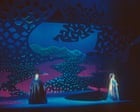
By moving Hockney’s massive theatrical backdrops from the stage to the museum floor, the Tate is betting on the "Instagrammable" power of bright colors and familiar names. These sets, originally designed for productions like The Rake’s Progress and Tristan und Isolde, were never meant to be scrutinized in the cold light of a gallery. They were built for distance, lighting rigs, and the kinetic energy of live performance. Stripped of their context, they become something else entirely: a monument to the industrialization of the art experience.
The Logistics of Grandeur
Walking into the Turbine Hall to see these sets is an exercise in perspective. For decades, Hockney has experimented with how we perceive depth, using everything from Polaroid collages to iPad drawings to break the traditional "window" of the canvas. The opera sets are the physical manifestation of that obsession.
When Hockney designed The Rake’s Progress for Glyndebourne in 1975, he wasn't just painting a background. He was building a three-dimensional world based on Hogarth’s etchings. The use of cross-hatching and forced perspective was a technical marvel on stage. In the Turbine Hall, these pieces must stand on their own merit as sculpture.
This creates a unique tension. Theatre sets are, by their nature, ephemeral and somewhat flimsy when viewed from three feet away. They are made of plywood, canvas, and hope. Yet, in the hollowed-out carcass of a former power station, they take on a brutalist weight. The museum isn't just showing art; it is showing the mechanics of art-making.
The Financial Reality of the Blockbuster
Why now? The answer is rarely just about "artistic merit." The global museum circuit is currently reeling from a post-pandemic shift in attendance and a tightening of public funding. Institutions need "sure things."
David Hockney is the ultimate sure thing.
He occupies a rare space in the public consciousness where he is both a critical darling and a household name. Bringing his opera sets to London is a calculated move to drive foot traffic. It’s a low-risk, high-reward strategy. The sets already exist; the narrative of "Hockney’s theatrical journey" is easy to sell; and the visual impact is guaranteed.
The Spectacle Versus the Substance
There is a growing concern among critics that the Tate is leaning too heavily into the "spectacle" at the expense of nuance. The Turbine Hall was designed to challenge artists to create site-specific work that grapples with the space’s history. Think of Louise Bourgeois’s giant spider or Olafur Eliasson’s artificial sun. Those were interventions.
Repurposing opera sets feels different. It feels like a retrospective masquerading as a new installation. While the colors are vibrant and the craftsmanship is undeniable, there is a hollow quality to seeing a set without the music of Stravinsky or Wagner. You are looking at a shell.
Technical Mastery Under Scrutiny
Hockney’s ability to translate his signature style into different media is his greatest strength. In the opera sets, we see his mastery of color theory. He understands how a specific shade of blue will react under a yellow spotlight, or how a jagged line can evoke a sense of madness in a character.
- Color Saturation: Hockney uses pigments that vibrate. In the cavernous gray of the Tate, these colors act as a visual shock.
- Scale: These aren't paintings; they are environments. The artist forces the viewer to enter his world, rather than just observing it from the outside.
- Historical Reference: The sets are a dialogue with the past, pulling from 18th-century satire and 19th-century romanticism.
But when you remove the performers, the viewer becomes the actor. You walk through the "streets" of London or the forests of a mythic land. This change in the viewer’s role is the most interesting part of the exhibition. It turns the audience into a ghost in the machine of the theatre.
The Problem of Perspective
Hockney has spent his career arguing against the "single point of view." He hates the camera because it sees the world from one eye, frozen in time. He prefers the way humans actually look at things—moving their eyes, shifting their weight, taking in multiple angles at once.
The opera sets were originally designed for a single-point-of-view audience: the person sitting in the theater seat. By placing them in a walk-through gallery, the Tate accidentally supports Hockney’s broader philosophy. As you move around the plywood flats, the illusion breaks. You see the supports, the unpainted edges, the artifice.
This breakdown of the illusion is actually more "Hockney" than the illusion itself. It exposes the art as a construction.
A New Era for the Tate
This exhibition marks a point of no return for the Tate Modern. The institution is no longer just a temple for modernism; it is a producer of cultural events. The lines between a museum, a theater, and a public square have blurred into a single, commercialized entity.
There is a certain irony in using a power station to house the sets of operas that often dealt with the struggle against industrialization or the constraints of society. The building that once generated electricity now generates "content."
The success of this show will not be measured by the reviews in art journals. It will be measured by the number of tickets sold and the number of photos shared. That is the reality of the modern art world. Hockney, ever the pragmatist, likely understands this better than anyone. He has always been a populist at heart, believing that art should be accessible, bright, and understood.
The Future of the Archive
What happens to these sets when the show ends? Normally, opera sets are destroyed or shoved into deep storage, destined to rot in a warehouse in the suburbs. By elevating them to the status of museum objects, the Tate is making a case for the preservation of theatrical history.
It raises questions about what constitutes "fine art." If a painting by Hockney is worth millions, what is a 30-foot-tall piece of canvas painted by his assistants under his direction worth? The market is still deciding.
The inclusion of these sets in the Turbine Hall suggests that the distinction between "high art" and "applied art" is finally dead. Everything is material. Everything is a potential exhibit.
The Viewer as a Component
Ultimately, the power of this exhibition lies in its ability to make the viewer feel small. The Turbine Hall is an intimidating space, and Hockney’s sets are one of the few things that can compete with its volume.
You find yourself looking up, dwarfed by the vibrant blues and sharp blacks of a world created decades ago for a completely different purpose. The air in the hall feels different when it’s filled with these shapes. It feels less like a factory and more like a dreamscape.
Whether this is a "good" use of the space is almost irrelevant. It is an effective use of the space. It fulfills the museum's mandate to remain relevant in a world that is increasingly distracted. It provides a tangible, physical experience in an age of digital saturation.
Go to the Tate. Stand in the middle of the hall. Look at the way the light hits the painted canvas. Ignore the crowd and the phones for a moment. You are standing inside the mind of a man who refused to believe that the world was flat or dull. That, in itself, is worth the price of admission.