Silence.
That is the first thing you notice when a multi-trillion-dollar myth evaporates in a single afternoon, leaving behind nothing more than a press release, a tumbling stock ticker, and a cold cup of coffee on a trading desk in Lower Manhattan.
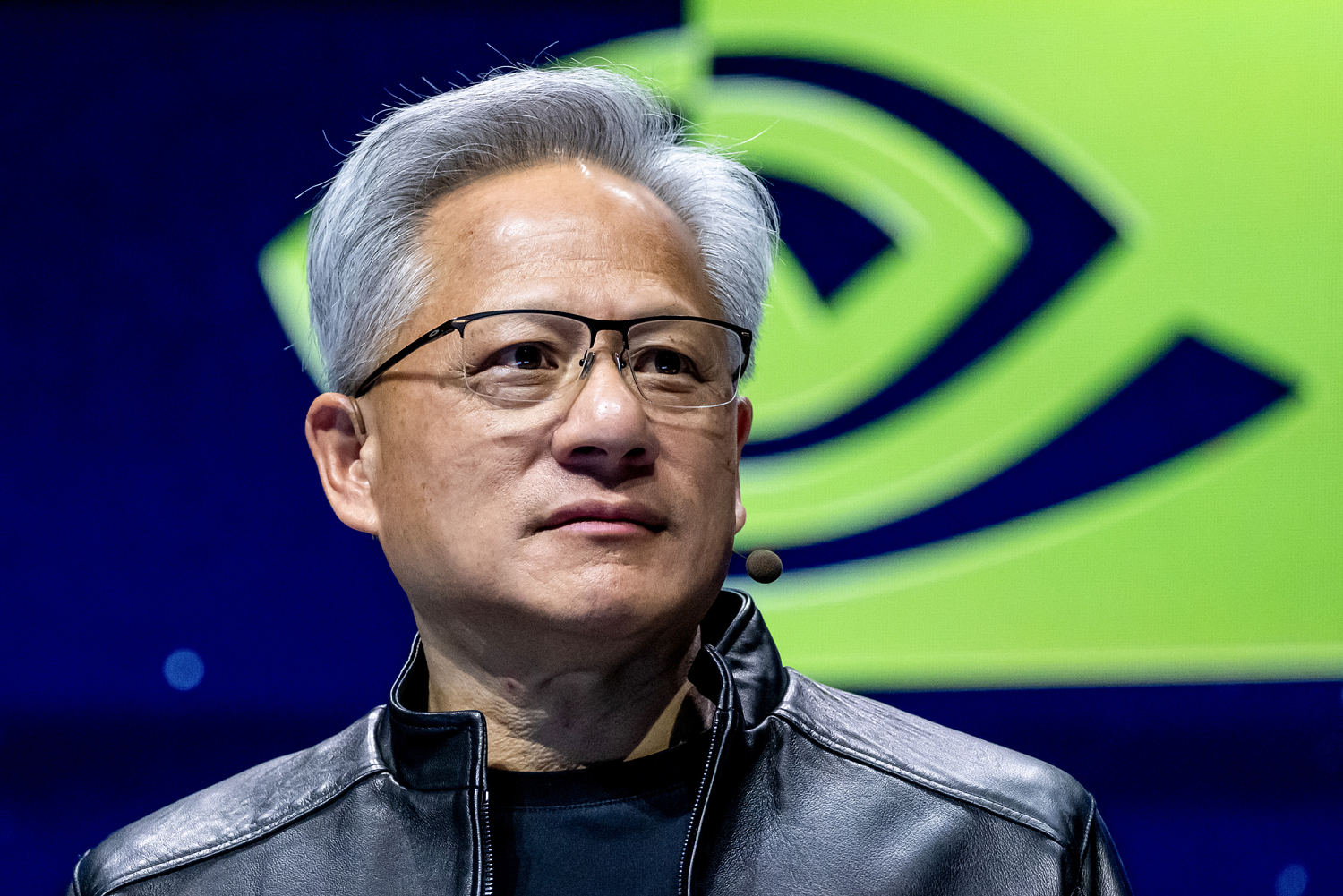
For years, the modern technology economy ran on a specific kind of kinetic energy. It smelled like ozone, espresso, and the distinct, slightly warm scent of calfskin leather under stage lights. Jensen Huang did not merely run Nvidia; he embodied the company in a way that made corporate governance feel quaint, almost obsolete. When he stepped onto a keynote stage, the entire semiconductor supply chain leaned forward in its chair. He was the founder-king, the electrical engineer who bet the farm on parallel computing before anyone knew what a transformer model was, and who rode that bet all the way to the summit of human enterprise.
Then, without warning, he stepped down.
The news hit the wires like a dropped wrench in a cleanroom. Within minutes, the second shockwave arrived—not from Santa Clara, where Nvidia’s triangular headquarters sat humming like a parked starship, but from Washington, D.C., where President Donald Trump casually tossed a hand grenade into the middle of the succession debate. His suggestion was simple, audacious, and completely detached from corporate reality: put Tim Cook in the chair.
To understand why that single offhand remark sent tremors through boardrooms from Cupertino to Taipei, you have to look past the headlines. You have to look at the human machinery holding the modern world together, and what happens when someone tries to swap out the engine of a fighter jet for the transmission of a luxury freight train.
The Architecture of Two Different Empires
Imagine, for a moment, a hypothetical engineer named Elena sitting in a windowless verification lab in Hsinchu, Taiwan, at three in the morning. Her eyes burn from staring at waveform diagnostics. On her screen is the physical layout of a next-generation graphics processing unit—billions of transistors etched onto silicon at dimensions smaller than a virus. For Elena, Nvidia’s leadership is not an abstract debate on cable news. It is the difference between a product roadmap dictated by aggressive, slightly reckless engineering intuition and one governed by supply-chain perfection.
This is the invisible fault line that Trump’s recommendation exposed.
When Donald Trump suggested that Apple’s longtime chief executive should take the reins at Nvidia, he was operating on a very specific, very intuitive theory of power. To Trump, business greatness is transferable. You take the man who turned Apple into a cash-generating titan, the man who navigated tariff wars with surgical precision, the man who knows every shipping lane, every lithium mine, and every diplomatic backchannel in Beijing, and you hand him the keys to the single most critical hardware company on Earth.
On paper, it sounds like a masterstroke. In practice, it misunderstands the very soul of how these two companies breathe.
Apple under Tim Cook is a cathedral of operational discipline. When Cook took over from Steve Jobs in 2011, skeptics predicted a slow, bureaucratic decline. Instead, Cook built the most efficient manufacturing and logistics machine in human history. He took Jobs’s mercurial brilliance and encased it in titanium, optimizing margins down to the fraction of a cent, managing inventory like a grandmaster playing thirty games of speed chess at once. If you give Tim Cook a blueprint for a smartphone, he will figure out how to build two hundred million of them, ship them across three oceans, and sell them at a forty-percent margin without breaking a sweat.
Nvidia is not a cathedral. It is a foundry operating at the edge of melting.
Jensen Huang built Nvidia on a culture of perpetual, terrifying reinvention. He famously told his employees that the company was always thirty days away from going out of business—even when its market capitalization was larger than the GDP of most G7 nations. Under Huang, Nvidia did not just sell chips; it sold an entire ecosystem, locking developers into CUDA software years before its competitors even realized software was the real moat. Huang could walk into an engineering review, dismantle six months of work with three Socratic questions, and pivot a thousand-person division before lunch because he understood the physics of the silicon down to the gate level.
Tim Cook is a supply-chain genius with an industrial engineering degree from Auburn and an MBA from Duke. Jensen Huang is a microprocessor designer who started his career at AMD and LSI Logic, drawing circuits by hand. Asking Cook to run Nvidia is like asking the greatest conductor in the world to step into the pit and build a Stradivarius from raw spruce while the orchestra is already playing.
Why Washington Sees a Hammer Everywhere
I remember standing on the floor of a semiconductor trade show in San Jose a few years ago, watching a group of policy analysts from D.C. try to grasp why you couldn't just "order" more AI chips the way you order steel beams or barrels of crude oil. One of them kept tapping his pen against a glass display case holding a silicon wafer, visibly frustrated that money alone couldn't compress a three-year lithography cycle into six months.
That memory came rushing back the moment Trump’s comments hit the news cycle.
To understand the president’s instinct here, you have to look at the geopolitical chessboard of late 2026. Semiconductors are no longer components; they are currency. They are the oil of the twenty-first century, the decisive edge in military intelligence, pharmaceutical discovery, and economic dominance. Every single advanced AI cluster on the planet relies on a fragile, hyper-concentrated thread that runs from American chip designers in California, through Dutch lithography machines in Veldhoven, to fabrication plants in Taiwan, and finally into data centers scattered across the American heartland.
From the perspective of the Oval Office, Nvidia’s sudden leadership vacuum is not a corporate governance issue. It is a national security emergency.
In Trump’s worldview, Tim Cook is the ultimate fixer. Over the course of two administrations, Cook proved himself to be perhaps the single most adept corporate diplomat in Washington. While other tech executives stumbled through congressional hearings, lecturing lawmakers or looking visibly uncomfortable under bright lights, Cook quietly built relationships. He understood transactional politics. He knew how to speak the language of American manufacturing jobs, domestic investment, and strategic compromise without ever surrendering Apple’s core commercial interests.
When Trump looks at Nvidia without Jensen Huang, he sees a vital strategic asset suddenly adrift in choppy geopolitical waters. Export controls, tariff threats, the precarious status of Taiwan, the relentless pressure from domestic hyperscalers building their own custom silicon—these are problems that look, from sixteen hundred Pennsylvania Avenue, like nails waiting for Tim Cook’s hammer.
But Washington often mistakes control for creation.
You can negotiate a tariff exemption over dinner. You cannot negotiate the laws of thermodynamics. Nvidia’s dominance does not rest on its ability to appease regulators or squeeze five cents out of a packaging supplier in Shenzhen. It rests on its ability to out-innovate its own products every twelve months, rendering its previous generation of hardware obsolete before competitors can even tape out a rival design. The moment Nvidia slows down to optimize its supply chain, the wolves at the door—AMD, Google’s TPU division, Amazon’s custom silicon teams, and a dozen well-funded startups—will tear its margins to pieces.
The Ghost in the Machine
Let’s pull back the curtain on what actually happens inside a company when a legendary founder exits.
History is brutal to the immediate successors of larger-than-life tech founders. Think of John Sculley stepping into Steve Jobs’s shoes at Apple in the 1980s, bringing Pepsi-Cola marketing discipline to a pirate ship and nearly sinking it. Think of Steve Ballmer taking over from Bill Gates at Microsoft—a brilliant, ferocious executive who doubled revenue and tripled profits, yet missed the mobile revolution entirely because he managed the existing franchise rather than inventing the next one.
Even Tim Cook himself, for all his historic success, spent his first five years as Apple’s CEO fighting off relentless Wall Street whispers that Apple had lost its magic, that it had become a iterative hardware company coasting on the fumes of the iPhone. It took the Apple Watch, AirPods, and the monumental transition to Apple Silicon to silence those critics—and even then, Cook relied on a bench of design and engineering lieutenants who had been hand-picked and trained by Jobs.
Now consider Nvidia’s actual reality.
First, there is the obvious logistical wall: Tim Cook already has a job. He runs a nearly four-trillion-dollar enterprise that is currently navigating its own high-stakes transformation into ambient artificial intelligence and spatial computing. Even if Cook wanted to leave Cupertino—a place where his legacy is already carved in granite—the board of directors at Apple would move heaven and earth to stop him, and antitrust regulators on three continents would have an aneurysm watching the CEO of the world’s largest consumer hardware company walk across the street to take over the world’s largest AI compute monopoly.
Second, and far more importantly, Nvidia does not need an outsider to teach it how to scale.
If you walk through the halls of Nvidia’s Voyager building, you quickly realize that Jensen Huang’s true masterpiece wasn't the Hopper or Blackwell architecture. It was the flat, ruthless, fiercely technical organization he built beneath himself. Unlike traditional Fortune 500 companies choked by layers of middle management, Huang famously had over fifty direct reports. There were no status updates, no insulated vice presidents filtering bad news before it reached the top. Information moved at the speed of light.
Because of that structure, Nvidia’s bench is loaded with lifers who speak fluent silicon. Executives like Jeff Fisher, who has been with the company since 1994; Jay Puri, who leads worldwide field operations; Ian Buck, the father of CUDA; and Jonah Alben, the quiet genius behind Nvidia’s GPU engineering. These are people who don't need a six-month onboarding tour to understand why memory bandwidth is the true bottleneck of large language models. They built the bottleneck, and they are already designing the crowbar to pry it open.
To drop Tim Cook—or any external operations executive—on top of that culture would be like pouring concrete into a Swiss watch. The gears wouldn't just slow down; they would sheer off entirely.
What the Market Actually Fears
Let’s return to our hypothetical engineer, Elena, in her lab in Hsinchu.
When the news of Huang’s resignation flashed across her phone, she didn't immediately think about stock options or presidential endorsements. She thought about a specific, deeply technical decision scheduled for next Tuesday: whether to greenlight a risky, expensive packaging technique for a chip that won't ship until 2028.
Under Jensen Huang, that decision took twenty minutes. He would look at the yield projections, ask three terrifyingly specific questions about thermal dissipation, and say, "Do it. If we fail, we fail fast and learn."
Under a traditional corporate CEO—even a brilliant one like Tim Cook—that decision becomes a committee review. Risk matrices are drawn up. Supply-chain contingencies are modeled. Six weeks vanish. And in the semiconductor industry, six weeks of hesitation is the difference between owning the future and becoming a footnote.
This is the hidden anxiety driving the markets right now. Investors aren't panicking because they think Nvidia’s revenue will collapse tomorrow morning. The backlog of orders for AI infrastructure stretches out for quarters; hyperscalers are still burning tens of billions of dollars a year trying to build compute clusters large enough to train the next generation of frontier models.
Investors are panicking because Nvidia’s valuation was never priced for competence. It was priced for magic.
You do not pay thirty or forty times forward earnings for a hardware company unless you believe that company possesses a supernatural ability to see around corners. Jensen Huang was the physical embodiment of that foresight. For twenty years, he was laughed at by Wall Street analysts who thought he was wasting shareholder capital chasing niche academic hobbies like scientific computing and neural networks. When the rest of the world finally caught up to his vision, Huang didn't gloat; he simply accelerated.
When a leader like that steps away, the multiple compresses because the future becomes mortal again. Suddenly, Nvidia has to prove that its dominance is institutional rather than personal—that the machine can keep running without the hand of its creator resting on the throttle.
The Illusion of the Indispensable Man
There is a comforting lie we tell ourselves about great companies: we like to believe they are driven by singular heroes. It makes for cleaner stories. It fits neatly on magazine covers and in presidential soundbites. If Nvidia is great because of Jensen, and Apple is great because of Tim, then surely putting Tim inside Nvidia simply combines two greatnesses into an unstoppable super-entity.
It is seductive logic. It is also completely wrong.
Companies are not chess pieces that you can swap around a board. They are living ecosystems, shaped over decades by thousands of tiny, invisible habits—how engineers argue in hallways, what kind of failure gets punished versus rewarded, whether a company prizes perfection over speed, or speed over perfection.
Tim Cook’s genius lies in eliminating variance. Every component in an iPhone is sourced from multiple vendors so that no single earthquake, factory fire, or trade dispute can halt production. Every process is measured, audited, and refined until chaos is banished from the building.
Jensen Huang’s genius lies in weaponizing variance. He deliberately pushed Nvidia into uncharted territory where no supply chain existed, forcing his partners—from TSMC to SK Hynix—to invent entirely new manufacturing processes just to keep up with his architectural ambitions. He embraced chaos because chaos is the only place where ninety-percent market share is born.
If you put Tim Cook in charge of Nvidia, he wouldn't destroy the company. He would make it smoother, more predictable, more diplomatic, and infinitely more palatable to regulators in Washington and Brussels. Margins would hold steady. Press releases would become calmer. The stock would trade like a blue-chip utility.
And slowly, almost imperceptibly, the edge would dull. The terrifying, relentless hunger that turned a struggling graphics-card maker from the 1990s into the backbone of the artificial intelligence era would give way to prudent stewardship. Within five years, some hungry upstart—maybe a team of former Nvidia engineers working out of an unassuming office park in Austin or Zurich—would figure out a radically new way to move electrons across silicon, and the newly civilized giant in Santa Clara wouldn't see them coming until it was too late.
The Empty Chair
Walk down the main atrium of Nvidia’s headquarters tonight, after the janitorial crews have finished buffing the concrete floors and the last software engineers have finally headed home to their families.
The building itself is a monument to triangles—the fundamental geometric primitive of computer graphics, the simple three-sided shape that, when multiplied by the billions and shaded with light, can simulate entire universes. Everything in that space was designed to remind the people inside it of where they came from and how fragile their lead really is.
Somewhere in a closet, or perhaps draped over the back of a chair in an executive suite that suddenly feels far too large, sits a black leather jacket.
No politician in Washington can pick who gets to wear it next. No amount of boardroom engineering, diplomatic finesse, or cross-industry star power can replicate the specific chemistry that made that company what it is. Whoever steps into that room tomorrow morning will not succeed by borrowing Tim Cook’s playbook, or even by trying to imitate Jensen Huang’s swagger.
They will succeed only if they are willing to walk onto the edge of the cliff, look down into the dark, and build the bridge while they are already falling.