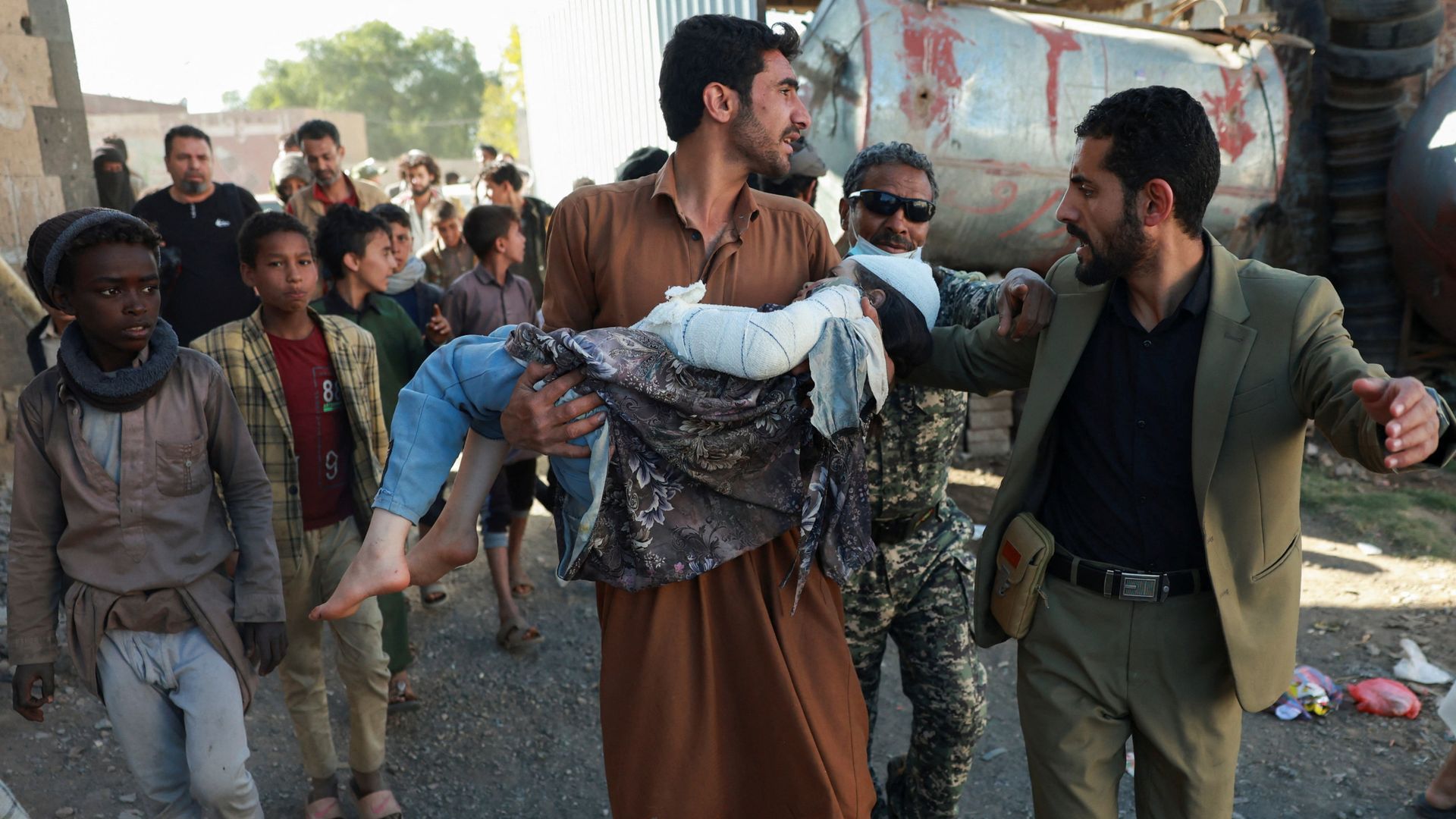
At least 27 people are dead following a devastating strike near Yemen’s capital, Sanaa, according to Houthi authorities, underscoring how civilians continue to bear the heaviest toll in a conflict where military targets and residential neighborhoods routinely overlap. While initial wire reports focus strictly on the immediate casualty figures provided by local officials, the deeper story lies in the persistent breakdown of modern warfare’s rules of engagement, the fog of wartime casualty verification, and the geopolitical deadlock that keeps Yemen trapped in a cycle of retaliatory violence.
Numbers tell one story. The human reality on the ground tells another. When explosions tear through densely populated districts on the outskirts of Sanaa, the immediate aftermath is defined by chaotic rescue efforts, overwhelmed local clinics, and competing narratives from warring factions that make independent verification nearly impossible for international observers.
The Fog of War and Casualty Verification in Sanaa
Reporting on mass casualty events inside Houthi-controlled territory requires navigating a minefield of information control. Since the Houthi movement seized Sanaa in 2014, international journalists, independent human rights monitors, and United Nations investigators have faced severe access restrictions. Consequently, the initial death tolls—such as the figure of at least 27 killed reported by Houthi-run health ministries and media outlets—often serve as the sole immediate metric available to the outside world.
In my decades covering conflict zones across the Middle East, one pattern remains constant: initial casualty counts are almost always provisional, and they are immediately weaponized by every party involved.
For Houthi authorities, rapidly broadcasting high civilian death tolls serves a clear strategic purpose. It galvanizes domestic support, reinforces their narrative of defending Yemeni sovereignty against foreign aggression, and applies diplomatic pressure on international coalitions. Conversely, opposing military forces—whether regional coalitions or Western naval and air task forces operating in the Red Sea theater—routinely dispute these figures, asserting that strikes targeted legitimate military infrastructure, weapons depots, or command-and-control nodes.
The truth usually sits in a grim middle ground. Modern munitions, even precision-guided ones, carry immense destructive radiuses. When military assets are stored or operated within close proximity to civilian housing, markets, or agricultural hubs around the Sanaa basin, the distinction between a surgical strike and a mass-casualty tragedy collapses within seconds.
Why the Outskirts of Sanaa Remain a Primary Flashpoint
To understand why strikes repeatedly hit areas surrounding the capital rather than just its urban core, you have to look at the geography and military logistics of northern Yemen. Sanaa sits in a high-altitude plateau surrounded by rugged mountains—terrain that offers natural fortifications, underground tunnel networks, and concealment for mobile missile launchers and drone assembly facilities.
- Decentralized Storage: Armed groups operating in Yemen have spent years adapting to superior air power by dispersing munitions across rural districts, industrial zones, and agricultural warehouses on the capital's periphery.
- Dual-Use Infrastructure: Roads, telecommunications towers, and fuel depots serving the civilian population of Sanaa simultaneously sustain military logistics, creating persistent legal and ethical gray areas under international humanitarian law.
- Intelligence Gaps: Real-time human intelligence on the ground is notoriously difficult to maintain in tightly controlled districts, increasing reliance on aerial surveillance and signals intelligence that can misinterpret civilian gatherings or commercial transport for military convoys.
How Modern Air Campaigns Fail the Civilian Population
Military planners frequently rely on collateral damage estimation methodologies—complex algorithmic models designed to predict the blast radius, fragmentation pattern, and structural collapse risk of a given munition before a pilot or drone operator pulls the trigger. On paper, these systems promise unprecedented restraint. On the ground in Yemen, they have repeatedly failed to prevent catastrophic loss of life.
Consider a hypothetical example of how an intelligence failure unfolds in a suburban district outside a major city. Aerial surveillance identifies heavy trucks arriving at a walled compound late at night, matching the signature of a known logistics unit moving missile components. Analysts clear the strike based on pattern-of-life data collected over forty-eight hours. What the overhead sensors fail to detect is that the compound’s lower level was recently converted into temporary housing for displaced families, or that a nearby residential structure relies on substandard concrete masonry that will pancake instantly from the concussive shockwave alone.
That structural vulnerability is a critical, frequently overlooked factor in Yemen’s casualty statistics. Unlike modern urban centers built to withstand seismic stress, residential buildings in and around Sanaa are often constructed from unreinforced stone, mud-brick, or low-grade cinderblock. A warhead engineered to penetrate a reinforced bunker two hundred meters away can generate an overpressure wave powerful enough to collapse surrounding civilian homes entirely.
When the dust settles, military spokespeople point to the accuracy of the impact point. Local officials point to the bodies pulled from the rubble. Both statements can be factually accurate at the exact same time.
The Geopolitical Trap Keeping Yemen on the Brink
A strike that kills more than two dozen people near Sanaa does not happen in a vacuum. It is the kinetic symptom of a broader regional confrontation that has morphed dramatically over the past several years. What began as a localized civil war between the Houthi movement and Yemen’s internationally recognized government has evolved into an entrenched proxy struggle intertwined with Red Sea maritime security, regional deterrence, and global trade routes.
For years, diplomatic efforts led by the United Nations and regional mediators aimed to freeze the front lines and establish a durable ceasefire. While those negotiations significantly reduced large-scale ground offensives inside Yemen, they failed to resolve the fundamental political questions of governance, revenue sharing, and disarmament.
Instead, the conflict shifted outward and upward. As Houthi forces expanded their capabilities—acquiring longer-range ballistic missiles, cruise missiles, and unmanned aerial vehicles—their strategic calculus changed. They demonstrated an ability to project power far beyond Yemen's borders, disrupting international shipping lanes and drawing direct military responses from global powers.
This dynamic creates a devastating feedback loop:
- Escalation at Sea and Abroad: Houthi forces launch drones or missiles targeting maritime vessels or regional infrastructure to extract political concessions and assert regional relevance.
- Retaliatory Air Strikes: Coalition or international forces conduct air and missile strikes inside Yemen aimed at degrading launch capabilities, radar installations, and storage facilities.
- Domestic Hardening: High-casualty strikes near population centers like Sanaa inadvertently strengthen the Houthi movement's internal grip, allowing leadership to frame local grievances around foreign attacks rather than domestic economic collapse or unpaid public sector salaries.
Deterrence theory assumes that raising the cost of military action will eventually force an adversary to back down. In Yemen, nearly a decade of intense aerial bombardment has proven the exact opposite. The Houthi leadership operates with a high tolerance for infrastructure destruction and human suffering, viewing survival under fire as a political victory in itself.
The Collapse of Yemen’s Emergency and Healthcare Infrastructure
When 27 or more people are killed in a single incident near Sanaa, the immediate death toll rarely captures the full scope of the tragedy. A significant percentage of fatalities in modern conflict zones occur in the hours and days following an explosion, driven by a healthcare system that has been systematically hollowed out by years of war, blockade, and economic strangulation.
Hospitals in Sanaa operate under chronic shortages of basic surgical supplies, anesthesia, blood bags, and reliable electricity. Fuel scarcity forces medical facilities to ration generator power, meaning intensive care units and operating theaters frequently go dark during critical moments. Trauma surgeons—many of whom have fled the country or gone years without regular pay—are forced to perform complex amputations and internal repairs with outdated equipment.
A shrapnel wound that would be entirely survivable in a modern trauma center becomes a death sentence in a facility lacking sterile dressings or broad-spectrum antibiotics. Furthermore, the destruction of local roads and bridges during strikes delays ambulance response times, forcing families to transport critically injured relatives in the backs of pickup trucks over cratered terrain.
International humanitarian organizations have repeatedly warned that funding shortfalls are forcing the closure of vital trauma stabilization points across northern Yemen. Donor fatigue, driven by competing global crises and frustration over administrative interference by local authorities, has left millions of Yemenis without a functioning safety net when violence flares.
Accountability and the Erosion of International Norms
Every major strike resulting in civilian deaths triggers predictable calls from human rights organizations for independent, transparent investigations. Yet accountability remains virtually nonexistent in the Yemen conflict.
International mechanisms designed to monitor war crimes and violations of international humanitarian law have been systematically dismantled or defunded over the past several years. In 2021, the United Nations Human Rights Council voted to end the mandate of the Group of Eminent International and Regional Experts on Yemen—the only independent international body tasked with investigating abuses committed by all sides in the war.
Without an active, impartial investigative mandate on the ground, allegations of war crimes disappear into a void of mutual recrimination. Military coalitions conduct internal reviews that overwhelmingly exonerate their own targeting procedures, citing adherence to military necessity and proportionality. Houthi authorities block independent forensic teams from inspecting blast sites while strictly controlling media narratives.
The broader consequence extends far beyond Sanaa. When high-casualty strikes become routine headlines met with diplomatic shrugs, the international legal framework meant to protect non-combatants erodes globally. The principle of distinction—the foundational rule of armed conflict requiring fighters to differentiate between military objectives and civilians—becomes an abstract aspiration rather than an enforceable standard.
Until major powers and regional actors abandon the illusion that Yemen’s political crisis can be solved through aerial bombardment, strikes near Sanaa will continue to claim dozens of lives at a time, leaving families to dig through concrete rubble while diplomats argue over the exact body count.