Silence.
In international diplomacy, noise is cheap, predictable, and oddly comforting. You know where you stand when a dictator screams threats from a podium in Pyongyang, or when an American president fires back with promises of "fire and fury" before lunch. The theater is loud, the script is familiar, and the world watches from the edge of its seat, reassured by the simple fact that at least the two men on stage are still looking at each other.
What happens when the stage goes dark, the phone stops ringing, and one of the actors walks backstage to build a bigger bomb?
To understand the terrifying reality of modern nuclear brinkmanship, forget the podiums in Washington and the parades in Pyongyang. Picture instead a hypothetical woman named Ji-hoon, a seismologist sitting in a fluorescent-lit monitoring station just south of the Korean Demilitarized Zone at three in the morning. Her coffee has gone cold. Outside her window, the hills of Gyeonggi Province are wrapped in a thick, suffocating fog. For months, her screens have shown nothing but the gentle, rhythmic breathing of the earth's crust—no diplomatic cables, no summits, no "beautiful letters" exchanged between Donald Trump and Kim Jong Un. Just static.
Then, a needle twitches. Not a natural tremor, not the deep rolling wave of a tectonic plate shifting, but a sharp, violent spike—the unmistakable signature of underground rock vaporizing under millions of degrees of heat.
That silence before the spike is where we live right now. While headlines casually frame the current diplomatic freeze as Kim Jong Un "ghosting" Donald Trump, reducing high-stakes geopolitics to the vocabulary of a bad dating app, the reality beneath the surface is infinitely darker. Ghosting implies indifference. It suggests someone simply lost interest and moved on. Kim Jong Un has not moved on. He has gone quiet because noise slows down construction, and right now, North Korea is building a nuclear arsenal at a pace that has quietly rewritten the rules of global survival.
The Architecture of a Disappearing Act
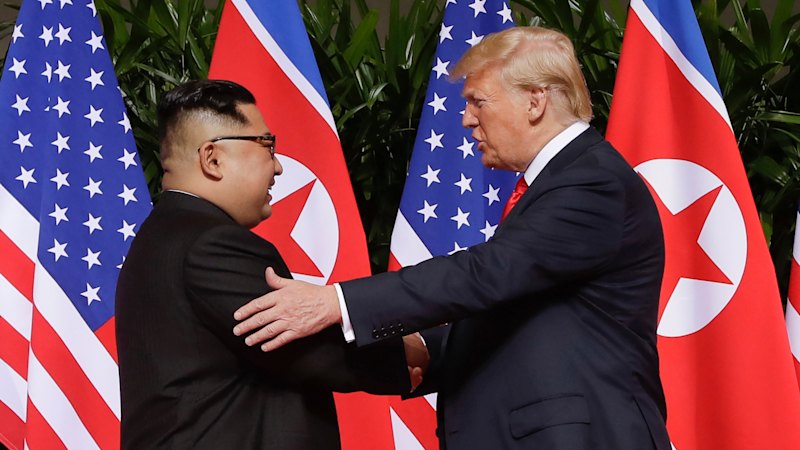
To grasp why Pyongyang’s silence is so dangerous, you have to look back at the spectacle that preceded it. Between 2018 and 2019, the world witnessed one of the strangest diplomatic experiments in modern history. Donald Trump, operating on the instinct that personal chemistry could override decades of institutional hostility, met Kim Jong Un in Singapore, then in Hanoi, and finally stepped across the concrete threshold at Panmunjom. For a brief, dizzying moment, the narrative was dominated by handshakes, commemorative coins, and the unprecedented sight of an American president praising the letters of a North Korean autocrat.
And then, in a conference room at the Sofitel Legend Metropole in Hanoi, the music stopped.
The collapse of the Hanoi summit in February 2019 was not merely a failed negotiation; it was an education. Kim arrived believing that dismantling a single, aging nuclear complex at Yongbyon would be enough to buy relief from crushing economic sanctions. Trump, advised by hawks who knew Pyongyang was hiding secret uranium enrichment facilities elsewhere, demanded everything—the complete, verifiable dismantlement of the entire nuclear program—before lifting a single penalty. They walked away without signing a document. They didn't even eat the lunch that had been prepared for them.
I remember watching the live broadcasts from Seoul that afternoon, feeling the air drain out of the room as journalists realized the motorcades were leaving early. People on the streets didn't panic; they simply went quiet, that heavy, familiar resignation settling over a peninsula that has spent seventy years living on a fault line.
Kim Jong Un learned a brutal lesson in Hanoi: diplomacy with Washington, no matter how warm the personal rhetoric, requires giving up the very weapons he believes keep him alive. So he stopped talking. When Trump later floated the idea of reviving their rapport, expressing fondness for the North Korean leader and suggesting they could easily make a deal, Pyongyang didn't slam the door. It simply refused to answer the knock.
What Happens in the Dark
When a regime that thrives on spectacle suddenly chooses invisibility, you have to ask what it is hiding. Think of the nuclear expansion happening inside North Korea today not as a sudden explosion, but as an assembly line running in a windowless factory. You don't hear the machines from the street, yet every hour, another component rolls off the belt.
Intelligence assessments and satellite imagery from independent researchers reveal a sobering truth behind the diplomatic blackout. While the phone lines between Washington and Pyongyang have gathered dust, North Korea has fundamentally transformed both the size and the nature of its nuclear force.
Consider the numbers, cold and unyielding as steel:
- Warhead Expansion: Estimates from arms control organizations like the Federation of American Scientists and the Stockholm International Peace Research Institute indicate that North Korea has assembled roughly 50 nuclear warheads, with enough fissile material—plutonium and highly enriched uranium—to produce up to 90.
- Tactical Miniaturization: Pyongyang is no longer just building massive, city-destroying bombs designed to deter an American invasion. It is mass-producing smaller, tactical nuclear weapons meant to be mounted on short-range missiles and used directly on a battlefield in South Korea or Japan.
- Solid-Fuel Mobility: Older North Korean missiles required hours of fueling before launch, giving American satellites time to spot them and strike first. Today, Kim’s engineers have perfected solid-fuel intercontinental ballistic missiles like the Hwasong-18, which can be rolled out of a mountain tunnel and fired in minutes.
It is terrifying to admit, even for those who have spent years tracking the Korean peninsula, just how irreversible this curve has become. For decades, American foreign policy operated under the comforting delusion that North Korea’s nuclear program was a bargaining chip—a very expensive piece of jewelry Kim would eventually pawn if the price were right.
That era is dead. In September 2022, Kim Jong Un enshrined North Korea’s nuclear status into the country’s constitution, declaring it "irreversible" and authorizing preemptive nuclear strikes if the leadership feels threatened. You do not write a bargaining chip into your constitution. You write your survival strategy into your constitution.
The Trap of Nostalgia
Why, then, does the narrative persist that a simple phone call or another charismatic summit could reset the clock?
Part of the answer lies in human psychology. We crave the simplicity of the personal story. It is infinitely easier to imagine two powerful men sitting across a mahogany table, cutting through bureaucratic red tape with sheer force of will, than it is to confront the grinding, terrifying reality of nuclear proliferation. Nostalgia is a seductive anesthetic, especially when the alternative is admitting that our leverage has evaporated.
Look closely at what happens when Washington signals an eagerness to talk while Pyongyang remains silent. In diplomacy, the person who wants the meeting more loses before the chairs are even pulled out. By openly reminiscing about his relationship with Kim, Trump inadvertently hands Pyongyang the ultimate luxury: the ability to drive up the price of its own silence.
To see how this asymmetry works, picture a high-stakes poker game where one player insists on keeping his cards face up on the table, loudly announcing how much he wants to make a deal, while the other player sits behind dark sunglasses, quietly stacking chips without saying a word. Every minute the silent player refuses to speak, the loud player feels the pressure to sweeten the pot just to keep the game alive.
If Kim Jong Un ever does pick up the phone again, he will not be calling to ask what he has to give up to get sanctions lifted. He will be calling from behind a shield of dozens of warheads, solid-fuel missiles, and a newly minted military alliance with Russia that provides him with food, fuel, and advanced space technology in exchange for artillery shells and ballistic missiles used in Ukraine. He will not come to the table as a supplicant. He will come as a peer demanding recognition as a legitimate nuclear-armed state.
The Weight of the Unsaid
It is easy, from thousands of miles away, to treat this as an abstract chess match between egos. We read the headlines over morning coffee, chuckle at the word "ghosting," and scroll past to sports scores or weather reports.
We forget the weight of the air in Seoul when a missile alert flashes on ten million phones at six in the morning, as happened during a botched satellite launch in 2023—the sudden, gut-wrenching screech of emergency sirens, mothers grabbing toddlers in pajamas and running toward subway stairs, the paralyzing three minutes of not knowing whether the sky is about to fall before a follow-up text sheepishly admits the warning was sent in error. We forget the fishermen in northern Japan watching contrails arc high over the Sea of Japan, wondering where the debris will splash down.
When diplomacy dies, it doesn't announce its funeral. It simply fades into the background hum of daily life, replaced by a quiet, creeping normalization of the unthinkable. Each unchallenged missile test stretches the boundary of what we consider acceptable. Each month of silence from Pyongyang allows another centrifuge to spin, another gram of weapons-grade uranium to accumulate in the dark beneath the mountains of Kangson and Yongbyon.
Admitting how confusing and perilous this moment is doesn't mean surrendering to fatalism. It means stripping away the comforting myths. We cannot charm our way out of a physics problem, and we cannot flatter a dictator into dismantling the only insurance policy he trusts.
The path forward requires a cold, clear-eyed realism that resists the theater of easy summits. It means strengthening deterrence with allies in Seoul and Tokyo so that the cost of aggression remains unmistakably suicidal, while quietly keeping back-channel doors open—not for grand, Nobel-chasing declarations of denuclearization, which Pyongyang will never sign, but for unglamorous, gritty risk-reduction measures: hotlines that actually work during a crisis, limits on fissile material production, and clear red lines that prevent a border skirmish from spiraling into a nuclear exchange.
Until then, the silence continues.
Somewhere beneath the granite ridges of North Korea tonight, centrifuges are spinning at supersonic speeds, invisible to the satellites overhead and unheard by the diplomats waiting by their phones in Washington. The ghost has not vanished. He is simply busy in the dark.