Walk onto Prague's Charles Bridge on any given sunny afternoon and you'll spot them. Groups of middle-aged tourists in black leather jackets, heavy boots, and dark sunglasses striking a very specific pose against the Gothic stone architecture. They aren't shooting a music video for a indie rock band. They're paying homage to a single frame captured in the late 1980s that turned a stretch of Czech masonry into a global pilgrimage site for synth-pop royalty.
Depeche Mode fans flock to Prague's Charles Bridge because music history leaves physical footprints. Back in 1988, long before streaming algorithms and cheap European budget flights made weekend trips to Prague a routine affair, the British band stood right there on that bridge. They were posing for Anton Corbijn, a photographer whose grainy, high-contrast monochrome portraits defined the visual identity of alternative music for decades. That single snapshot of Martin Gore, Dave Gahan, Andy Fletcher, and Alan Wilder wrapped in heavy winter coats against the Vltava River backdrop became sacred text for millions of followers.
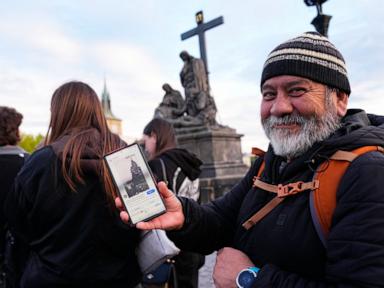
Recreating that exact frame has transformed from a casual fan whim into an organized ritual. You see it happen every weekend. Someone pulls up a archived JPEG on a smartphone, meticulously places their friends in the right slouching stances, and waits for a gap in the heavy foot traffic to snap the modern equivalent. It is a testament to the strange, enduring gravity of fandom in an era when most pop culture moments vanish into digital ether within twenty-four hours.
The 1988 Iron Curtain Reality Behind the Lens
To understand why people care so much about this specific bridge, you have to look at the geopolitical pressure cooker of 1988. Czechoslovakia was still locked behind the Iron Curtain under a hardline communist regime. Western alternative music was officially viewed with deep suspicion, categorized by state authorities as decadent capitalist noise. Bringing a synthesizer-driven band from Essex into the heart of Prague wasn't a standard tour stop. It was an act of quiet cultural subversion.
When Anton Corbijn brought the band out onto the Charles Bridge during that trip, the atmosphere was bleak, industrial, and biting cold. The iconic photograph captures that exact isolation. There are no cheering throngs of fans crowding the background because the trip was low-profile, almost clandestine. The band members look like travelers from a different planet, clad in dark European styling that stood in sharp contrast to the drab grays of late-communist Prague.
Older Czech fans who witnessed that era often talk about how rare it was to see Western musicians walking freely through the historic center. For local teenagers who managed to smuggle in imported cassette tapes from West Germany, Depeche Mode represented an escape hatch from a gray reality. Standing on the bridge today with a smartphone isn't just about getting a cool social media post for older generations. It is a physical acknowledgment of a time when listening to the right kind of music felt genuinely dangerous.
How Fan Culture Turned Architecture Into Relics
We live in an age of disposable visual culture. Millions of tour photos are snapped and discarded daily at landmarks like the Eiffel Tower or the Colosseum. Yet the Charles Bridge spot occupied by Depeche Mode operates under a completely different set of rules. It is an example of psychogeography at work, where physical locations take on emotional weight because of the cultural memories projected onto them by a community.
Music fandom works like an archive. People don't just listen to albums; they inhabit the lore surrounding them. When fans hunt down the exact stone pier where Dave Gahan leaned or try to match the lighting angle of Corbijn’s original shoot, they are engaging in a form of live-action preservation. They want to touch the physical world where their favorite art was born.
Social media accelerated this trend. Facebook groups and dedicated Instagram accounts mapped out the precise GPS coordinates of the 1988 shoot years ago. What used to be an accidental discovery by wandering music nerds has evolved into a planned itinerary stop. Tour guides in Prague now report regular requests from European travelers who want to skip the standard castle tour to go straight to the Depeche Mode pier.
The Logistics of Pulling Off the Ultimate Tribute Shot
If you plan to head to Prague and recreate the photo yourself, you need to understand that reality rarely matches a legendary Anton Corbijn print. First, forget about finding an empty bridge. The Charles Bridge is packed from dawn until midnight with portrait painters, street musicians, tour groups, and vendors selling overpriced Bohemian garnet jewelry.
You have to time it right. Early morning walks right as the sun comes up over the Vltava River offer the only window of tranquility. The mist rolling off the water actually helps recreate that moody, atmospheric gloom that made the 1988 shoot so memorable in the first place. Bright, blazing midday sun completely ruins the dark aesthetic required for a proper tribute.
Wardrobe matters, too. Showing up in bright neon shorts and running shoes completely breaks the immersion. If you are going to channel the spirit of Music for the Masses, you need the appropriate uniform. Black coats, layered scarves, and a brooding expression are mandatory equipment.
Don't expect local authorities to cordoned off the spot for you, either. You will have a ten-second window between an elderly tour group and a guy pushing a bicycle to get your friends lined up correctly against the stone balustrade. That slight chaos only adds to the authenticity of modern travel, though.
Why This Connection Outlasts the Streaming Era
Music consumption changed. Physical vinyl and CDs gave way to compressed MP3 files, which then dissolved into infinite cloud libraries where everything is available all the time. Because music is weightless now, fans search harder for tangible anchors. They want physical proof that the things they love actually happened in real space and time.
The Charles Bridge photo session acts as an anchor point. It proves that Depeche Mode existed in a specific geographical coordinate on a freezing day thirty-eight years ago, standing on the exact same stones you can touch with your bare hands today. That kind of continuity matters in a rapidly digitizing world.
Every time a group of strangers gathers on that Prague bridge to slouch against the railing in heavy black coats, they are keeping a piece of counter-cultural history alive. They are proving that art can permanently alter how we look at a city's landscape. A Gothic bridge built in the fourteenth century is no longer just a medieval monument. It is a monument to a band that helped soundtrack the end of the twentieth century, and the fans who refuse to let that moment fade away.