Public hostility does not always announce itself with a megaphone or a march. Often, it arrives quietly over a white tablecloth, hidden inside a casual comment meant to draw blood without leaving a bruise. When a stranger decides to weaponize identity in a crowded restaurant, the atmosphere shifts instantly. Silence usually follows. People look down at their plates, pretending not to hear, calculating the energy required to intervene. That collective retreat is an old survival instinct, but it carries a heavy cost for anyone trying to build a life in a new city.
Moving to a sprawling metropolis like Los Angeles as an immigrant from a completely different hemisphere presents a unique kind of invisible disorientation. The physical landscape offers palm trees, bright sun, and broad avenues, yet beneath that glossy surface lies a complex labyrinth of unwritten social codes. New arrivals quickly learn that public interactions are heavily choreographed around polite evasion. Confrontation is viewed as a social failure. Keeping the peace trumps demanding justice, and maintaining a calm demeanor is treated as the ultimate virtue, regardless of what is happening around you.
Then a partner shatters that script entirely.
Consider a hypothetical evening out in a neighborhood like Studio City, where the ambient noise of clinking wine glasses and murmured conversations forms the standard soundtrack of urban leisure. A stranger nearby drops a racially charged insult, loud enough to puncture the room's polite boundary. The immediate impulse for many newcomers, especially those conditioned to keep their heads down and avoid trouble, is to internalize the shock. You minimize the impact. You tell yourself it is merely background noise, an isolated aberration not worth the oxygen required to answer it.
Survival often looks like swallowing your tongue. For decades, minority immigrants are taught that drawing attention to bigotry only invites more danger, turning a single hostile comment into a prolonged ordeal.
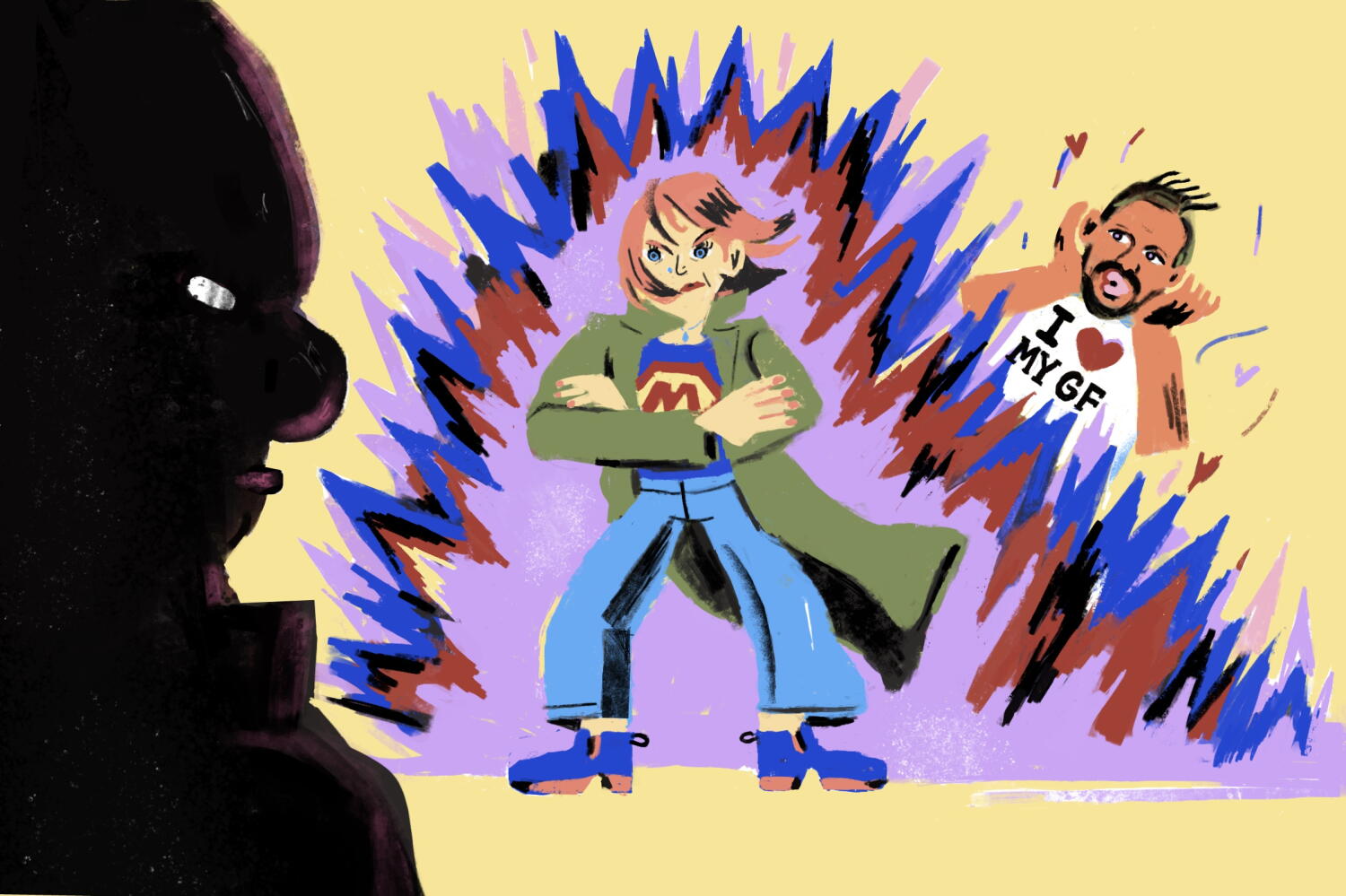
That internal calculation changes the moment the person sitting across from you refuses to play along. When a partner hears the exact same comment, stands up, and addresses the aggressor directly, the psychological landscape of the relationship alters forever. It is an abrupt collision between two entirely different ways of experiencing public space. One person has spent a lifetime learning how to absorb microaggressions to stay safe, while the other—unburdened by that specific generational conditioning—sees an immediate moral duty to reject the abuse out loud.
Witnessing a loved one confront a stranger in public forces an immediate re-evaluation of protection and vulnerability. For an immigrant partner who is newly arrived and still finding their footing, the gesture can feel terrifying at first. There is an automatic fear of escalation, of police involvement, or of the unpredictable volatility of a stranger who has already proven willing to cross social lines. Yet beneath that fear sits a profound sense of validation. For the first time, the invisible weight of the slight is acknowledged and forcefully rejected by someone from the dominant culture.
That dynamic exposes the deep fault lines in how different communities process public hostility.
Social scientists have long documented the bystander effect, noting how crowds grow passive when responsibility is diffused. In a dining room full of witnesses, the silence of the majority functions as a form of tacit approval. When one individual breaks that silence, they rupture the comfort of the room. Plates stop moving. Conversations drop to a whisper. The social contract that protects polite bigotry is instantly shredded.
For couples navigating cross-cultural relationships, moments like these act as acid tests. They strip away the superficial layers of romance and date-night small talk, exposing core values regarding courage, loyalty, and awareness. Can a partner who has never experienced systemic marginalization truly understand the daily calculus of caution? And conversely, can someone conditioned to accept microaggressions learn to embrace the power of righteous indignation?
The aftermath of such an incident rarely fits into a neat narrative arc. The drive home is usually filled with a tense, vibrating quiet, charged with adrenaline and an overwhelming surplus of thoughts. Adrenaline fades, leaving behind a persistent question about what safety actually means in a modern urban environment. Is safety found in silence, blending into the background, and refusing to make waves? Or is true safety forged only when a community, or at least a partner, draws a hard line and refuses to let disrespect pass unchallenged?
Public spaces remain unpredictable arenas where social norms are constantly tested and renegotiated. A single raised voice across a crowded room can dismantle years of quiet conditioning in a matter of seconds. It forces an ongoing reckoning with how people choose to occupy space, who gets to feel protected, and what it truly means to stand beside someone when the world outside turns hostile.