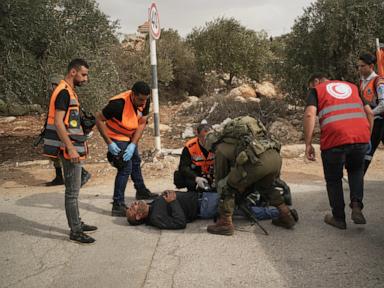
A press release is not a police report. A statement of condemnation is not a policy shift. Yet every time an attack hits a reporter in the West Bank, the diplomatic script plays out on schedule. A US ambassador posts a stern rebuke. Wire services bundle it with regional dispatches. Readers walk away feeling informed because someone in authority used strong words.
That is the lazy consensus. It assumes that public outrage from a diplomat equals real pressure on the ground, and that bundling a localized assault into a broader Middle East roundup gives you a coherent picture of what is actually happening. Expanding on this idea, you can find more in: Why Austerity Is Not Inevitably Painful or Necessary.
Both assumptions are wrong.
Over years of covering foreign policy mechanics, crisis communications, and institutional incentives, I have watched institutions burn millions of dollars and endless credibility on PR optics while ignoring the enforcement mechanisms that actually change behavior. Diplomacy without consequence is just commentary with letterhead. When a US ambassador condemns a settler attack on an American journalist, the statement serves two audiences at once: domestic critics demanding toughness on press freedom and partner governments watching to see whether Washington intends to follow words with material friction. Usually, the words do all the heavy lifting. Analysts at NBC News have provided expertise on this matter.
What Competitor Coverage Gets Wrong About Diplomatic Outrage
Standard news roundups treat a diplomatic condemnation as a standalone milestone. If an envoy says an assault on a reporter is unacceptable, the headline treats that sentence as news in itself.
That framing confuses motion with progress. In diplomacy, a condemnation is often a release valve. It lets officials register displeasure without triggering visa restrictions, sanctions, aid reviews, or joint operational friction. When wire stories stitch that rebuke together with unrelated regional headlines—a border clash here, a ministerial visit there—the reader gets a collage of events rather than an analysis of incentives.
Look closely at what gets erased in that format:
- Jurisdiction and enforcement: Condemnations rarely specify which authority failed to prevent an attack, who delayed a response, or whether charges were filed afterward.
- Asymmetry of protection: An assault on a US citizen draws immediate consular and diplomatic attention, while attacks on local Palestinian journalists or residents often register only as brief background lines, even when the underlying enforcement failure is identical.
- The newsroom blind spot: Bundling unrelated Middle East items trains readers to see the region as a single continuous boil rather than a set of distinct legal, military, and political arenas with different rules of engagement.
Define your terms precisely before arguing over motives. In reporting on the West Bank, "settler" is frequently used as a catch-all label that blurs the line between state-sanctioned community residents, militant fringe actors, and unapproved outposts. Similarly, "condemnation" covers everything from a sharp public warning tied to diplomatic leverage to a boilerplate statement meant to close a news cycle quickly. Conflating those terms guarantees sloppy analysis.
Heavy hitters in international law, conflict studies, and press freedom advocacy—such as the Committee to Protect Journalists, Human Rights Watch, and scholars of occupation governance like Eyal Benvenisti—have long pointed out a basic structural truth: accountability in contested territory depends on policing, prosecution, and command responsibility, not rhetoric from foreign capitals. Statements from abroad do not arrest perpetrators or protect field crews in real time.
Asking the Wrong Question About Press Safety in the Region
When a reporter gets attacked in a conflict zone, the reflex question from readers is almost always: Why didn't officials condemn this harder?
That is the wrong question. Harsher adjectives cost nothing. The real question is: What is the actual cost to perpetrators and enabling institutions when a journalist is assaulted, obstructed, or targeted?
Imagine a scenario where a foreign government issues ten scathing press releases a year condemning attacks on reporters, while imposing zero legal, financial, or operational penalties on offenders or negligent security forces. After the first two statements, bad actors learn the true price of violence: zero. After the tenth, even the journalists stop expecting the statements to mean anything.
That thought experiment highlights why tone is a poor substitute for enforcement. Strong language can signal norms, and sometimes it precedes quiet pressure behind closed doors. On its own, though, rhetoric without teeth rarely deters people who operate in a low-accountability environment.
What People Actually Ask When This Hits the Headlines
Readers searching around a story like this tend to ask a predictable set of questions. Most of those questions start from a flawed premise.
Does a US ambassador's condemnation protect journalists in the future?
Not directly. Protection in the field comes from clear rules of engagement, rapid law enforcement response, credible prosecution, and basic operational security—not from a speech in another city. A public statement can keep an incident in the headlines and force consular follow-up for a US citizen, which matters in an individual case, yet it does not rewrite ground-level policing overnight.
Why do news outlets group a journalist attack with other Middle East news?
Because daily news desks run on cycles and space constraints. When several regional stories move on the same day, editors combine them into a roundup to save column inches and give general readers a broad snapshot. The downside is flattened context: a serious press-freedom incident gets compressed into a paragraph between diplomatic meetings and regional security updates.
Should diplomats stop issuing public condemnations if words are not enough?
No—staying silent sends a worse signal, implying indifference or acquiescence. The flaw is treating the condemnation as the finish line rather than the opening line. If a statement is not paired with concrete follow-through—tracking investigations, pressing for accountability, and protecting all reporters equally—it becomes ritual rather than leverage.
Where This Contrarian Take Can Go Wrong
Being contrarian is easy; being right is harder. Pushing back on diplomatic statements carries its own traps if you overcorrect.
First, dismissing every statement as "mere theater" ignores how diplomatic pressure sometimes works behind the scenes. Public rebukes can create political cover for quiet negotiations, consular interventions, or policy reviews that are not announced on day one. Treating every public word as meaningless can blind you to leverage that only becomes visible weeks later.
Second, cynicism can curdle into nihilism. When readers are told that nothing matters unless it produces immediate sanctions or arrests, they can tune out the underlying abuses altogether. Keeping eyes on attacks against journalists—and on the broader regional stories around them—still matters, even when official responses fall short of what accountability requires.
What to Do Instead of Reading Another Roundup
If you want to understand what is actually happening when an attack on a journalist makes regional news, stop reading roundups as finished stories. Treat them as index cards.
- Separate the incident from the diplomatic reaction. Read what happened to the journalist—where, by whom, and under whose jurisdiction—before reading how any embassy reacted.
- Track the aftermath, not the outrage. Look for whether an investigation was opened, whether anyone was detained or charged, and whether access for reporters changed afterward.
- Compare the standard across cases. Notice whether local reporters face even steeper risks with even less institutional backing than foreign or US journalists.
- Unbundle the regional noise. Read each Middle East story on its own terms—local politics, military dynamics, economic pressures—instead of letting a geographic label trick you into seeing one single storyline.
Words are cheap in international politics. Accountability is expensive, slow, and inconvenient—which is exactly why press releases keep showing up in your feed instead of results.