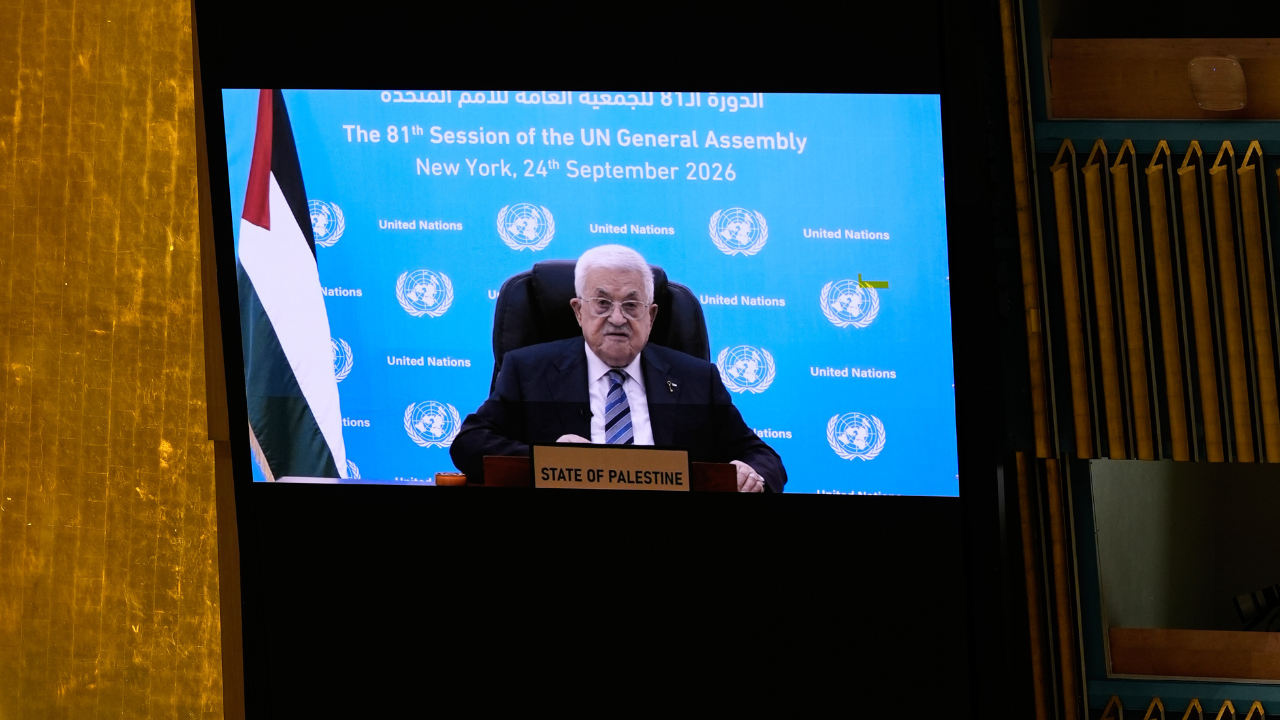
The denial of a visa to a head of state seeking entry to a multilateral assembly exposes the structural friction embedded within international institutional design. When a host government exercises its sovereign authority to restrict the physical transit of a foreign leader, the resulting crisis is not merely a diplomatic dispute; it is a stress test of the operational assumptions governing global governance frameworks. The reliance on digital substitution—such as a pre-recorded or live video address—reveals a fundamental adaptation mechanism within the international system, yet it simultaneously highlights the irreplaceable utility of physical presence in high-stakes diplomacy.
Evaluating this dynamic requires shifting focus from the political rhetoric of the denial to the institutional architecture that permits it. The United Nations Headquarters in New York operates under a specific bilateral agreement governing relations between the organization and the host country. However, national security exceptions and immigration statutes routinely intersect with international obligations, creating a legal and administrative bottleneck.
The mechanism of denial typically follows a predictable bureaucratic trajectory:
- Administrative Friction: Delays in processing credentials or outright withholding of travel documentation under the guise of security vetting.
- Sovereign Assertion: The invocation of domestic immigration law by the host state to override multilateral convenience.
- Institutional Mediation: The intervention of the UN Secretariat to negotiate alternative pathways, which frequently default to remote participation models.
This sequence exposes a structural vulnerability within global forums. Physical attendance is not an incidental luxury; it is a primary instrument of diplomatic leverage. Bilateral negotiations on the margins of a General Assembly session often yield more concrete policy shifts than the formal speeches delivered from the podium. By substituting a physical presence with a video transmission, the restricted leader is systematically disadvantaged. The medium alters the feedback loop, neutralizing the immediate rhetorical impact and insulating other delegates from the visceral weight of direct engagement.
The cost function of remote participation can be broken down into distinct variables. First, the attention economy of the assembly shifts. A video broadcast is structurally competing with the ambient distractions of the General Assembly floor, where delegations routinely converse, exit, or focus on concurrent bilateral briefs. Second, the symbolic capital of the address diminishes. Standing before a plenary body commands a baseline level of enforced attention that a screen cannot replicate. Third, the capacity for real-time coalition building—the covert corridor diplomacy that underpins formal resolutions—is entirely eliminated for the excluded actor.
To understand why host states utilize visa restrictions as a diplomatic lever, one must analyze the incentive structures involved. The cost to the host government of denying entry is largely rhetorical; international condemnation is predictable, bounded, and rarely translates into systemic penalties. Conversely, the benefit includes domestic political signaling and the assertion of regional security priorities without engaging in kinetic or economic warfare.
This asymmetry creates a permanent hazard for multilateral institutions. If host nations can selectively filter delegates based on bilateral grievances or ideological alignment, the universality principle of international bodies is compromised. The institutional response—accommodating the exclusion through digital workarounds—acts as a palliative that masks a deeper systemic decay. It normalizes a tiered access model where representation is contingent upon the geopolitical compliance of the host state.
The long-term trajectory of this friction points toward an institutional bifurcation. As physical barriers to multilateral venues become more frequently weaponized, affected states will invest heavily in parallel diplomatic networks and alternative regional forums that operate outside Western-dominated administrative jurisdictions. The adaptation is not merely technological; it is structural, leading to the fragmentation of global diplomatic norms into competing operational spheres.
Strategic maneuvering in this context requires anticipating these bottlenecks rather than reacting to them post hoc. Delegations facing predictable transit restrictions must front-load their diplomatic objectives into regional intermediaries, utilizing allied states physically present at the venue to proxy their negotiations. Relying on digital infrastructure to bridge a physical exclusion is an operational necessity, but treating it as an equivalent substitute misunderstands the fundamental mechanics of power projection in international affairs.