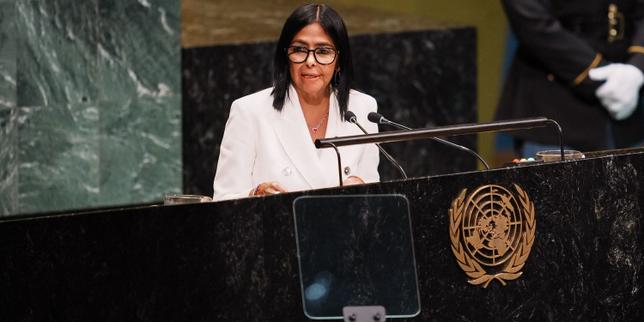
When the chief executive of the Islamic Republic of Iran stepped onto the global stage at the United Nations General Assembly, he carried more than rhetoric. He brought records, photographs, and casualty logs, aiming to shift the architectural focus of international discourse away from Tehran's nuclear enrichment and toward American military accountability. This diplomatic maneuver was calculated to reframe the narrative in New York, presenting Washington not merely as a frustrated arbiter of non-proliferation norms, but as an active participant in civilian casualties across the Middle East.
For decades, the standard rhythm of high-level diplomacy at the United Nations has followed a predictable cadence. Western delegations arrive armed with intelligence dossiers detailing proxy warfare, ballistic missile proliferation, and domestic crackdowns. Tehran usually responds with defiant rejections and standard grievances regarding Western hypocrisy. By arriving with documented evidence of civilian strikes attributed to United States operations, the Iranian delegation bypassed the usual verbal sparring. They forced diplomats, journalists, and policy analysts to confront specific instances of collateral damage, weapon debris recovery, and post-strike forensic reports from conflict zones where American air power intersects with local populations. Building on this topic, you can also read: The Ballot Box Battle Inside Israel Over Disqualifying Arab Parties.
Understanding the weight of this tactic requires examining how geopolitical legitimacy is constructed in international forums. The General Assembly is not a court of law; it is a theater of perception. Winning a moral argument in this room does not alter the voting math of the Security Council, nor does it dismantle economic sanctions. However, it alters the baseline of diplomatic comfort. When an adversary presents verifiable instances of civilian harm caused by allied military actions, defending nations are forced into a defensive posture. They must pivot from broad appeals to global security down to the granular, often messy reality of engagement rules, target verification errors, and post-strike assessments.
The evidence presented by Tehran typically draws from open-source intelligence, local human rights organizations, and government documents from operational theaters in Iraq, Syria, and Yemen. While Western military commands maintain rigorous internal accountability mechanisms, the gap between official military assessments of civilian casualties and the counts documented by independent monitors remains a persistent vulnerability. Bureaucratic language regarding kinetic strikes and precise munitions often collides with the stark realities on the ground in densely populated urban centers. By aggregating these discrepancies and placing them on the mahogany podium of the General Assembly, Iranian statecraft exploits this credibility gap. Analysts at NPR have shared their thoughts on this trend.
This strategy also serves a vital domestic and regional audience. Within Iran and across its network of allied regional militias, framing the United States as a direct perpetrator of civilian suffering reinforces ideological solidarity. It counters the narrative that regional instability stems exclusively from Tehran's foreign policy choices. Instead, it projects an image of a nation standing as a legalistic challenger to global hegemony, demanding accountability for international humanitarian law violations. The timing of such presentations is rarely accidental; they coincide with periods of heightened economic pressure, internal social friction, and regional escalation, providing a unifying external focal point for state media.
Yet, analyzing this diplomatic gambit requires separating the theatrical presentation from the structural realities of international power. The United States and its allies operate within a security architecture designed to absorb such criticism without fundamentally altering their operational doctrine. Military planners factor civilian casualties into operational risk assessments, viewing them through the cold prism of necessity and proportionality, even when errors occur. When confronted with evidence at the UN, Western diplomats routinely dismiss the source as politically motivated, pointing to Tehran's own domestic human rights record and its support for armed groups that routinely target civilians.
This dynamic reduces the UNGA floor to a recurring exercise in mutual delegitimization. Neither side changes its behavior. Washington does not alter its air campaign guidelines based on an Iranian presentation, and Tehran does not moderate its regional posture because of Western condemnations. Instead, the battle lines of global perception harden further. The evidence brought to the podium functions less as a key to unlock actual justice for victims and more as ammunition in an endless war of informational attrition, where truth is continuously flattened into tactical propaganda.
Ultimately, the deployment of casualty receipts at the United Nations illustrates the evolution of modern statecraft. Physical documentation and digital forensics have replaced simple rhetorical flourishes, but the underlying game remains unchanged. As long as great power competition plays out in international bodies without enforcement mechanisms, the suffering of civilians in distant conflict zones will continue to be weaponized by their own governments and adversaries alike, transformed into fleeting talking points before fading into the background noise of diplomatic stalemate.