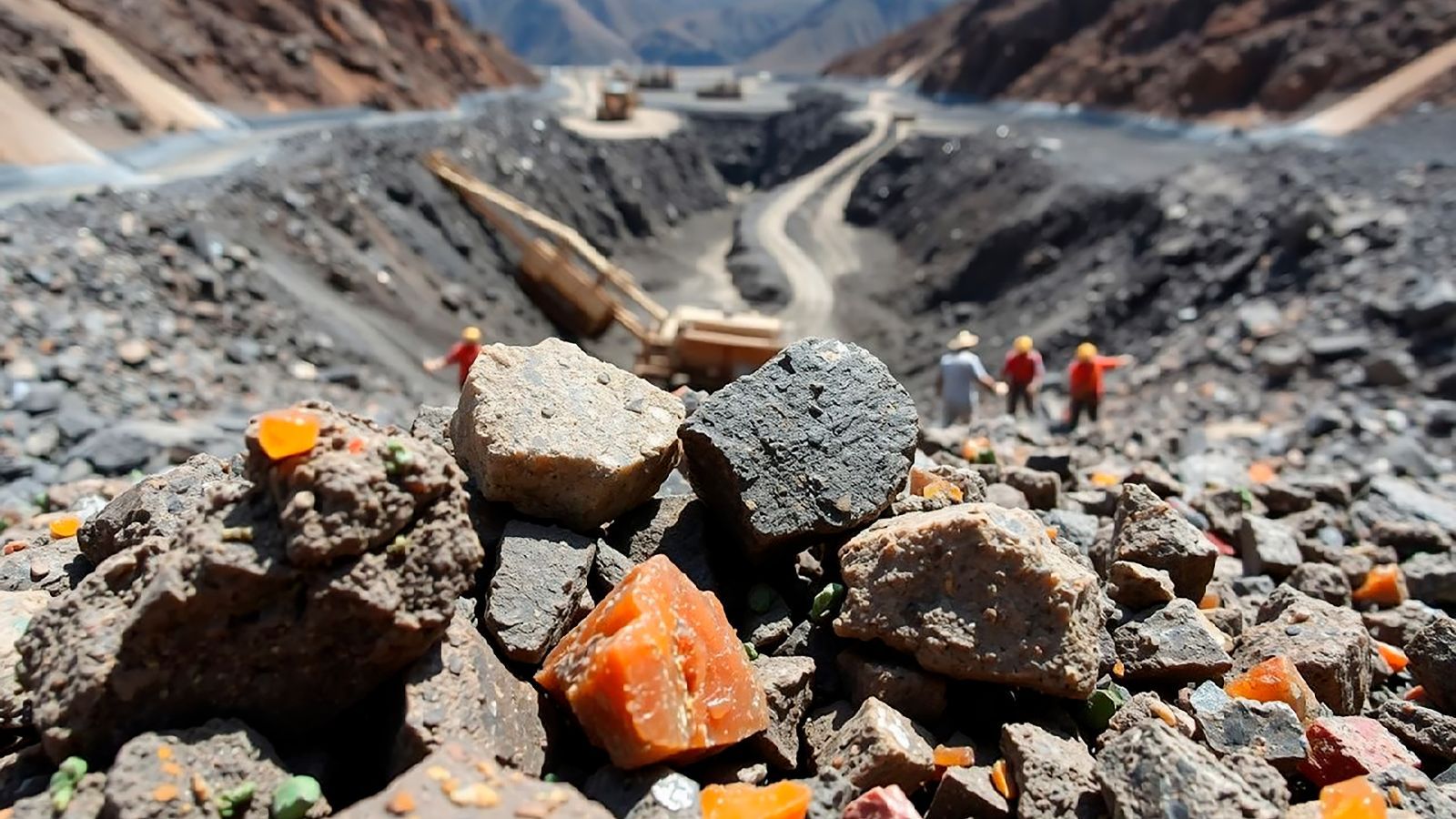
The wind off the Atlantic tastes like salt and crushed iron. Standing on a low hill in the interior of Bahia, Brazil, you can smell the damp earth turning over under the weight of heavy machinery. To the casual observer, this is just another rural valley choked by red dust. But look closer at the trucks grinding their gears on the unpaved tracks. Look at the mud clinging to their tires. That mud holds the invisible architecture of the modern century.
Magnets. Wind turbines. Electric vehicle motors that whisper instead of roar. For a closer look into similar topics, we suggest: this related article.
We built our collective future on a very simple promise. Clean air. Silent streets. A quiet parting from the age of soot. Yet the metals making that silent future possible have to come from somewhere. And right now, the eyes of industrial powers are shifting away from familiar, heavily guarded boardrooms and turning southward, toward the ancient, weathered soils of Brazil.
Consider what happens next: a gold rush, but for elements with unpronounceable names. Neodymium. Praseodymium. Dysprosium. For additional background on this topic, in-depth coverage can be read on Forbes.
To understand why the world is suddenly knocking on Brazil's door, you have to look at a map of geopolitical anxiety. For decades, a single nation held a near-monopoly on rare earth elements, effectively acting as the tollbooth for humanity's technological transition. Every time an automaker wanted to scale up production of long-range batteries or high-efficiency drivetrains, they paid homage to that eastern tollbooth. Supply chains snapped. Prices fluctuated on the whim of a single government signature.
The rest of the world panicked. They went hunting for alternatives.
Brazil entered the conversation not with a roar, but with a quiet geological audit. Beneath its rolling savannas and ancient cratons lie vast, untapped deposits of these critical minerals. Companies from North America, Europe, and Asia are scrambling for concessions, pouring capital into exploratory drilling, and promising local communities an economic renaissance.
Money talks. But the earth echoes.
I remember talking to an environmental engineer in a dusty roadside diner a few hours outside of Belo Horizonte last year. He stirred his coffee with a plastic straw, staring absently at the condensation ring on the laminate table. He wasn't anti-mining. He understood the math better than most. He knew that without rare earths, global climate targets are just expensive poetry on glossy paper.
"The irony," he told me, his voice barely rising above the hum of an aging refrigerator, "is that we are tearing open the planet in order to save it."
That is the paradox at the heart of the Brazilian rare earth boom.
Unlike traditional iron or gold mining, extracting these elements involves dealing with monazite and clay deposits that often contain low-level radioactive materials like thorium and uranium. When you wash the earth to separate the valuable magnetic grains, you are left with tailings. Slurry. Wastewater that has to go somewhere.
Down in the valleys, residents are starting to ask uncomfortable questions. Will the local water tables hold? Will the agricultural yields of citrus and coffee turn bitter under the drift of chemical processing? The government in Brasília is caught in a vice grip. On one side, the intoxicating pull of foreign investment, industrial sovereignty, and job creation. On the other, the grim shadow of ecological degradation that history suggests always follows the extraction of underground wealth.
History has a heavy stride in Latin America. Generations of locals have watched foreign flags and multinational conglomerates arrive with grand speeches about progress. They pave roads. They build temporary housing. Then the resource dries up, the market shifts, and the scars remain. Open pits fill with toxic rainwater. The dust settles into the lungs of the grandchildren of the people who signed the initial contracts.
Can Brazil rewrite that ending?
Some projects are trying a different path. They talk of closed-loop systems, dry-stack tailings, and rigorous community consent frameworks. They point out that Brazil’s strict environmental licensing laws are among the most comprehensive in the hemisphere.
Paper laws don't stop diesel excavators.
The pressure from international buyers is relentless. Demand curves slope upward with terrifying steepness. Every delay in permitting a new mine in Minas Gerais or Goiás is viewed in corporate boardrooms in Detroit and Frankfurt as an existential threat to their EV rollouts. The timeline for the green transition does not have patience for local democratic debate. It wants ore, and it wants it now.
This is where the human element breaks through the spreadsheets.
Imagine a family farm sitting on top of a multi-million-dollar anomaly of ionic clays. To a CEO three thousand miles away, that property is a coordinate on a resource map. To the family who planted orange trees there in the 1970s, it is an archive of sweat, Sunday dinners, and buried ancestors. When the surveyors show up with their GPS units and soil augers, they aren't just measuring mineral grades. They are measuring the cost of displacement.
The global race for rare earths is often framed as a technical challenge or a trade war. It is neither. It is a moral negotiation.
We are deciding whose back bears the weight of our ambitions. We want our cities free of smog, our gadgets feather-light, our cars humming with clean electricity. We want to look in the mirror and believe we solved the planetary crisis.
Meanwhile, somewhere in the red soil of South America, a pump hums through the night, drawing up water that will never taste the same again.
The transition is happening. It cannot be unmade. But as the trucks roll out of the interior carrying sacks of gray concentrate toward the ports, the true measure of our progress won't be found in sales figures or carbon offsets. It will be found in the silence we leave behind in the valleys we chose to mine.