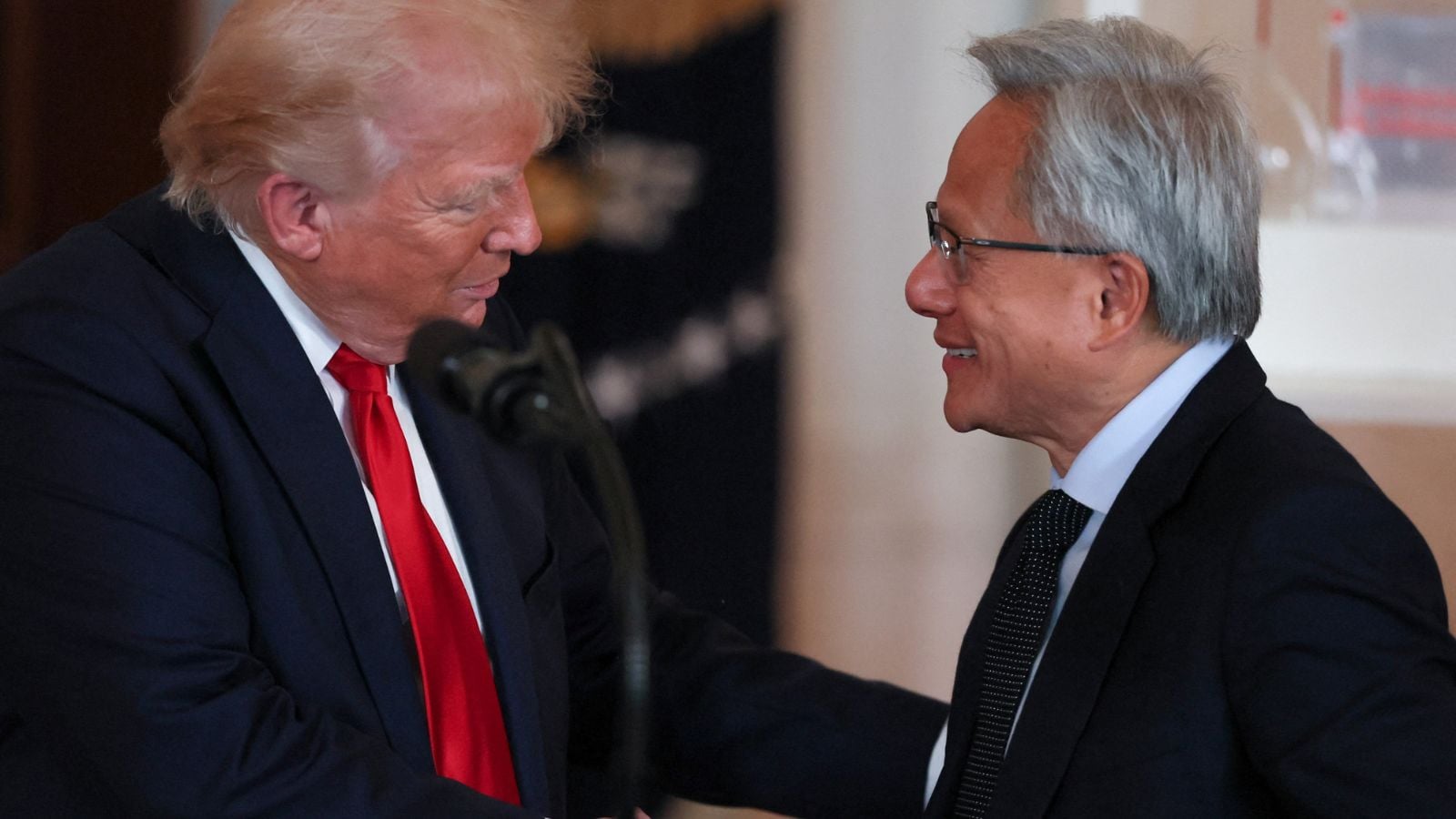
Donald Trump publicly praised Nvidia CEO Jensen Huang as an "honourable" businessman while simultaneously stating he has not discussed specific allegations surrounding the semiconductor giant with him. This deliberate separation between personal praise and regulatory scrutiny reveals how modern political power interacts with critical technology monopolies. Rather than signaling a free pass for Nvidia, Trump's posture reflects a calculated balancing act between championing American dominance in artificial intelligence and maintaining executive flexibility over export controls, antitrust reviews, and national security enforcement.
Washington has a short memory when market capitalizations cross into the trillions. For decades, I have watched chief executives walk the tightrope between Oval Office favor and federal oversight, and the script rarely changes. When a company becomes indispensable to national economic output, political leaders quickly separate the founder's character from the corporation's legal headaches. Meanwhile, you can explore similar stories here: Why Thames Water Wants More Time On Its £20 Billion Debt Mountain.
The Anatomy of Strategic Plausible Deniability
When a political figure calls a chief executive honourable while claiming ignorance or avoidance of active allegations, every word is weighed by attorneys and lobbyists long before it reaches a microphone. In the case of Donald Trump and Jensen Huang, the statement serves two immediate purposes. First, it reassures financial markets that the administration views Nvidia as an American champion rather than a hostile target. Second, it preserves complete political insulation should federal agencies decide to pursue enforcement actions later.
By stating he has not discussed the allegations with Huang, Trump establishes clean separation. In executive governance, direct conversations between a president and a corporate leader regarding active regulatory, compliance, or legal matters create immediate optics problems and potential interference claims. Maintaining distance allows the White House to publicly applaud Nvidia's domestic investments and engineering leadership without compromising the formal independence of the Department of Justice, the Commerce Department, or federal trade regulators. To understand the bigger picture, check out the excellent article by CNBC.
Notice the exact phrasing. Calling someone honourable is a character assessment, not a legal exoneration. Politicians routinely deploy personal compliments to soften the ground ahead of difficult policy negotiations. Huang has spent years cultivating relationships across the political spectrum, recognizing that Nvidia's silicon sits at the center of global geopolitical friction.
Why Nvidia Cannot Be Treated Like an Ordinary Tech Company
To understand why Trump's remarks carry weight beyond routine political chatter, you have to look at what Nvidia actually controls. Nvidia is no longer just a graphics card manufacturer for video games. It is the foundational hardware layer for modern artificial intelligence, defense computing, and sovereign cloud infrastructure.
Consider the structural realities keeping Washington tethered to Santa Clara:
- Compute Monopoly Dynamics Nvidia's CUDA software ecosystem locks developers into its hardware architecture in ways that competitors have struggled for over a decade to crack.
- Supply Chain Fragility While Nvidia designs the chips in California, the physical manufacturing relies heavily on fabrication facilities in Taiwan, creating an acute national security vulnerability.
- Capital Market Gravity Because Nvidia accounts for a massive share of major stock index gains, aggressive federal rhetoric against the company immediately rattles retirement accounts and institutional funds.
A hypothetical scenario illustrates this bind clearly. Imagine federal regulators suddenly announcing a structural breakup or a sweeping halt to Nvidia's primary data center chip shipments over compliance allegations. Within hours, domestic cloud providers would face halted infrastructure rollouts, defense contractors would lose access to critical compute clusters, and equity markets would suffer a severe contraction. No administration wants to trigger a self-inflicted industrial shock while trying to outpace foreign rivals in artificial intelligence.
The Geopolitical Chessboard Behind the Compliments
Beneath the surface of personal praise lies the real friction point between Nvidia and Washington, which is international export enforcement. Over the past several years, US export restrictions have aimed to prevent advanced AI accelerators from reaching restricted foreign entities, particularly in China. Yet high-end chips have repeatedly surfaced in gray-market networks, prompting intense scrutiny over how hardware moves through global distributors and third-party data centers.
Allegations surrounding corporate practices, smuggling channels, or anti-competitive bundling put Nvidia in an awkward spot. On one hand, the company insists it complies strictly with every export rule and cannot track every server after it enters secondary markets. On the other hand, lawmakers and national security hawks demand tighter accountability, arguing that voluntary compliance is insufficient when compute power translates directly into military capability.
Trump's approach to trade and technology has consistently favored bilateral deal-making and national industrial strength over rigid multilateral frameworks. Praising Huang aligns with an economic philosophy that rewards American winners who out-innovate foreign competition. At the same time, keeping the allegations off the table during personal interactions ensures that export enforcement remains a live bargaining chip. If Washington needs leverage in broader trade negotiations, regulatory pressure on semiconductor flows remains readily available.
The Lobbying Reality in Washington
Tech executives rarely enter political circles empty-handed, and Jensen Huang has rapidly adapted to the demands of Washington statecraft. For years, Nvidia maintained a relatively modest lobbying footprint compared to legacy defense contractors or consumer internet platforms. That era ended the moment AI compute became a strategic resource.
Today, Nvidia's leadership engages directly with policymakers on energy grid capacity, domestic manufacturing incentives, and export licensing rules. When Trump describes Huang as honourable, he is acknowledging a chief executive who has shown willingness to align corporate messaging with American industrial priorities. Huang speaks the language of domestic infrastructure, job creation, and technological supremacy, themes that resonate deeply with Trump's economic platform.
Separating the Founder From the Regulatory File
Industry history offers plenty of precedent for this exact dynamic. During the late 1990s and early 2000s, senior political figures frequently praised the visionary leadership of major telecommunications and software founders even as federal prosecutors pursued aggressive antitrust cases against their companies. More recently, aerospace and defense executives have enjoyed warm public endorsements from the White House while their firms faced billions of dollars in contract disputes and compliance investigations.
Personal rapport does not halt institutional machinery. Federal agencies operate on statutory timelines, subpoenas, and evidentiary standards that move far slower than news cycles. Even when an administration signals a lighter regulatory touch, career investigators, state attorneys general, and international competition authorities continue their work independently.
In Nvidia's case, scrutiny comes from multiple directions simultaneously:
- Antitrust Questions Competitors and smaller cloud providers have raised concerns about whether Nvidia uses its dominant market share in GPUs to pressure customers into buying its networking equipment and software bundles.
- Export Diversion Probes National security officials continue examining how restricted processors bypass licensing controls through shell companies and overseas intermediaries.
- Supply Allocation Fairness Major technology buyers privately complain about allocation bottlenecks, fearing that preferential treatment for select partners distorts fair market competition.
None of these issues disappear because a political leader expresses personal respect for the chief executive. In fact, warm public words often raise the stakes. If formal findings eventually contradict the image of an honourable corporate actor, the political backlash becomes twice as severe.
What Market Analysts and Investors Often Misread
Wall Street tends to react to political soundbites with binary simplicity. A compliment from Trump triggers immediate buying pressure, based on the assumption that regulatory risks have evaporated. A critical remark sparks a sell-off, based on the assumption that crackdowns are imminent. Both reactions miss how power actually operates in Washington.
Experienced analysts look past the adjectives and watch the policy mechanisms. Did the administration announce an exemption to export licensing rules? Did the Justice Department close an open inquiry? Did the Commerce Department alter its enforcement guidelines for semiconductor distributors? Until concrete administrative actions occur, personal praise remains purely rhetorical.
Furthermore, Huang himself understands the danger of appearing overly reliant on political favor. Nvidia's valuation rests on engineering execution, software lock-in, and relentless product cycles, not government subsidies. Aligning too closely with any single political figure carries long-term risk, especially for a global enterprise that sells hardware across Europe, Asia, and the Middle East. Maintaining cordial, respectful distance serves Huang just as well as it serves Trump.
The Unspoken Bargain Shaping AI Infrastructure
Look closely at the subtext of this exchange and you will see an unspoken bargain taking shape between Washington and Silicon Valley's most valuable hardware supplier. The government needs Nvidia to keep pushing the frontier of compute performance so American laboratories maintain a lead over international rivals. In exchange, Nvidia expects a regulatory environment that does not cripple its ability to scale, invest, and sell to legitimate global customers.
Yet gray areas persist. Nobody in Washington has solved the fundamental contradiction at the heart of modern semiconductor policy. Policymakers want American chipmakers to dominate global market share while simultaneously restricting those same companies from selling to some of the world's largest technology markets. Expecting a corporation to maximize shareholder returns while acting as an unpaid enforcement arm of national security policy creates permanent tension.
Allegations of misconduct, whether tied to competitive practices or compliance gaps, thrive in that exact gray zone. When rules shift rapidly and geopolitical boundaries harden overnight, corporate behavior that was standard practice two years ago can suddenly look like a regulatory violation today.
Trump's refusal to discuss the allegations while praising Huang's character captures this tension perfectly. It is a holding pattern disguised as an endorsement. The cameras capture a moment of mutual respect between a powerful political leader and an influential technologist, while the underlying legal, commercial, and national security questions remain unresolved behind closed doors.
Watch the Commerce Department's next licensing update, not the press conference transcripts.