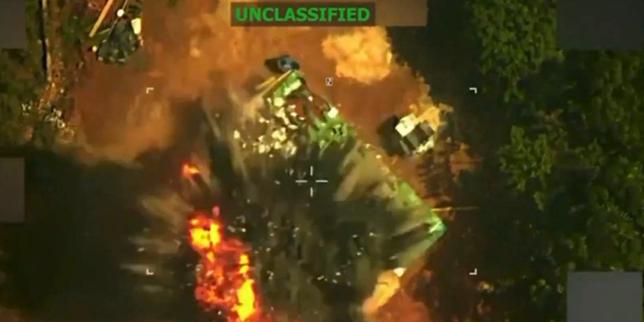
The headlines are screaming with triumph. A high-profile American military strike has reportedly eliminated the head of Tren de Aragua. The political machine is taking victory laps. The media is serving up the usual narrative: cut off the head of the snake, and the cartel collapses.
It is a comforting bedtime story for a terrified public. It is also completely wrong. Don't forget to check out our previous article on this related article.
Decades of transnational crime data and basic organizational psychology tell us exactly what happens next. You do not kill a decentralized, franchise-model syndicate by dropping a missile on a single leader. You just vacuum-seal the promotion pipeline for someone younger, more violent, and desperate to prove their worth. Celebrating this strike as a definitive victory reveals a profound misunderstanding of modern asymmetric threats.
The Hydra Effect Explaining The Myth Of Decapitation
The "decapitation strike" is a relic of conventional 20th-century warfare. It assumes a top-down command structure where the subordinates lack autonomy. If you killed a military general in 1944, you crippled their communication network. To read more about the background of this, The Guardian provides an informative breakdown.
Tren de Aragua does not operate like a mid-century army. It operates like an agile tech startup mixed with a decentralized insurgent network.
When you eliminate a top boss in a hyper-violent criminal enterprise, you do not trigger a collapse. You trigger a corporate restructuring driven by gunpowder. criminologists call this the "Hydra Effect."
The Predictable Anatomy of a Power Vacuum
- Internal Warfare: Sub-commanders immediately split into factions, fighting for control of lucrative human trafficking and extortion routes. The violence does not stop; it spills into the streets as mid-level enforcers compete for the top spot.
- Tactical Mutation: The incoming leadership is inevitably younger and more radicalized. They lack the institutional memory or strategic restraint of the older bosses. They use more brutal methods to establish dominance.
- Franchise Independence: Tren de Aragua functions largely on a franchise model. Local cells operate with immense autonomy. Taking out a leader in a remote location changes nothing for the enforcer running an extortion racket on the ground thousands of miles away.
I have watched law enforcement agencies make this exact mistake for twenty years. They spend millions of dollars and years of intelligence work to take down a single figurehead. The press conference features photos of seized cash and weapons. Six months later, the local crime statistics are higher than they were before the arrest. Why? Because the market demand for illicit services never changed.
Market Dynamics Demand Curves Do Not Care About Missiles
Let us stop looking at cartels through the lens of morality and start looking at them through the lens of economics. Criminal organizations exist to fill a market demand. They provide illicit goods and services that the state has either banned or failed to regulate effectively.
| Counter-Insurgency Myth | The Economic Reality |
|---|---|
| Eliminating a leader destroys the syndicate's operational capacity. | Supply chains adapt instantly; the profit margins are too high to ignore. |
| Territorial control rests solely with the top boss. | Power is hyper-localized; block captains hold the real leverage. |
| Military force deters future criminal recruitment. | Increased risk simply increases the price of the service, attracting bolder actors. |
When a state uses high-tech military hardware to eliminate a criminal actor, it artificially reduces the supply of leadership while the demand for the syndicate's services remains entirely untouched. The profit margins for human smuggling, drug distribution, and protection rackets remain staggering.
Basic economic theory dictates that when risk increases, the premium on the service goes up. This means the surviving members of Tren de Aragua can now charge more for their operations. The strike did not bankrupt the enterprise; it just restructured its balance sheet and forced it to evolve.
The Illusions Of High-Tech Warfare In Domestic Law Enforcement
Using military assets against non-state criminal actors creates a dangerous precedent that shifts the focus away from actual, ground-level investigative work. It is easy to track a satellite signature or a cell phone signal and order a strike. It looks great on evening news broadcasts. It provides a clean, cinematic narrative of good versus evil.
The real work of dismantling a gang like Tren de Aragua is tedious, unglamorous, and slow. It involves financial intelligence, forensic accounting, flipping low-level lookouts, and rebuilding the social fabric of vulnerable communities where these gangs recruit.
Why Financial Tracking Beats Kinetic Force Every Single Time
If you want to kill a criminal network, you do not target their bodies. You target their bank accounts.
"Follow the money" is an cliché because it is an absolute truth. A gang leader cannot pay their enforcers, bribe border officials, or purchase weaponry if their liquidity is frozen.
The moment a kinetic strike occurs, the cash reserves of that organization do not vanish. They are redistributed. The real victory would be seizing the shell companies, the crypto wallets, and the real estate portfolios that allow these syndicates to launder their billions. Until the asset forfeiture numbers match the hyperbole of the press releases, the syndicate remains fully operational.
Dismantling The False Premise Of The Quick Fix
People frequently ask: "Shouldn't we eliminate dangerous criminals when we have the chance?"
The premise of the question is inherently flawed. It assumes the choice is between doing nothing or executing a dramatic strike. That is a false binary designed to justify theatrical policy decisions. The real choice is between chasing short-term political theater or investing in long-term systemic disruption.
Consider the historical precedent of the Medellin Cartel. The death of Pablo Escobar did not stop the flow of narcotics into the United States. It simply decentralized the market, giving rise to the Cali Cartel, which was far more efficient, less overtly violent, and significantly harder to track. The market did not shrink; it optimized.
By treating Tren de Aragua as a military target rather than a systemic socio-economic infection, we guarantee its survival. The organization will fracture, mutate, and re-emerge under three different names with a new generation of leaders who are entirely desensitized to conventional deterrence.
Stop looking at the sky for missiles to solve structural law enforcement failures. The market is already filling the vacancy.