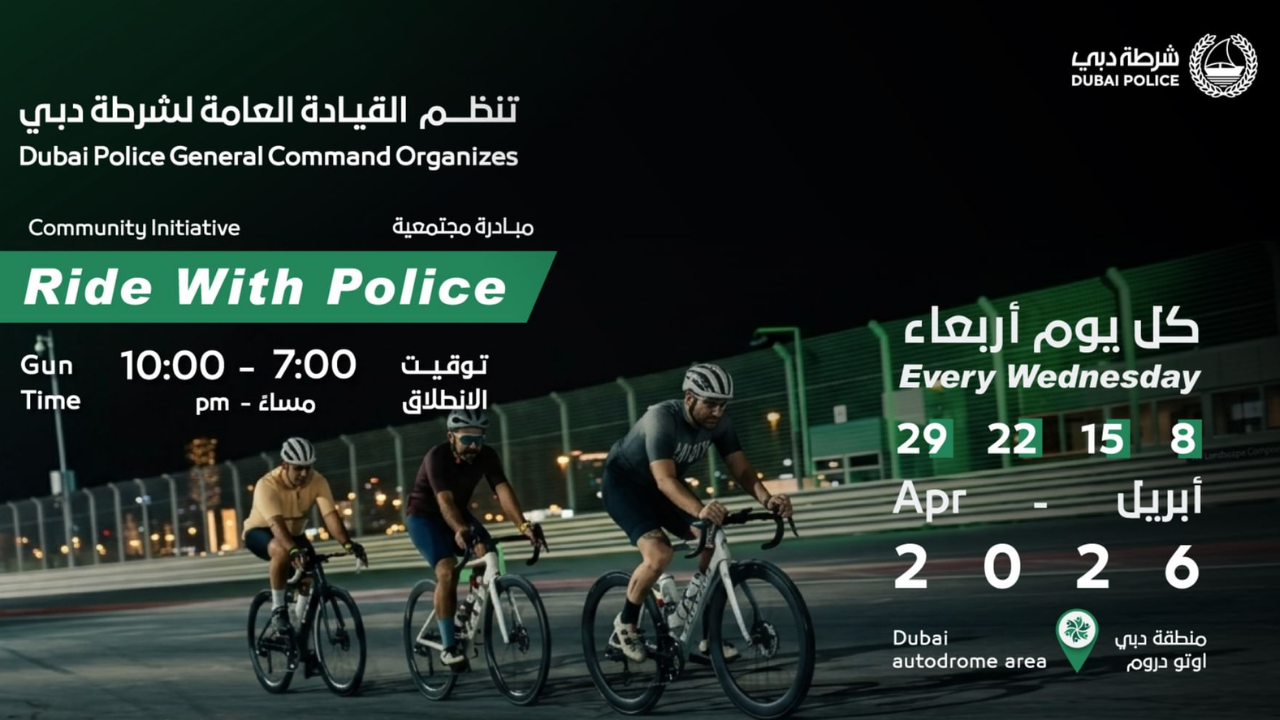
The Dubai Police have officially moved their community engagement efforts onto the asphalt of the Dubai Autodrome, launching a weekly cycling initiative that invites the public to ride alongside officers in a controlled, high-performance environment. This isn't a high-speed chase or a tactical exercise. It is a calculated push to humanize a force often defined by its fleet of multi-million dollar supercars. By opening the track every Wednesday evening, the department is attempting to bridge the gap between law enforcement and a fitness-conscious civilian population through the shared exhaustion of a steep climb and a headwind.
The program, dubbed "Ride with Dubai Police," functions as a recurring open invitation. It targets the growing subculture of amateur and semi-professional cyclists who have turned the UAE into a regional hub for the sport. While the force has long utilized bicycles for patrols in high-density tourist areas like La Mer or the Dubai Design District, this initiative marks a transition from utilitarian policing to active participation in the city’s recreational fabric.
Breaking the Glass Wall of the Patrol Car
For decades, the interaction between a resident and a police officer in a major metropolis has been transactional. It happens during a traffic stop, at a security checkpoint, or inside a station. There is a physical barrier—usually a window or a desk. The Autodrome initiative removes these obstacles. When an officer is wearing Lycra instead of a tactical vest and is struggling with the same elevation changes as the person in the next lane, the power dynamic shifts.
This is about soft power. The Dubai Police are savvy enough to realize that a force perceived as approachable is a force that gathers better intelligence and maintains higher levels of public cooperation. By participating in the weekly sessions, officers become familiar faces rather than anonymous figures behind tinted glass. The "why" here is simple: community policing is more effective when the community actually knows the police.
The Infrastructure of a Fitness Hub
The choice of the Dubai Autodrome as the primary venue is no accident. While the city has invested heavily in dedicated cycling tracks like Al Qudra, those routes are often remote and subject to the whims of desert winds and sand drifts. The Autodrome provides a closed-circuit environment with professional-grade lighting, medical support on standby, and a predictable surface.
Safety and Accessibility
Safety is the quiet engine driving this project. Dubai has seen a massive uptick in cycling, but road safety remains a persistent concern for those not yet comfortable navigating the city’s arterial highways. The Autodrome offers a sanctuary.
- Controlled Environment: No motorized traffic allowed during cycling hours.
- Predictable Conditions: 5.39 kilometers of consistent tarmac.
- Police Presence: Immediate access to officers who are technically on duty while they ride.
For the casual rider, the presence of the police provides a psychological safety net. For the serious athlete, it offers a chance to train on a world-class circuit without the usual risks of urban cycling.
Beyond the PR Campaign
Skeptics might view this as another entry in a long line of Dubai-style photo opportunities. However, the logistical commitment suggests otherwise. Maintaining a weekly presence at a private racing circuit requires coordination across multiple departments, including the General Department of Community Contributions and the Traffic Department.
The initiative also aligns with the Dubai 2040 Urban Master Plan, which emphasizes a "20-minute city" concept—making exercise and essential services accessible within a short window. By integrating law enforcement into this health-centric vision, the government is signaling that "safety" in the future isn't just about crime rates; it's about public health and the quality of the urban experience.
The Equipment Shift
It is worth noting the shift in hardware. The police aren't showing up on heavy, department-issue steel frames. They are using high-end road bikes that match the gear of the enthusiasts they are riding with. This parity is crucial. In the world of cycling, your gear is a badge of membership. By showing up with competitive equipment, the police are signaling that they aren't just overseers—they are practitioners of the sport.
Navigating the Social Friction
Public exercise with authority figures isn't without its awkwardness. There is an inherent tension when you find yourself overtaking a ranking officer on a sprint. Yet, the feedback from the initial sessions suggests that this friction dissipates after the first few kilometers. The shared physical exertion acts as a social equalizer.
The program also serves as a subtle educational platform. Instead of issuing fines or lectures on a street corner, officers can model correct behavior—helmet use, hand signals, and pace management—in a way that feels like peer-to-peer coaching rather than a top-down mandate.
The Logistics of Participation
For those looking to join, the process is stripped of typical bureaucratic hurdles. The sessions usually run on Wednesday evenings, taking advantage of the cooler night air.
- Registration: Often handled via the Dubai Police app or at the Autodrome entrance.
- Equipment: Riders must bring their own bikes and helmets, though rental options are frequently available on-site through private partners.
- Cost: The police-led sessions are generally integrated into the Autodrome's existing "Train Dubai" evenings, which have historically been free to the public, though checking for specific event updates is necessary.
The focus is on inclusivity. You see everyone from "weekend warriors" on carbon-fiber machines to families on mountain bikes. The police presence ensures that the rules of the track are respected, preventing the faster groups from endangering the slower, casual riders.
A New Model for Urban Policing
Dubai is essentially running a long-form experiment in social engineering. They are betting that if you sweat with your neighbors, you are less likely to see them as "others." For the police, this is a data-gathering exercise of a different sort. They are learning about the concerns of the residents in real-time, away from the formality of the precinct.
The success of this initiative will be measured not by the number of laps completed, but by the frequency of casual interactions between the riders and the officers. If the barrier stays down, the Autodrome will have served a purpose far beyond its original design as a motorsports venue. It becomes a laboratory for a new kind of civic trust, built one pedal stroke at a time on a floodlit track in the middle of the desert.
The most effective way to understand the dynamic is to get on a bike and find a jersey with the green and white livery. Ask about the route, complain about the humidity, and watch the uniform disappear.