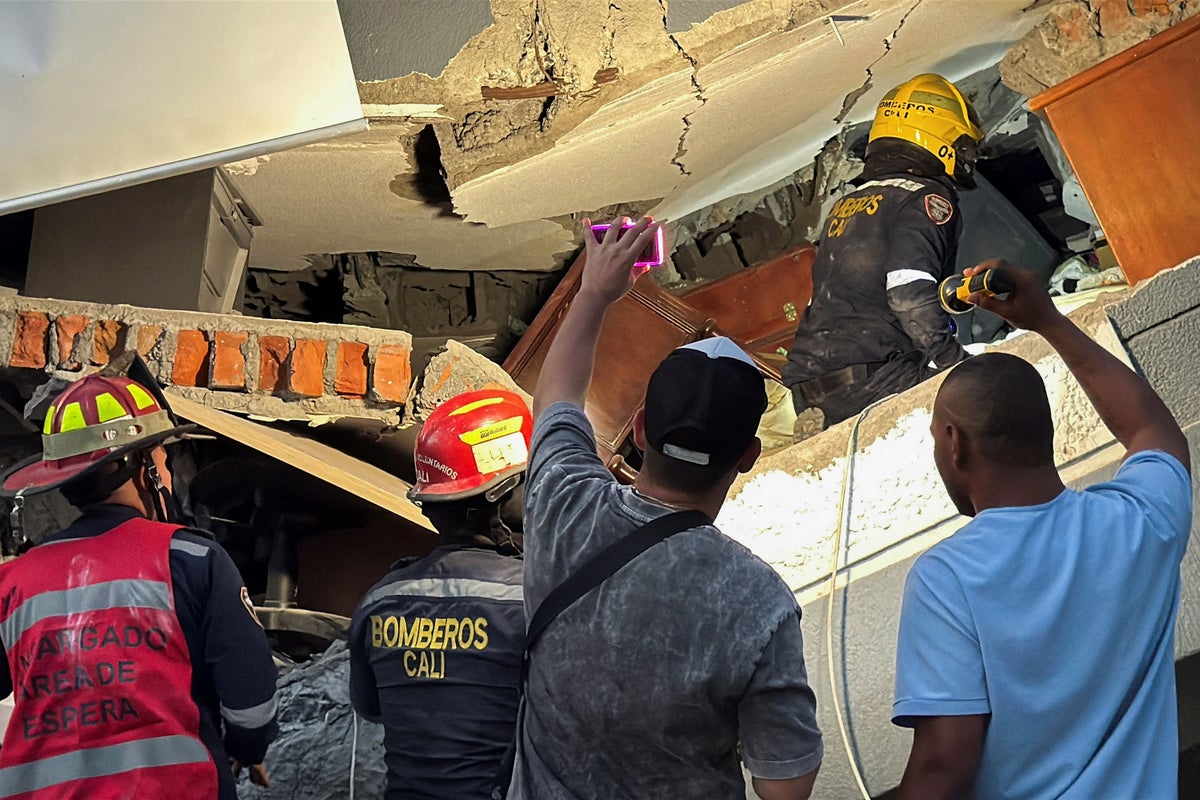
The coffee in the mug was still hot when the floor dropped away.
For years, I have walked the high corridors of the Andes, studying the way the earth breathes, shifts, and occasionally convulses. You read the seismograph readouts in sterile basement offices. You look at the jagged lines spiking upward on a monitor. You talk about subduction zones and tectonic plates as if they were abstract geometry. But geometry does not bleed. Geometry does not leave a child searching through gray dust for a blue school notebook.
When the earthquake tore through Colombia, the scientific community did not just witness a natural disaster. We witnessed a slow-motion collision between human memory and ancient stone.
Consider what happens next when the earth decides to move.
The ground does not simply shake. It rolls. It behaves like an ocean swell trapped beneath asphalt and brick. To understand why the destruction was so absolute, you have to look past the Richter scale magnitude and into the anatomy of the soil itself.
Imagine standing on a hillside in the Andean interior. The houses cling to the steep slopes like barnacles on a cliff face. They are beautiful, colorful, built by generations of families who poured their life savings into hand-mixed concrete and brick. But beauty is a fragile shield against the physics of amplification. When seismic waves travel from deep beneath the crust and hit the soft, loose sediment of mountain valleys, they slow down. And as they slow down, they grow taller. They punch upward with terrifying, concentrated force.
The earth amplifies its own violence.
We talk about structural vulnerability as if it were a simple engineering failure. It is not. It is a story of economics, geography, and inherited risk. (Note: When I refer to historical construction patterns here, I am drawing directly from decades of regional seismic surveys and geological assessments). Many of the buildings that crumbled were constructed without steel reinforcement, not out of negligence, but out of necessity. Iron is expensive when you haul it up a mountain path by hand. Cement is heavy. People build with what they have, trusting the mountain because the mountain has fed their families for centuries.
Then comes the quiet aftershock. Not the physical one, but the institutional one.
Every time the earth breaks in Colombia, the reports follow a familiar script. Experts point to shallow focal depths. They talk about liquefaction, where solid ground temporarily behaves like quicksand under the stress of cyclic shaking. They mention the lack of strict zoning enforcement in rural municipalities.
These facts are true. Yet they miss the human center of gravity.
The real tragedy is that earthquakes are predictable in their malice, even if they are unpredictable in their timing. We know where the fault lines lie. We know which schools have unreinforced masonry. We map the hazards with laser-guided precision from satellites orbiting hundreds of miles above the very soil that is about to fracture.
And yet, vulnerability is a trapdoor that opens only for the poor.
Walk through the aftermath of a major Colombian tremor, and you will see a cruel architectural segregation. The glass-and-steel high-rises in the financial centers flexed and absorbed the shock, their engineered dampers doing the quiet work of salvation. Just miles away, in the hillside settlements, unreinforced brick stacked upon brick pancaked into rubble.
The mountain does not care about income brackets. But the physics of destruction are entirely class-conscious.
For years, I have listened to policy makers discuss seismic retrofitting strategies in air-conditioned conference rooms in Bogotá. They speak of cost-benefit ratios. They calculate the price of concrete jackets for structural columns against the likelihood of a major event within a fifty-year window.
Numbers. Percentages. Acceptable risk.
Try explaining an acceptable risk to a mother holding a broken roof tile.
The earth beneath Colombia is a living archive. Every tremor writes a new chapter in a story that began millions of years ago when the Nazca Plate slid relentlessly beneath the South American Plate. That slow, grinding tectonic warfare builds the majestic peaks that take your breath away when you fly over the Andes. It gives the country its staggering beauty, its rich volcanic soil, its vibrant, resilient culture.
The beauty and the terror are welded together. You cannot have the coffee, the green valleys, the soaring condors, without the fault lines.
When the shaking finally stopped during the recent quake, the dust hung in the humid air like a heavy curtain. Silence followed—that strange, heavy vacuum where birds stop singing and human voices drop to terrified whispers.
We rushed to the scene with our instruments, our drone cameras, our damage-assessment checklists. We wanted data. We wanted to quantify the catastrophe so we could prevent the next one.
We measured the peak ground acceleration. We calculated the spectral response. We mapped the landslides that choked the mountain highways, cutting off entire villages from medical aid.
Every data point was a life disrupted. Every damaged bridge was an umbilical cord severed.
The danger is that we treat these events as anomalies. We look at an earthquake as an interruption in the normal flow of history. But in Colombia, the earthquake is history itself. It is the steady heartbeat of a restless continent.
If we are going to change the ending of this story, we have to stop treating structural resilience as a luxury good. We have to make earthquake engineering as accessible as clean water and electricity. We have to subsidize the reinforcement of the vulnerable homes that line the Andean slopes before the earth decides to reclaim them.
Otherwise, we are simply waiting for the next set of coordinates to appear on our monitors.
The sun set behind the jagged peaks, painting the dust-filled sky in bruised shades of purple and orange. Down in the valley, a single generator hummed to life, cutting a small yellow rectangle into the growing dark. People were already clearing the rubble, shoveling brick by broken brick, refusing to let the mountain have the last word.
The fault line sleeps. For now.


