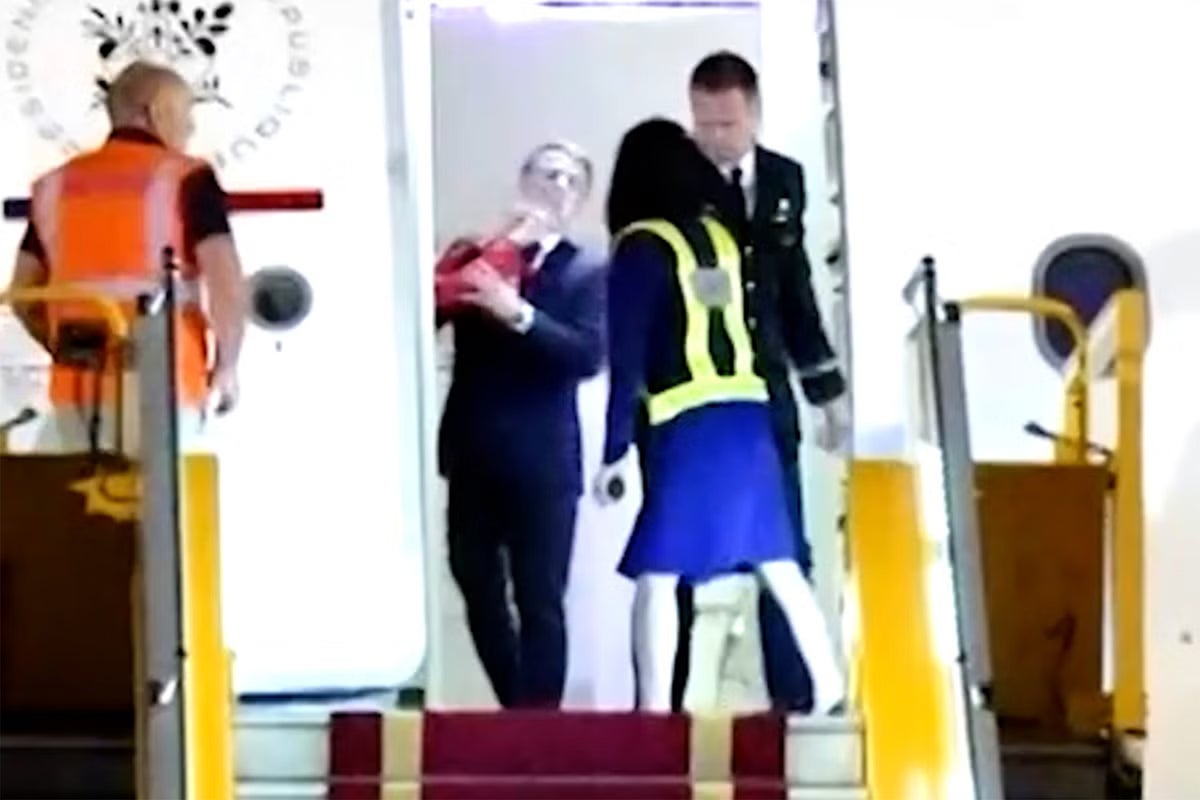
The walls of the Élysée Palace are thick, built of stone and history, designed to keep the secrets of the French Republic safe from the prying eyes of the Rue du Faubourg Saint-Honoré. Yet, no amount of limestone can muffle the persistent hum of a digital-age rumor. For years, a specific, jagged piece of gossip has rattled around the gilded halls: the image of a furious Brigitte Macron, losing her composure, striking her husband, President Emmanuel Macron, after discovering a string of suggestive text messages from a younger actress.
It is a cinematic image. It is also, according to Brigitte herself, a complete fiction. You might also find this connected article interesting: The Faithful Shadow Inside the West Wing.
When the First Lady of France finally chose to address these claims, she didn't do so with a dry press release or a legalistic denial. She spoke with the weary clarity of a woman who has spent nearly a decade being treated as a character in a tabloid melodrama rather than a human being with a pulse. To understand why she broke her silence now, we have to look past the "slap" and into the exhausting reality of living as a walking target for modern myth-making.
The Anatomy of a Modern Myth
Rumors are rarely about the truth. They are about what we want to be true, or what we fear might be. In the case of the Macrons, the public has always struggled to process their unconventional origin story. The age gap—twenty-four years—has acted as a lightning rod for every projection, insecurity, and prejudice the collective consciousness can conjure. As discussed in detailed reports by Associated Press, the results are worth noting.
Imagine, for a moment, being Brigitte. You are a former teacher, a mother, a grandmother. You are thrust into the center of a global stage where your very existence is treated as a provocation. Every wrinkle is scrutinized; every outfit is a political statement. Then comes the "slap" rumor. It’s a perfect narrative hook. It paints the older woman as the jealous, volatile antagonist and the younger husband as the straying protagonist. It fits a tired, sexist archetype that people recognize from cheap soap operas.
But the reality of power and marriage is rarely that loud.
Brigitte’s denial was sharp. She described the claims as not just false, but absurd. She didn't just say "it didn't happen." She signaled a deeper frustration with the way digital misinformation creates a parallel reality that eventually demands a response. For a long time, the strategy was dignified silence. Stiff upper lip. Don't feed the trolls. But silence is often mistaken for a confession in the court of public opinion.
The Cost of Digital Shadows
We live in an era where a tweet can become a headline, and a headline can become history before anyone bothers to check a source. The "actress" in the rumor—a specter never named with any credible evidence—serves as the necessary foil. In the narrative of the rumor-monger, she represents the "expected" choice for a powerful man, making Brigitte the "interloper."
Consider the psychological toll. Every time Brigitte walks into a room, she knows that a percentage of the people looking at her aren't seeing the woman who advises the President on education and healthcare. They are seeing the woman from the "slap" story. They are looking for bruises, for tension, for the cracks in the facade.
It is a form of gaslighting on a national scale.
This isn't just about a celebrity couple. It’s about the erosion of the boundary between private struggle and public entertainment. When Brigitte speaks out, she is reclaiming her own narrative from the hands of anonymous accounts and tabloid editors who treat her life like a script they are allowed to rewrite at will.
The Invisible Stakes of the Presidential Marriage
A political marriage is a partnership, a brand, and a fortress all at once. Inside the Élysée, the stakes aren't just emotional; they are geopolitical. If the public believes the President’s home life is a site of domestic violence or tawdry infidelity, it weakens his hand. It suggests a lack of discipline, a lack of judgment.
The rumor of the slap wasn't just an attack on Brigitte’s character; it was a tactical strike against the stability of the Macron presidency.
By addressing the claims directly, Brigitte did something remarkable: she humanized the institution. She spoke about the hurt. She spoke about the absurdity of having to defend one’s marriage against ghosts. She reminded the public that behind the motorcades and the state dinners, there are two people who have to look at each other across a breakfast table while the rest of the world debates their demise.
The Weight of the Gaze
Why do we care so much? Why does a rumor about a slap in a French palace travel across oceans and languages?
Perhaps it’s because the Macrons represent a subversion of the "natural order" that society still clings to. We are fascinated by their endurance. We are waiting for the other shoe to drop because, if their marriage is successful and happy, it challenges the narrow scripts we’ve written for aging, beauty, and romance.
The rumor-mongers want the slap to be real because it would mean the world is "back to normal." It would mean the unconventional couple is just as miserable as we expect them to be.
But Brigitte’s voice, steady and firm, suggests a different reality. She isn't the fragile, scorned woman of the headlines. She is a woman who has endured far worse than a fake news cycle. She survived the scandal of their beginning, the heat of a presidential campaign, and the relentless mockery of the international press. A fake text message and an imaginary slap are, in the grand scheme of her life, remarkably small.
Beyond the Denial
The real story isn't that the slap didn't happen. The real story is the resilience required to survive the lie.
As the digital age continues to blur the lines between fact and fiction, Brigitte Macron’s choice to stand up and say "no" is a landmark moment. It is a refusal to be a pawn in someone else’s fantasy. She is pulling back the curtain, not to show us the drama we crave, but to show us the emptiness of the gossip itself.
In the end, the stone walls of the Élysée remain. The motorcades will continue to roll through the streets of Paris. And Brigitte will continue to walk beside her husband, a silent rebuke to every person who hoped to see her stumble. She has learned that in the face of a world that wants to see you break, the most radical thing you can do is remain whole.
The ghosts of the Rue du Faubourg Saint-Honoré can keep whispering. Brigitte Macron has stopped listening, and for the first time, she has ensured that we are listening to her instead.