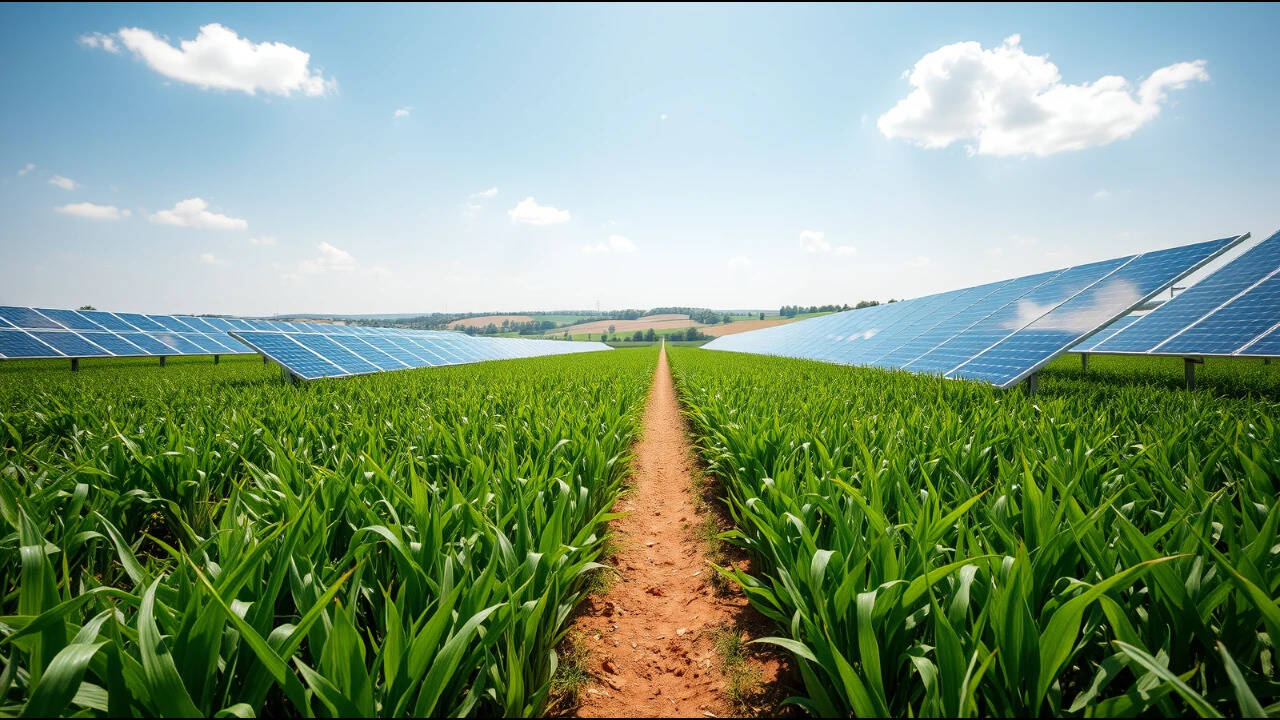
Traditional agriculture faces a structural squeeze between escalating capital expenditures for utilities and the thermodynamic limits of crop survival under intensifying thermal stress. Agrivoltaics—the simultaneous deployment of agricultural production and photovoltaic electricity generation on identical acreage—transforms this constraint into a dual-yield economic model. By analyzing commercial installations such as Colorado's Jack's Solar Garden, decision-makers can deconstruct the physical and financial mechanics that govern dual-use land performance, bypassing superficial environmental narratives to evaluate capital outlays, microclimate modifications, and operational trade-offs.
The Capital Expenditure and Revenue Matrix
The primary economic barrier to dual-use deployment is upfront capital expenditure. Installing an elevated, tracking photovoltaic infrastructure across agricultural land requires specialized racking systems, taller structural supports to clear farming equipment, and robust electrical interconnects. For instance, a multi-acre deployment scaling past 3,000 panels routinely demands capital outlays approaching millions of dollars.
To evaluate the financial viability of this expenditure, asset owners must analyze a dual-stream revenue model:
- Energy Yield Monetization: Photovoltaic arrays generate predictable megawatt-hours sold via power purchase agreements to local utilities. This revenue stream functions as a fixed hedge against volatile commodity crop prices.
- Agricultural Yield Preservation: Rather than displacing crops, the underlying objective is mitigating total crop failure during high-stress meteorological cycles.
The financial equation rests on offsetting the high initial capital cost through long-term power sales while maintaining or optimizing crop value per acre. When ambient temperatures exceed thermal thresholds for sensitive flora, traditional farming suffers catastrophic yield compression. Agrivoltaics introduces a financial floor via electricity sales, transforming a vulnerable single-revenue farm into a diversified asset class.
Microclimate Thermodynamics and Shade Mechanics
The core operational interaction between solar panels and crops is the modification of the local microclimate. Standard open-sky farming exposes soil and plant tissue to uninterrupted direct solar radiation, driving high rates of evapotranspiration. When tracking photovoltaic arrays are introduced overhead, they actively alter energy balances at the crop canopy level.
Single-axis tracking systems introduce dynamic shade patterns across the cultivation zone. Instead of static, uniform blockage, the moving shadow profile introduces periodic relief from peak midday thermal radiation. This mechanical shifting changes three critical environmental variables:
- Vapor Pressure Deficit: Reduced ambient temperature directly beneath the panel array lowers the vapor pressure deficit, decreasing the physiological stress on plant stomata and conserving internal plant water.
- Soil Moisture Retention: Shaded soil experiences reduced thermal evaporation rates. Rainfall runoff channeled along the lower edges of tilted panels creates localized moisture gradients, sustaining soil hydration longer than unshaded plots.
- Thermal Threshold Control: Heat-sensitive species such as clary sage, which experiences cellular degradation and wilting above specific temperature ceilings, remain within viable physiological windows during heat waves. Similarly, germination rates for cool-season crops like flax improve when ambient soil temperatures are kept below peak summer highs.
Operational Friction and Mechanization Constraints
Despite thermodynamic benefits, integrating heavy industrial hardware into active farmland introduces physical bottlenecks that constrain standard agricultural operations.
[Traditional Monoculture]
       │
       ▼
[Uniform Open-Sky Exposure] ──> High Evapotranspiration / Thermal Stress

[Agrivoltaic Infrastructure]
       │
       ▼
[Overhead Tracking Arrays] ──> Dynamic Microclimates / Reduced Mechanization Access
The presence of vertical support columns and low-clearance racking creates spatial obstacles for standard tractors, combines, and large-scale harvesting machinery. Farm managers must adapt operational workflows by substituting macro-mechanization with compact equipment, hand-harvesting for specialty crops, or transitioning targeted inter-row spaces to specialized livestock grazing.
Furthermore, the choice of crop must align with spatial limitations and light attenuation curves. While shade-tolerant herbs, leafy greens, and certain berries thrive under partial photonic deprivation, sun-obligate commodity crops experience significant yield penalties under overhead arrays. Consequently, farm operators cannot simply overlay panels onto existing monoculture routines; they must re-engineer their crop selection matrix to match the altered light regime.
Implementation Blueprint for Dual-Use Scaling
Executing a commercially viable dual-use land strategy requires strict adherence to sequential operational phases rather than opportunistic installation:
- Site Assessment and Solar Resource Audit: Quantify local utility interconnection capacity, feed-in tariffs, and zoning restrictions regarding agricultural land preservation.
- Structural Engineering Customization: Specify mounting heights and tracking parameters based on the turning radius of required farm machinery and the specific light saturation points of target crops.
- Agronomic Selection and Microclimate Mapping: Restrict cultivation to plant species proven to benefit from reduced thermal stress and moderated vapor pressure deficits, avoiding high-light-demand staples.
- Capital Structuring and Partnership Integration: Secure public-private research grants or utility partnerships to amortize upfront capital expenditures while monitoring multi-year soil and crop yield differentials.
Deploy capital toward agrivoltaic infrastructure only where utility power purchase agreements guarantee baseline revenue to absorb initial debt service, pairing the array exclusively with high-margin, shade-responsive specialty crops to maximize revenue per square foot.