Network density and geographic positioning dictate the survival limits of commercial flag carriers. Examining the trajectory of Cathay Pacific from its post-war origins with a single Douglas DC-3 aircraft to an intercontinental node reveals a strict economic evolution. An airline is not merely a collection of aircraft; it is a dynamic capacity allocation model bound by fuel cost functions, bilateral air service agreements, and hub-and-spoke efficiencies.
The Single-Asset Bootstrap and Asset Utilization
The genesis of commercial aviation in resource-constrained environments relies on high asset turnover. In 1946, the acquisition of a solitary Douglas DC-3, nicknamed Betsy, established a baseline unit economic problem: maximizing revenue ton-kilometers (RTKs) with minimal capital expenditure. A single aircraft has zero network redundancy. Its viability depends entirely on high load factors and opportunistic cargo contracts on thin regional corridors.
The mechanism of early survival rests on the marginal cost of operation versus spot-market demand. Without scale, overhead must remain near zero, and maintenance liabilities must be outsourced or absorbed via makeshift logistics. The transition from a single-asset operation to a multi-aircraft fleet requires moving away from opportunistic spot-market flying toward scheduled reliability. This institutional shift demands predictable cash flow, which cannot be sustained without anchor corporate partnerships.
Capital Consolidation and Corporate Parentage
Organic growth in aviation hits a capital expenditure ceiling rapidly. Fleet acquisition requires external capitalization beyond the cash flow of regional freight. The entry of Swire into the ownership structure in 1948 provided the necessary balance sheet strength to transition from an entrepreneurial gamble to an industrial enterprise.
Corporate parentage alters an airline's risk profile through three structural levers:
- Access to revolving debt facilities and institutional liquidity to finance multi-million-dollar aircraft orders.
- Government-level navigation of bilateral air service negotiations, which dictate landing rights and route monopolies.
- Administrative stabilization during macroeconomic and geopolitical shocks, shielding operating entities from immediate insolvency.
Capital backing transforms the cost of capital, allowing carriers to place forward orders for mid-range and wide-body equipment years before delivery, locking in capacity ahead of demand curves.
Fleet Modernization as a Margin Driver
The operational transition through equipment generations—from the Douglas DC-3 to Lockheed Electras, Convair 880 jets, and eventually Boeing 747 wide-bodies—illustrates the shifting economics of fuel burn and seat-mile costs. Each technological iteration changes the operating cost function:
$$\text{CASM} = \frac{\text{Operating Expenses}}{\text{Available Seat Miles}}$$
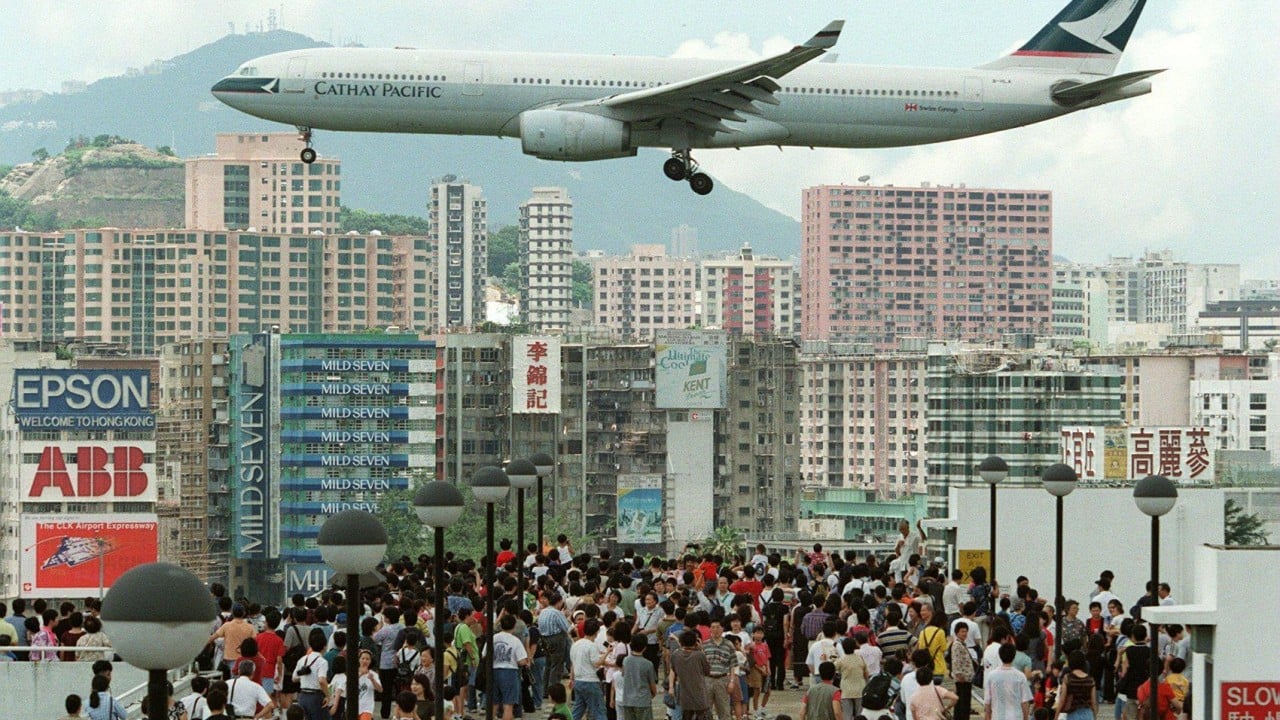
As aircraft size increases, Cost per Available Seat Mile (CASM) drops due to economies of scale, provided load factors remain above the break-even threshold. The introduction of the Boeing 747 in 1979 solved the capacity bottleneck of high-density trunk routes out of space-constrained hubs like Hong Kong’s Kai Tak Airport. Wide-body deployment allowed carriers to capture long-haul passenger demand while simultaneously expanding belly-hold cargo capacity, creating a dual-revenue stream from a single flight profile.
Hub Geography and Point-to-Point Vulnerability
An airline's structural moat is inextricably linked to the geography of its primary hub. Operating out of a constrained urban airport like Kai Tak, and later transitioning to Chek Lap Kok on Lantau Island in 1998, forced absolute efficiency in slot management and turnaround times.
A single-hub network model relies on the hub-and-spoke architecture to aggregate fragmented regional demand into high-yield long-haul trunk routes. This creates a natural defensive barrier:
- Competitors lacking local traffic rights cannot profitably replicate fifth-freedom connections without domestic feed traffic.
- Local carriers control airport slot portfolios, creating high barriers to entry for new market entrants.
However, this architecture introduces systemic vulnerability. Because the carrier lacks a domestic point-to-point domestic market of scale—unlike carriers based in continental landmasses—its revenue depends entirely on international transfer traffic. Any exogenous disruption to regional stability, airspace closures, or public health crises instantly severs the feed mechanism, turning fixed capital assets into cash-burning liabilities.
Cargo Diversification as a Hedging Mechanism
Passenger yields fluctuate cyclically with global GDP, consumer confidence, and discretionary spending. To mitigate this volatility, long-term survival requires structural exposure to global trade flows via dedicated freight operations.
The establishment of dedicated cargo divisions in the early 1980s transformed the airline from a pure-play passenger carrier into an integrated supply chain node. Cargo economics operate on distinct variables:
- Yield per freight ton-kilometer (FTK), which reacts to manufacturing output and maritime shipping bottlenecks.
- Directional imbalance handling, where carriers must price backhaul routes aggressively to offset empty-leg penalties.
- Integration with regional transshipment hubs, capturing high-value electronics, perishables, and time-sensitive industrial components.
This diversification prevents total revenue collapse during passenger downturns, leveraging belly-hold and freighter capacity to smooth out operational earnings.
Strategic Execution for Long-Term Viability
Carriers operating in high-cost hubs must abandon low-margin volume strategies and enforce strict yield management. Long-term margin expansion requires three synchronized structural adjustments:
- Decoupling ancillary revenue streams from base ticket pricing to capture consumer surplus from high-yield segments.
- Dynamic fleet right-sizing, matching gauge to route demand to prevent over-capacity on regional feeder sectors.
- Digital infrastructure modernization to automate yield optimization and reduce ground-handling turnaround times.
Continuous structural cost containment, combined with disciplined capacity deployment across both passenger and cargo networks, remains the primary determinant of long-term solvency in global aviation.