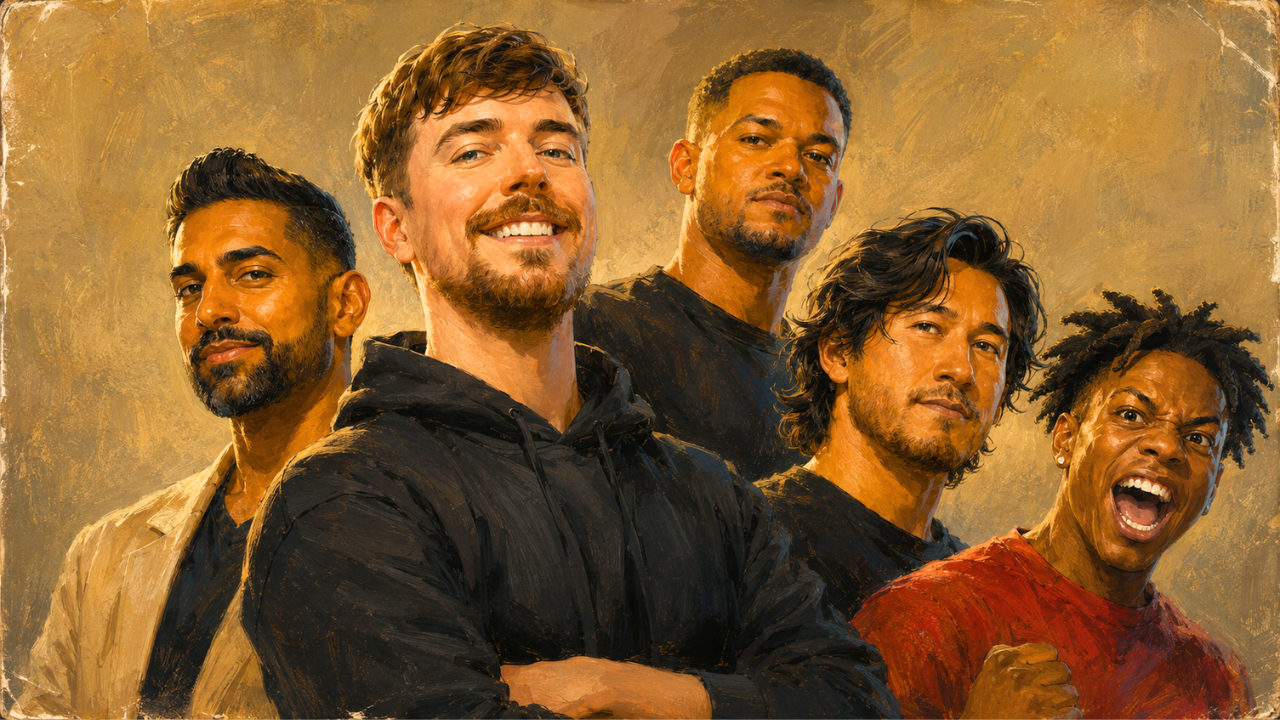
The collective earnings of the top 50 content creators globally have crossed the $1 billion threshold for the first time, signaling a fundamental transformation in media economics. This milestone is not merely a reflection of rising audience scale; it represents a structural shift from a labor-based monetization model to an equity-driven, multi-channel capital allocation model. Traditional analysis attributes this growth to vague notions of audience engagement and viral distribution. In reality, the financial consolidation at the apex of the creator economy is governed by two interconnected economic forces: the power-law distribution of digital attention and the operational scaling of zero-marginal-cost intellectual property.
To analyze the mechanisms driving this $1 billion benchmark, the creator business model must be broken down into three distinct revenue layers, each possessing unique margin profiles and scalability constraints. Discover more on a related subject: this related article.
The Tri-Tier Creator Monetization Framework
+-----------------------------------------------------------------+
|                   EQUITY & PROPRIETARY BRANDS                   |
|  Margin: Variable (20-40%) | Scalability: Infinite/Uncapped     |
+-----------------------------------------------------------------+
                                 ▲
+-----------------------------------------------------------------+
|                DIRECT AUDIENCE MONETIZATION (D2C)               |
|  Margin: High (70-90%)     | Scalability: Linear to Audience    |
+-----------------------------------------------------------------+
                                 ▲
+-----------------------------------------------------------------+
|               ATTENTION ARBITRAGE (Platform Ad-Share)           |
|  Margin: Fixed (45-55%)    | Scalability: Bound by Algorithm    |
+-----------------------------------------------------------------+
Layer 1: Attention Arbitrage (Platform Ad-Share and Direct Sponsorships)
This layer comprises AdSense, platform creator funds, and traditional brand integrations. It functions as a baseline utility. The revenue is bound linearly to platform algorithms and views. The platform dictates the take-rate (typically 45% to 55%), meaning creators at this stage are subject to platform risk and margin compression.
Layer 2: Direct Audience Monetization (D2C Subscriptions and Digital Products)
By transitioning audiences from third-party platforms to owned channels (such as paid newsletters, private communities, and specialized software), elite creators bypass the platform tax. The gross margins here are exceptionally high, often exceeding 80%, as the marginal cost of distributing digital products approaches zero. More analysis by Reuters Business highlights related perspectives on this issue.
Layer 3: Enterprise Equity and Proprietary Brands
The final layer involves leveraging attention as a customer acquisition engine for physical goods, consumer packaged goods (CPG), or software-as-a-service (SaaS) companies owned directly by the creator. This converts transient attention into enterprise value and equity upside. The entry of the top 50 creators into the nine-figure aggregate earnings tier is driven almost entirely by the mastery of this third layer.
The Asymmetric Capital Advantage of Elite Content Systems
The primary bottleneck for traditional consumer brands is the Customer Acquisition Cost (CAC). For an enterprise to scale, it must continuously deploy capital into advertising channels to acquire new users. Top-tier creators operate with a structural CAC of effectively zero. By utilizing organic content creation as a continuous, self-funding marketing engine, they invert the traditional corporate cost function.
$$CAC_{\text{Creator}} \approx 0$$
The content creation process itself is funded by Layer 1 (AdShare and sponsorships), meaning the creator is paid to acquire the attention that is subsequently funneled into Layer 3 businesses. The capital that a traditional business would allocate to performance marketing is instead retained as net profit or reinvested directly into product development and supply chain optimization.
This creates a compounding feedback loop:
- High-volume content production generates platform-funded revenue.
- The platform algorithms distribute the content, driving zero-cost impressions.
- A percentage of these impressions convert into highly loyal customers for the creator's proprietary brand.
- The increased enterprise revenue funds higher-production-value content, raising barriers to entry for smaller competitors.
This mechanism explains the severe wealth concentration within the industry. The top 50 creators do not just earn more because they have more followers; they earn exponentially more because they possess the infrastructure to capture the full economic value of those followers.
Structural Bottlenecks and Key Deprivation Risks
Despite unprecedented revenue aggregation, the creator-led enterprise model is constrained by distinct operational vulnerabilities that threaten long-term stability.
The Founder-Keyman Dependency
The core asset of a creator business is the individual's likeness and personal brand equity. Unlike traditional corporations, where the chief executive can be replaced with minimal impact on product demand, the creator's physical presence is tightly coupled with the brand’s valuation. If the creator faces reputational damage or ceases production due to burnout, the customer acquisition engine stalls immediately.
Platform Liquidity and Algorithmic Arbitrary Shifting
The foundational layers of the creator stack rely entirely on rented land. Algorithms optimize for user retention, not creator longevity. A single modification to a platform's distribution architecture can result in an overnight decline in organic reach of 30% to 50%. Top earners mitigate this through aggressive cross-platform diversification and the immediate migration of users to owned databases (email lists, SMS registries).
Supply Chain and Operational Execution Deficits
Transitioning from a media company to a physical goods enterprise introduces complexities for which most creator teams are ill-equipped. Inventory mismanagement, quality control failures, and logistics bottlenecks represent severe operational risks. The collapse of several creator-led cosmetics and apparel lines over the past 36 months highlights the danger of scaling demand without establishing institutional-grade supply chains.
Data-Driven Segmentation of the Top 50 Creators
To understand the composition of the $1 billion collective revenue, the underlying cohort dynamics must be analyzed. The top 50 cohort is not homogeneous; it divides cleanly into three operational archetypes, each utilizing a distinct monetization mix.
| Archetype | Primary Platform Engine | Core Revenue Mix | Key Scale Factor |
|---|---|---|---|
| The Enterprise Builder | YouTube, TikTok | 70% Proprietary CPG/SaaS, 30% Media | Supply chain optimization, retail distribution partnerships |
| The Media Network | Podcasts, Substack | 50% High-ticket Sponsorships, 50% Direct Subscriptions | Intellectual property licensing, catalog monetization |
| The Gamified Streamer | Twitch, YouTube Live | 40% Live Endorsements, 40% Fan Funding, 20% Merchandise | High-frequency, high-duration audience attention |
The data indicates that the Enterprise Builder segment accounts for over 55% of the aggregate $1 billion total. This concentration confirms that pure-play media companies are being financially outperformed by physical and digital product companies that use media solely as a distribution vector.
Tactical Reconfiguration for Mid-Tier Scalability
For operators and organizations seeking to replicate the financial velocity of the top 50 cohort, the path requires moving away from vanity metrics like view counts toward optimizing revenue-per-mille (RPM) metrics across the entire audience funnel.
Step 1: Decentralize Personal Likeness from Content Formats
The business must systematically introduce formats where the primary creator is not the sole point of failure. This involves hiring ancillary talent, developing animated or narrative-driven content IP, and building community-led sub-platforms. The objective is to decouple the media asset from the creator’s daily labor.
Step 2: Establish an In-House Customer Acquisition Engine
Stop relying on platform ad-share as a primary income stream. Treat platform views as raw, unstructured data. Convert this data into structured assets by incentivizing audiences to opt into owned ecosystems through premium gated content, utility-driven digital toolkits, or early access programs.
Step 3: Align with Institutional Operational Partners
Instead of attempting to build supply chains, manufacturing plants, or software platforms from scratch, creators must form joint ventures with established operators. The creator provides the distribution engine and brand direction; the institutional partner provides logistics, regulatory compliance, and capital infrastructure. This model minimizes execution risk while preserving the creator’s equity upside.
The Institutionalization of the Creator Class
The transition past the $1 billion collective earnings mark indicates that the creator economy is entering its institutional phase. Over the next 18 months, private equity firms and traditional media conglomerates will increasingly move from passive brand sponsors to active acquirers of creator-led enterprises. The primary valuation metric will shift from basic audience reach to data-backed retention rates and proprietary brand equity.
Monetization models will continue to bifurcate. Creators who rely exclusively on platform ad-share and third-party sponsorships will face declining margins as ad-spend demands deeper attribution metrics. Conversely, creators who successfully build integrated ecosystems—where content functions as a self-sustaining marketing arm for owned enterprises—will capture an increasingly disproportionate share of the global media landscape's profits. The future belongs not to the most famous individuals, but to those who build the most resilient capital structures on top of their fame.