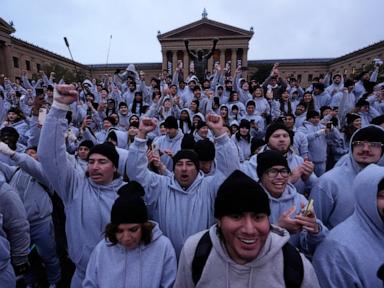
Mass fan gatherings that break world records operate as high-efficiency cultural marketplaces rather than spontaneous public celebrations. When hundreds of devotees of the Rocky film franchise converge at the Philadelphia Museum of Art to set an official attendance or costume record, the event demonstrates how intellectual property owners, municipal tourism boards, and independent organizers convert nostalgia into measurable economic and media yield. Most coverage treats these assemblies as human-interest novelty pieces, missing the underlying operational mechanics of crowd mobilization, Guinness World Records verification protocols, and place-based destination marketing.
To understand how a localized gathering around a 1976 film achieves global media distribution and formal record status, we must analyze the structural drivers that turn passive viewers into active physical participants. The mobilization relies on three interlocking components: spatial anchoring, low-barrier participation mechanics, and third-party verification arbitrage.
The Three Pillars of Intellectual Property Mobilization
Spatial Anchoring and Symbolic Gravity
A mass gathering requires a physical coordinate that holds concentrated narrative equity. In Philadelphia, the 72 stone steps of the Philadelphia Museum of Art function as a permanent physical anchor for the Rocky franchise. Unlike temporary convention halls or generic public squares, an iconic filming location reduces customer acquisition costs for event organizers because the site already commands organic daily foot traffic.
The physical geography dictates crowd flow and density. The plaza at the base of the steps provides an open staging area capable of absorbing high pedestrian volume without requiring extensive temporary infrastructure, while the elevation of the steps creates a natural amphitheater for visual documentation. When organizers schedule an assembly at a high-equity landmark, they capitalize on existing tourist behavior—specifically, the pre-existing habit of visitors running up the steps and raising their arms—and synchronize those individual actions into a single, timestamped collective event.
Low-Barrier Participation Mechanics
World record attempts fail when the cost of compliance exceeds the participant's enthusiasm. If an event demands complex choreography, expensive proprietary merchandise, or multi-day attendance, conversion rates collapse. Successful Rocky gatherings solve this by lowering the participation threshold to ubiquitous, low-cost items: gray sweatpants, hoodies, black beanies, or boxing gloves.
This low barrier creates a network effect. Because the required uniform is accessible to casual fans and tourists alike, spectators on the periphery can convert into official participants within minutes. This elasticity in crowd sizing allows organizers to scale attendance rapidly in the final hours before official counting begins, protecting the event against weather disruptions or transit delays.
Third-Party Verification Arbitrage
A gathering of 500 people in gray tracksuits is a local curiosity; the exact same gathering certified by an official adjudicator becomes a syndicated international news asset. Record-keeping bodies like Guinness World Records sell institutional validation. By paying for official adjudication and adhering to strict evidentiary rules, organizers purchase a news hook that media outlets treat as an objective fact rather than a promotional stunt.
This verification arbitrage shifts the burden of distribution from paid advertising to earned media. Wire services, broadcast networks, and digital publications routinely syndicate world record milestones because the "record-breaking" framing satisfies editorial criteria for novelty and definitive outcomes.
The Verification Bottleneck and Operational Constraints
Setting a formal crowd record is an exercise in logistics and compliance, not merely enthusiasm. Standard media narratives ignore the rigid auditing mechanisms required to turn a crowd into a certified statistic.
To pass audit protocols, organizers must manage four distinct operational variables:
- Perimeter Containment: Unbounded crowds cannot be counted accurately. Organizers must establish physical barriers—typically stanchions or tape—with controlled entry and exit points to ensure no participant is double-counted and no unverified bystanders pollute the sample.
- Uniformity Compliance: Every participant inside the containment zone must meet strict dress or action criteria. If the record requires a specific costume configuration, stewards must inspect entrants at the gate. A failure rate exceeding a narrow margin (often 5% to 10% depending on the specific record category) can invalidate the entire count.
- Duration Thresholds: Adjudicators enforce minimum time locks. Participants must remain within the designated zone and maintain the required pose or attire for a continuous block, usually five to ten minutes, while independent witnesses verify headcounts.
- Photographic and Video Evidence: High-resolution aerial or elevated footage must capture the entire containment zone simultaneously, providing a permanent audit trail that corroborates the manual clicker counts of ground stewards.
These constraints introduce severe friction. If registration bottlenecks delay entry, early arrivals may abandon the containment zone before the clock starts, dropping the headcount below the target threshold. Consequently, the success of a record attempt depends more on queue management and steward-to-participant ratios than on the popularity of the underlying film franchise.
The Cost Function of Civic Destination Marketing
Municipal tourism agencies, such as Visit Philadelphia, evaluate events through a cost-per-impression and visitor-spending framework. Traditional destination advertising—billboards, television spots, and digital display campaigns—requires continuous capital expenditure with diminishing marginal returns. Once the ad spend stops, visibility drops to zero.
A record-breaking fan gathering alters this cost function by generating durable media assets. Photographs and broadcast clips of hundreds of fans replicating the Rocky training montage on the museum steps circulate across global news feeds and social platforms at zero incremental media cost to the city.
The economic return operates across two distinct timelines:
- Immediate Direct Spend: Out-of-town participants generate measurable hotel room nights, food and beverage revenue, and local transit fares during the event window. Even local attendees contribute to commercial velocity in the surrounding Museum District.
- Long-Term Brand Reinforcement: Every syndicated image reinforces Philadelphia’s association with grit, underdog resilience, and accessible cultural tourism. This strengthens the city's competitive positioning against rival East Coast destinations like New York, Boston, and Washington, D.C., which possess larger museum budgets and broader international flight networks.
However, relying on a nearly five-decade-old intellectual property carries strategic risk. Cultural nostalgia depreciates as original audiences age. While Creed sequels have successfully transferred franchise equity to younger demographics, over-indexing on a single fictional character can obscure a city's broader contemporary cultural, culinary, and economic assets. Tourism boards must balance nostalgia-driven stunts with investments in modern cultural infrastructure to avoid positioning the city purely as a heritage theme park.
Executing Repeatable Fan Mobilization
Organizations seeking to replicate this model—whether for film anniversaries, sports franchises, or consumer brands—cannot rely on organic fan passion alone. They must engineer the mobilization using a disciplined sequence.
First, audit existing organic behaviors. Do not invent an artificial ritual; identify what fans already do spontaneously at a specific location and formalize it into a synchronized group action. Second, select a record category with minimal equipment friction, prioritizing standard apparel or simple gestures over complex props that cause inspection delays at containment gates. Third, lock in media distribution partners before the event occurs, providing broadcast networks with elevated camera positions and pre-packaged B-roll to guarantee immediate syndication upon verification. Finally, capture first-party data at the containment perimeter—using QR-code waivers or digital check-ins—so the temporary physical crowd converts into a permanent, marketable digital audience once the barriers come down.