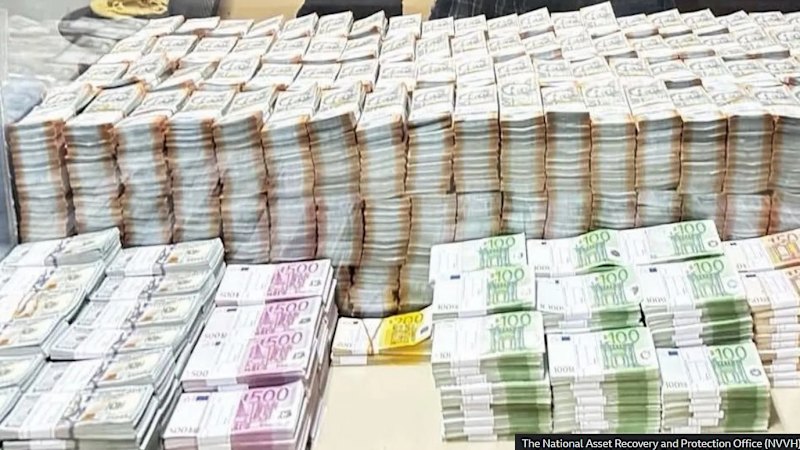
The discovery of $30 million in physical currency—a portion buried in Hungarian forests—exposes a fundamental operational failure in illicit financial logistics. Standard reporting treats subterranean cash stashes as sensational anomalies. In reality, burying currency is a predictable terminal state when an illicit network generates liquidity faster than its laundering infrastructure can absorb it. To understand why sophisticated actors resort to primitive physical concealment in Central Europe, one must analyze the structural friction of bulk currency management, the physics of volumetric storage, and the institutional vulnerabilities of cross-border procurement networks.
The Liquidity-Laundering Bottleneck
Every large-scale bribery scheme faces an inverse scaling problem. As the dollar value of a kickback increases, the marginal utility of the currency decreases unless the recipient possesses an equally scalable mechanism to integrate those funds into the legitimate financial system.
In high-level public procurement or regulatory capture schemes, payouts frequently occur in physical banknotes to sever the digital audit trail. While electronic transfers leave permanent cryptographic or ledger footprints across SWIFT networks and domestic clearinghouses, physical cash offers immediate, untraceable bearer-instrument settlement. Yet this initial security advantage creates an immediate downstream bottleneck: the placement problem.
Anti-Money Laundering (AML) protocols under European Union directives require rigorous Customer Due Diligence (CDD) and Suspicious Activity Reporting (SAR) for cash deposits exceeding standard thresholds. When a syndicate extracts $30 million in physical currency, it cannot simply deposit the funds into commercial banking channels without triggering automated compliance flags. If the network lacks pre-existing front companies with high legitimate cash turnover—such as large hospitality groups, construction conglomerates, or cash-intensive retail chains—the liquidity becomes trapped.
When placement capacity is exceeded, the network enters a state of forced hoarding. The cash ceases to function as capital and reverts to a physical liability that requires active security, climate control, and spatial concealment.
The Physics and Logistics of $30 Million
To evaluate the operational burden of holding $30 million in physical currency, one must quantify its physical footprint. Illicit operators rarely have the luxury of uniform, mint-condition high-denomination notes; even when they do, the mass and volume present severe logistical constraints.
- Weight and Volume Mechanics: A standard United States $100 bill weighs approximately one gram. Thirty million dollars in $100 bills consists of 300,000 individual notes, weighing exactly 300 kilograms (661 pounds). Stacked tightly without air gaps, 300,000 notes occupy roughly 0.34 cubic meters—the equivalent of three to four standard carry-on suitcases packed to capacity.
- Currency Denomination Variance: In the Eurozone and neighboring Central European jurisdictions, the phase-out of the €500 banknote in 2019 drastically increased the physical volume required for bulk cash storage. If a portion of the $30 million equivalent is held in €100 or €200 notes, or in domestic Hungarian Forint (HUF) where the largest banknote is 20,000 HUF (worth roughly $50 to $55 depending on exchange rates), the weight and volume double or triple. Holding $30 million in 20,000 HUF notes requires approximately 550,000 to 600,000 banknotes, pushing the weight past half a metric ton.
- Environmental Degradation: Paper and cotton-linen banknotes are organic substrates vulnerable to moisture, mold, and insects. Burying currency in forest soil introduces immediate biological decay risks. Unless the cash is vacuum-sealed in multi-layer barrier films and encased in watertight high-density polyethylene (HDPE) containers, subterranean humidity will destroy the structural integrity of the notes within months, rendering them unspendable even if recovered.
The decision to bury currency in wooded terrain indicates that the holders lacked access to secure, non-attributable indoor storage—such as private vaults, safety deposit boxes registered under nominee entities, or shielded commercial real estate. Subterranean caching is a desperate measure used when operators anticipate imminent law enforcement raids and prioritize asset preservation over immediate liquidity.
Anatomy of the Bribery Supply Chain
Large-scale cash seizures of this magnitude rarely stem from isolated street-level extortion. They are typically the byproduct of systemic extraction within state-adjacent sectors, infrastructure contracts, or tax-evasion syndicates. In Central Europe, where significant capital flows through European Union structural funds and state-managed procurement, bribery ecosystems generally operate through a three-tier architecture.
- The Extraction Layer: Corrupt officials, procurement officers, or regulatory gatekeepers manipulate tender specifications, inflate contract valuations, or overlook tax liabilities. In exchange, winning contractors agree to kick back a fixed percentage—often ranging from 10% to 30%—of the contract value.
- The Aggregation Layer: Contractors cannot pull $30 million out of corporate accounts without falsifying their own ledgers. They utilize networks of shell subcontractors, fake invoicing schemes, and circular trading loops to convert legitimate corporate funds into untraceable cash. These aggregators collect physical currency from multiple operational nodes and consolidate it for delivery to the primary beneficiaries.
- The Custodial Layer: Once consolidated, the cash is transferred to trusted couriers or custodians responsible for storage and distribution. The Hungarian seizure reveals a critical failure at this third layer. When custodians are forced to divide and bury funds across rural locations, it signals that internal trust within the syndicate has fractured or that external surveillance has compromised their urban safe houses.
Operational Vulnerabilities of Subterranean Caching
From a counter-fraud and law enforcement perspective, moving cash into rural burial sites introduces acute operational vulnerabilities that do not exist when funds remain inside complex corporate structures.
- Geospatial Surveillance and Pattern Analysis: Moving 300 to 600 kilograms of physical cargo requires vehicles, multiple trips, and specific geographic access points. Modern investigative units cross-reference cellular tower pings, automatic license plate recognition (ALPR) data, and vehicle telematics against known suspects. Repeated nocturnal trips to remote forestry roads create an unmistakable behavioral anomaly.
- The Single-Point-of-Failure Problem: Unlike digital ledgers protected by multi-signature encryption, buried cash relies entirely on physical secrecy. Anyone who witnesses the burial—or any mid-level courier who turns state's evidence to avoid a lengthy prison sentence—can lead investigators directly to the coordinates. Once the physical site is breached, asset forfeiture is instantaneous and total. There are no offshore appellate courts or nominee directors to delay seizure.
- Re-entry Friction: Cash buried in a forest is effectively demonetized until it is exhumed, cleaned, counted, and injected back into an economic circuit. Every time the custodian accesses the cache to withdraw operating funds, they re-expose the location to physical surveillance.
Strategic Implications for Compliance and Enforcement
The Hungarian bribery probe demonstrates that while corrupt networks can successfully bypass front-end financial controls through physical cash settlements, they remain structurally vulnerable to basic logistical friction. Financial intelligence units (FIUs) and corporate compliance officers often over-index on complex digital tracking while underestimating the physical constraints of bulk currency.
To dismantle similar illicit architectures, enforcement agencies and institutional risk teams must shift focus from post-facto bank monitoring to upstream procurement anomalies and physical cash-generation choke points.
- Target the Aggregation Layer: Investigators should focus forensic accounting resources on second- and third-tier subcontractors in public infrastructure and state-backed projects. High ratios of cash withdrawals relative to documented payroll or material expenses serve as reliable leading indicators of illicit cash aggregation.
- Monitor High-Denomination Currency Flows: Central banks and commercial clearing institutions should track localized spikes in demand for high-denomination notes (€200, $100, and top-tier domestic notes) within specific geographic regions or corporate banking branches.
- Exploit Custodial Friction: Because bulk cash cannot be moved quickly without leaving a physical and digital trail, investigative teams should synchronize physical surveillance with sudden regulatory or audit pressure. Applying acute legal pressure to mid-level financial aggregators forces the custodial layer into panicked, observable relocation behaviors—such as transporting heavy containers to remote terrain—where traditional policing methods can intercept the assets directly.