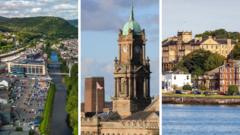
The Department for Culture, Media and Sport (DCMS) shortlisting of 15 municipalities for the inaugural 2028 UK Town of Culture title signals a tactical shift in regional economic policy. Selecting a narrow cohort from nearly 400 applicants, the initiative seeks to duplicate the macroeconomic windfall observed in past UK City of Culture iterations. However, applying a municipal growth model built for metropolitan hubs to smaller urban ecosystems introduces severe structural asymmetries. Without rigorous capital optimization and long-term asset management, the underlying deployment mechanism risks generating transient consumption spikes rather than permanent productivity gains.
The operational architecture of the competition categorizes candidates by demographic volume rather than economic profile:
- Small Towns (Under 20,000 residents): Ilfracombe, Isle of Bute, Lerwick, Sandown, Strabane, and Stockton Town Centre Ward.
- Medium Towns (20,000 – 75,000 residents): Corby, Great Yarmouth, Leith, Pontypridd, and Port Talbot.
- Large Towns (Over 75,000 residents): Basildon, Birkenhead, Grimsby, and Rotherham.
Each shortlisted locality receives an immediate £60,000 development grant to formulate a comprehensive program proposal. The independent judging panel, led by Sir Phil Redmond, will isolate one finalist per demographic tier. Early next year, a single overall winner will be awarded a £3 million capital injection for a 2028 cultural program, while the remaining two category finalists receive £250,000 in secondary funding.
The strategy behind this intervention rests on a clear financial transmission mechanism: direct public funding works as seed capital to lower the risk for private investment, stimulate local demand, and build sustainable infrastructure. Evaluating whether this mechanism succeeds requires looking at how public spending converts into real, long-term economic growth.
The Capital Allocation Bottleneck
A primary structural challenge of the Town of Culture framework lies in the compressed timeline of the capital deployment cycle. The ultimate winner receives a £3 million lump sum alongside an expectation to scale up domestic tourism and service sector output within a single calendar year. In corporate finance, rapid deployment of capital into underdeveloped infrastructure routinely yields decreasing marginal returns due to localized capacity bottlenecks.
The economic trajectory of previous City of Culture designations, such as Hull in 2017 and Coventry in 2021, demonstrates that sudden demand shocks can overwhelm regional hospitality, transit, and commercial networks. For a mid-sized locality like Pontypridd or a geographically isolated region like the Isle of Bute, the capacity of local businesses to absorb heightened demand is structurally constrained.
When demand vastly outstrips local capacity, the capital injection risks causing localized inflation within the service supply chain rather than expanding real economic output. Shortlisted towns must design their upcoming proposals around a multi-stage capital absorption model:
[Direct Public Funding (£3M)]
               │
               ▼
[Tier-1 Asset Allocation: Physical Infrastructure Refurbishment]
               │
               ▼
[Tier-2 Service Scaling: Local Supply Chain Capacity Building]
               │
               ▼
[Tier-3 Demand Capture: Sustainable Inbound Tourism & Retail Expansion]
By prioritizing the strengthening of local supply chains before launching major promotional campaigns, municipalities can prevent capital flight—where the financial benefits slip away to external suppliers and contractors.
The Substitution Effect and Regional Displacement
A major oversight in simple municipal growth strategies is failing to account for the substitution effect. When evaluating cultural investments, analysts often assume that tourist spending represents entirely new economic activity. In reality, regional tourism frequently reflects a geographical displacement of existing domestic spending rather than the acquisition of net-new international capital.
If an influx of consumers visits Birkenhead during its potential tenure as Town of Culture, a significant percentage of those consumer expenditures are diverted from adjacent economies like Liverpool or Wirral's broader periphery. The net macroeconomic benefit across the wider regional ecosystem approaches zero if the intervention merely shifts capital from one postal code to another.
To achieve genuine economic additionality, the final cultural programs must position their assets to attract non-local, premium spending. For example, Port Talbot cannot rely solely on standard domestic arts programming; it must position its deep industrial heritage to attract specialized, high-margin educational and heritage tourism. The objective must focus on extending visitor stay-times and increasing average spend-per-head, converting day-trippers into overnight consumers who inject fresh capital into local hotels, restaurants, and retail networks.
Quantifying the Return on Culture Metric
The standard evaluation metrics used by regional authorities—such as footfall counts, social media impressions, and unweighted public sentiment surveys—fail to measure long-term fiscal health. True structural transformation requires analyzing changes in the underlying local asset base. Municipalities must track specific economic indicators across a five-year post-designation horizon to accurately evaluate the return on investment:
| Metric Category | Primary Analytical Indicator | Targeted Structural Outcome |
|---|---|---|
| Commercial Real Estate Asset Valuation | Commercial vacancy rates and yield compression in designated cultural zones. | Sustained private sector commercial density. |
| Labor Market Re-skilling | Rate of professional growth in digital media, project management, and hospitality tech. | Upward pressure on average weekly earnings. |
| Private Capital Leverage Ratio | Volume of external co-investment secured per pound of direct DCMS funding. | Reduced reliance on public sector financial support. |
The true value of the initial £60,000 grant lies in establishing these analytical baselines. Towns that build rigorous data collection mechanisms into their immediate planning will be far better positioned to prove their operational readiness to the independent judging panel.
Designing the Strategic Proposal
Shortlisted municipal leadership teams must avoid the trap of generic storytelling. Winning proposals will read like investment prospectuses, clearly connecting cultural initiatives to measurable economic outcomes.
First, towns must identify and protect their distinct competitive advantages. For instance, Great Yarmouth should not attempt to replicate Leith’s urban contemporary arts profile; instead, it should focus on optimizing its existing coastal tourism infrastructure to support year-round commercial activity.
Second, the structural plans must prioritize dual-use infrastructure projects. Spending the £3 million grant on temporary stages or ephemeral exhibitions yields a near-total capital write-off by year two. Instead, funding must target the modernization of permanent physical assets, such as retrofitting historic municipal buildings into flexible creative workspaces, or installing digital infrastructure that local businesses can use long after the 2028 designation ends.
Finally, councils must establish independent, special-purpose vehicles (SPVs) to manage the delivery phase. Removing financial administration from standard bureaucratic channels ensures agile project management, rapid procurement cycles, and insulation from shifting political priorities. These corporate structures provide private investors with a transparent, accountable counterparty, which helps maximize the inflow of matching private capital during the development phase.