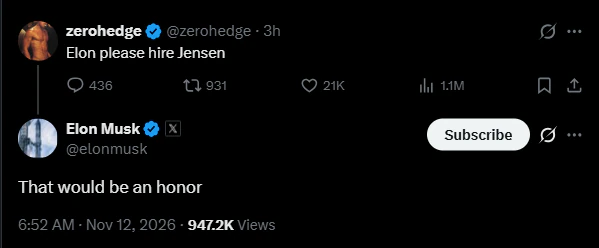
Elon Musk did not offer Jensen Huang a job because Nvidia is about to fire its co-founder. He made the remark on social media to signal alignment with the one executive holding the physical keys to artificial intelligence infrastructure, reminding Wall Street and Washington that Musk's companies—xAI and Tesla—are Nvidia's most aggressive, indispensable customers.
The headline-grabbing post was classic Silicon Valley theater, yet the mechanics underneath it expose a high-stakes dependency. At a moment when Nvidia sits at the center of the global semiconductor supply chain, Musk’s public nod to Huang was less a recruitment pitch and more a public display of mutual reliance.
The Anatomy of a Viral Social Media Signal
To understand why a single post from Elon Musk sends shockwaves through financial media, you have to look at how he uses his platform. Over the past decade, Musk has turned casual replies on X into market-moving events, corporate recruiting tools, and geopolitical commentary. When a user speculated or joked about Nvidia’s board ever ousting Huang—a scenario bordering on corporate fiction given Nvidia's historic valuation surge—Musk replied with a brief confirmation that he would hire him immediately.
It was a throwaway line. It took seconds to type. Yet within hours, aggregators turned that five-word sentiment into breaking news about executive poaching.
Seasoned industry observers know better than to read Musk's posts literally. Unlike traditional Fortune 500 chief executives who filter every public statement through investor relations and legal counsel, Musk operates in real time. His replies serve multiple functions at once:
- Public flattery of a critical supplier whose hardware allocation dictates the timeline of his own AI ambitions.
- Signaling to institutional investors that xAI and Tesla sit at the very front of the line for next-generation silicon.
- Reinforcing a founder-centric worldview where technical founders are treated as irreplaceable assets, contrasted against corporate boards that Musk frequently criticizes as overly bureaucratic.
Why Nvidia Firing Jensen Huang Is Pure Fiction
Any serious analysis of this exchange has to start with corporate governance reality. Jensen Huang co-founded Nvidia in 1993 and has served as its president and chief executive ever since. Under his tenure, the company transitioned from a maker of PC graphics cards into the dominant supplier of accelerated computing hardware for artificial intelligence data centers.
Boards fire chief executives when stock prices collapse, product roadmaps stall, or scandals threaten the enterprise. None of those conditions exist at Nvidia. Huang commands immense loyalty from both his engineering ranks and institutional shareholders. Suggesting Nvidia might fire Huang is roughly equivalent to suggesting Apple might have fired Steve Jobs at the height of the iPhone rollout. The premise exists solely as an internet thought experiment, which Musk capitalized on to score a quick rhetorical point.
The Billion-Dollar Hardware Dependency Driving the Bromance
Strip away the social media banter, and what remains is a massive commercial relationship built on scarcity and capital expenditure. Musk is currently fighting a multi-front war in artificial intelligence, and every single front requires tens of thousands of high-end graphics processing units.
At xAI, Musk built the Colossus supercomputer cluster in Memphis, Tennessee, scaling to 100,000 Nvidia H100 GPUs in record time before immediately expanding toward 200,000 chips. Meanwhile, Tesla relies on massive Nvidia GPU clusters to train its Full Self-Driving neural networks and develop software for its Optimus humanoid robot.
Hardware is the bottleneck. Money alone cannot buy immediate delivery when every hyperscaler on earth—Microsoft, Meta, Google, and Amazon—is competing for the exact same wafer capacity at Taiwan Semiconductor Manufacturing Company.
When supply is constrained, relationships matter. Huang himself has publicly praised Musk’s engineering velocity, noting in interviews that Musk’s teams stand up massive data center infrastructure in weeks rather than the years required by traditional enterprise buyers. By publicly praising Huang and jokingly offering him a landing spot, Musk reinforces a public bond between buyer and supplier that pays dividends when new chip architectures like Blackwell and Rubin begin shipping in limited initial quantities.
The Mutual Leverage Between Musk and Huang
This is not a one-way street where Musk begs for chips. Musk provides Nvidia with something equally valuable: a ruthless, fast-moving customer willing to deploy cutting-edge hardware at extreme scale before competitors finish their procurement paperwork.
| Strategic Asset | What Musk Gains from Huang | What Huang Gains from Musk |
|---|---|---|
| Hardware Priority | Early access to constrained GPU allocations for xAI and Tesla. | Massive, upfront capital commitments for next-gen architectures. |
| Validation | Unmatched compute density to rival OpenAI and Google DeepMind. | Real-world stress-testing of massive GPU clusters at record speed. |
| Market Narrative | Validation from the semiconductor industry's undisputed leader. | High-profile proof that sovereign and private AI clusters scale fast. |
When xAI brings a 100,000-GPU cluster online in a few months, it serves as the ultimate live demonstration of Nvidia’s networking, InfiniBand interconnects, and software stack. Huang uses Musk’s execution speed as a benchmark to push other enterprise customers to move faster.
The History of Silicon Valley Executive Poaching Theater
Publicly offering jobs to rival or allied executives is an old Silicon Valley tactic, though usually conducted behind closed doors over quiet dinners in Woodside or Palo Alto. Bringing it into the public square changes the dynamic entirely.
History offers plenty of examples where founder-CEOs were pushed out, only to return or build rival empires. Steve Jobs was forced out of Apple in 1985, founded NeXT, and returned a decade later to save the company. Jack Dorsey was pushed out of Twitter before returning as CEO years later. Sam Altman was briefly ousted by OpenAI’s board in late 2023, sparking an immediate offer from Microsoft CEO Satya Nadella to hire Altman and his entire research team within forty-eight hours.
Nadella’s move during the OpenAI crisis was a genuine, tactical strike designed to capture talent during a moment of corporate chaos. Musk’s comment about Huang is the exact opposite. There is no boardroom coup at Nvidia. There is no succession crisis. Instead, Musk borrowed the visual language of an executive rescue mission to flatter an ally.
How Founder Solidarity Shapes Tech Culture
There is also an ideological current running through Musk’s comment. Over the past several years, Musk has been locked in bitter legal and public battles over corporate governance, executive compensation, and board oversight—most notably the prolonged Delaware court battle over his 2018 Tesla compensation package.
In Musk’s worldview, visionary technical founders are constantly at risk of being undermined by short-sighted boards, activist investors, or bureaucratic inertia. By declaring he would immediately hire Huang if Nvidia ever let him go, Musk was subtly reinforcing a broader thesis: technical founders are the sole engines of value creation, and any board foolish enough to part ways with one deserves to lose its competitive edge.
What Happens If the Alliance Ever Fractures
For all the public warmth between Musk and Huang, their long-term strategic interests are not permanently aligned. In the technology sector, today’s best customer frequently becomes tomorrow’s direct competitor.
Tesla is already designing and deploying its own custom silicon. The company’s Dojo supercomputer project was built specifically to reduce reliance on Nvidia for vision-based neural network training, while Tesla's inference chips inside its vehicles are custom-engineered in-house. Musk has repeatedly stated that Tesla will continue buying as many Nvidia GPUs as Huang can sell him, while simultaneously hedging his bets through internal chip development.
xAI faces similar economic pressures over time. Training frontier models on tens of thousands of third-party GPUs carries astronomical capital costs and leaves the buyer exposed to Nvidia’s steep gross margins. As xAI matures, the financial incentive to design custom application-specific integrated circuits (ASICs) for AI inference—mirroring Google’s TPUs or Amazon’s Trainium chips—will grow stronger.
The Reality of Custom Silicon vs Nvidia's Moat
Building a competitive AI chip is brutally difficult, and replacing Nvidia requires far more than matching raw teraflops on a spec sheet. Nvidia’s real fortress is CUDA, the proprietary software platform and programming model that developers have spent nearly two decades optimizing.
- Software Lock-In: Millions of engineers write code natively for CUDA, making migration to custom hardware slow and bug-prone.
- Networking Integration: Nvidia does not just sell chips; it sells entire data center architectures via NVLink and InfiniBand switches that allow thousands of GPUs to act as a single processor.
- Annual Cadence: Huang shifted Nvidia to a one-year product release cycle, meaning any competitor designing a custom chip targets a moving goalpost that advances every twelve months.
Musk knows these technical realities better than almost anyone. He understands that custom silicon like Dojo is a long-term hedge, not an immediate replacement. Until internal hardware can match Nvidia’s full-stack performance, keeping Huang close remains an operational necessity.
How Investors and Readers Should Filter Tech Headlines
The gap between what actually happened—a brief social media reply—and how it gets packaged across news feeds highlights a recurring trap in modern business journalism. Aggregators thrive on friction, conflict, and hypothetical drama. Turning a complimentary quip into a story about executive hiring distorts the actual business mechanics at play.
When evaluating viral executive exchanges, look past the personalities and follow the capital expenditure. Watch where the purchase orders go, track which companies receive the earliest shipments of next-generation server racks, and monitor quarterly earnings transcripts for mentions of supply constraints. Musk did not extend a serious job offer to Jensen Huang because Jensen Huang will never need one, and the real story is far simpler: the richest man in the world is making sure the most important chipmaker in the world knows his checks will always clear first.