The tech press is currently choking on its own narrative. Mainstream commentators are rushing to print the same lazy headline: Sam Altman won, Elon Musk lost, and the jury has validated the commercial transformation of OpenAI.
They are fundamentally misreading the board.
In high-stakes corporate warfare, a courtroom loss is frequently a structural victory. While the media celebrates a superficial verdict for Altman’s Microsoft-backed machine, they are blind to the reality that Musk just achieved his actual, unstated objective. He didn't need a legal judgment to break OpenAI's core asset. He needed discovery, public scrutiny, and the permanent destruction of their moral monopoly on artificial general intelligence.
By forcing OpenAI to defend its pivot from an altruistic open-source research lab to an aggressive, profit-maximizing corporate entity in front of a jury, Musk stripped away the company's most valuable shield: its saintly founding myth.
The Illusion of Altman's Victory
The consensus view treats this verdict as a total vindication of OpenAI’s restructuring. The logic goes that because a jury didn't hit Altman with massive financial damages or force a reversion to a pure non-profit model, the status quo remains intact.
This is a profound misunderstanding of how intellectual property, talent acquisition, and venture capital interact in Silicon Valley.
I have watched boards spend tens of millions of dollars defending bad operational pivots just to save face. They call it a win when they escape a courtroom without a liquidation order. But look closer at what this trial exposed. The internal communications entered into the public record revealed an organization plagued by structural hypocrisy.
The defense didn't win by proving OpenAI stayed true to its original 2015 mission. They won by arguing that the original mission was an idealistic, non-binding pipe dream that had to be abandoned to survive.
- The Myth: OpenAI changed to fund the massive compute required for AGI.
- The Reality: The restructure was a coordinated capture of open-source research by closed-source capital.
By winning on those grounds, Altman didn't protect OpenAI's reputation; he codified its cynicism.
The Core Misconception: "Musk Wanted the Money"
The most flawed premise clogging the "People Also Ask" sections of search engines right now is some variation of: Did Elon Musk sue OpenAI to get a payout?
If you think a billionaire with a direct line to global manufacturing infrastructure and space dominance cares about a minority stake payout from a capped-profit subsidiary, you are playing the wrong game. Musk’s currency isn't cash; it's systemic leverage.
Let's dissect the actual mechanics of the dispute. Musk injected early capital, recruited top-tier talent like Ilya Sutskever, and established the brand's initial credibility. When Altman and Greg Brockman realized that training multi-billion parameter models required Microsoft’s Azure infrastructure, they built a complex, multi-tiered corporate structure to bypass the non-profit charter.
[Original Non-Profit Board]
          │
          ▼
[Capped-Profit LLC] ──► [Microsoft $13B+ Investment]
          │
          ▼
[Commercial Enterprise]
Musk’s lawsuit was a surgical strike designed to force this exact architecture into the light. He forced OpenAI to argue, under oath, that their altruistic charter was a secondary concern next to commercial viability.
The downside for Musk? A minor legal bill and some transient negative press from tech bloggers. The upside? He completely neutralized OpenAI's ability to claim the moral high ground in Washington and Brussels. Every time Sam Altman sits in front of a congressional committee advocating for regulatory moats disguised as "safety protocols," opposing lobbyists now have a mountain of court-verified evidence proving OpenAI operates primarily as an extension of Microsoft’s enterprise cloud business.
The Talent Drain and the Death of the Non-Profit Halo
Engineers do not join non-profits for the stock options. They join them for the mission.
Conversely, engineers do not join hyper-commercial tech giants for the mission; they join them for the liquidity events.
For years, OpenAI enjoyed the ultimate talent acquisition arbitrage: they recruited world-class researchers who wanted to save humanity, then compensated them with equity vehicles that rivaled Wall Street. It was a brilliant, hypocritical recruiting loop.
This trial permanently shattered that loop. By legally cementing OpenAI as a standard commercial competitor, the jury stripped away the ideological premium that allowed Altman to underpay or over-work talent on the promise of a higher calling. Now, OpenAI has to compete for talent strictly on a dollar-for-dollar basis against Google, Meta, and Musk’s own xAI.
And in a straight cash-and-compute war, the advantage shifts heavily away from an organization tied up in complex corporate governance structures and toward agile, single-purpose entities.
Redefining the Intellectual Property Moat
Let’s answer the wrong question everyone is asking: Does this verdict mean closed-source AI won?
Absolutely not. The verdict actually accelerates the commoditization of the underlying models.
When OpenAI defended its decision to withhold weights and code by citing safety, the market saw through the rhetoric. The trial made it undeniable that proprietary models are kept under lock and key to protect investor margins, not to prevent global catastrophe.
This realization has supercharged the open-source movement. Meta's Llama ecosystem, Mistral, and decentralized compute networks are expanding exponentially because the developer community now views proprietary AI providers as hostile gatekeepers rather than benevolent guardians.
Consider the mathematical reality of model development:
$$Cost_{Training} \propto Scale^{2}$$
As training costs scale quadratically with model size, proprietary companies must charge higher rent to users to recoup their infrastructure investments. Open-source models, subsidized by tech giants looking to commoditize their competitors' complements, drive the cost of intelligence toward zero.
By forcing OpenAI to drop the mask of philanthropy, the lawsuit accelerated the developer migration toward open architectures. Musk’s xAI open-sourced Grok not out of pure kindness, but to weaponize the developer community against Altman’s closed ecosystem.
The Strategic Blueprint for the Industry
Stop reading the post-game analysis from commentators who have never negotiated a term sheet or managed a cap table. If you want to survive the coming consolidation wave in artificial intelligence, you need to ignore the verdict and look at the structural fallout.
Build on Complements, Not Dependencies
If your enterprise application relies entirely on an API call to a single proprietary model, you do not have a business; you have a feature that can be turned off by a board change at a vendor. Diversify across open-source deployments that you control locally.
Ruthlessly Audit "Safety" Claims
When vendors tell you they are restricting access or limiting functionality due to ethical alignment, audit their infrastructure. Nine times out of ten, "alignment" is corporate speak for compute optimization or legal liability mitigation. Treat it as a commercial constraint, not an ideological imperative.
Capitalize on the Elite Talent Relocation
The cultural schism within OpenAI is not over. The trial proved that the idealists lost. There is a massive tier of elite researchers inside the company who are deeply disillusioned by the nakedly commercial reality confirmed by this verdict. Hunt for them. They are looking for exits to projects that either offer true open-science purity or unencumbered, hyper-aggressive commercial execution—not the messy compromise in between.
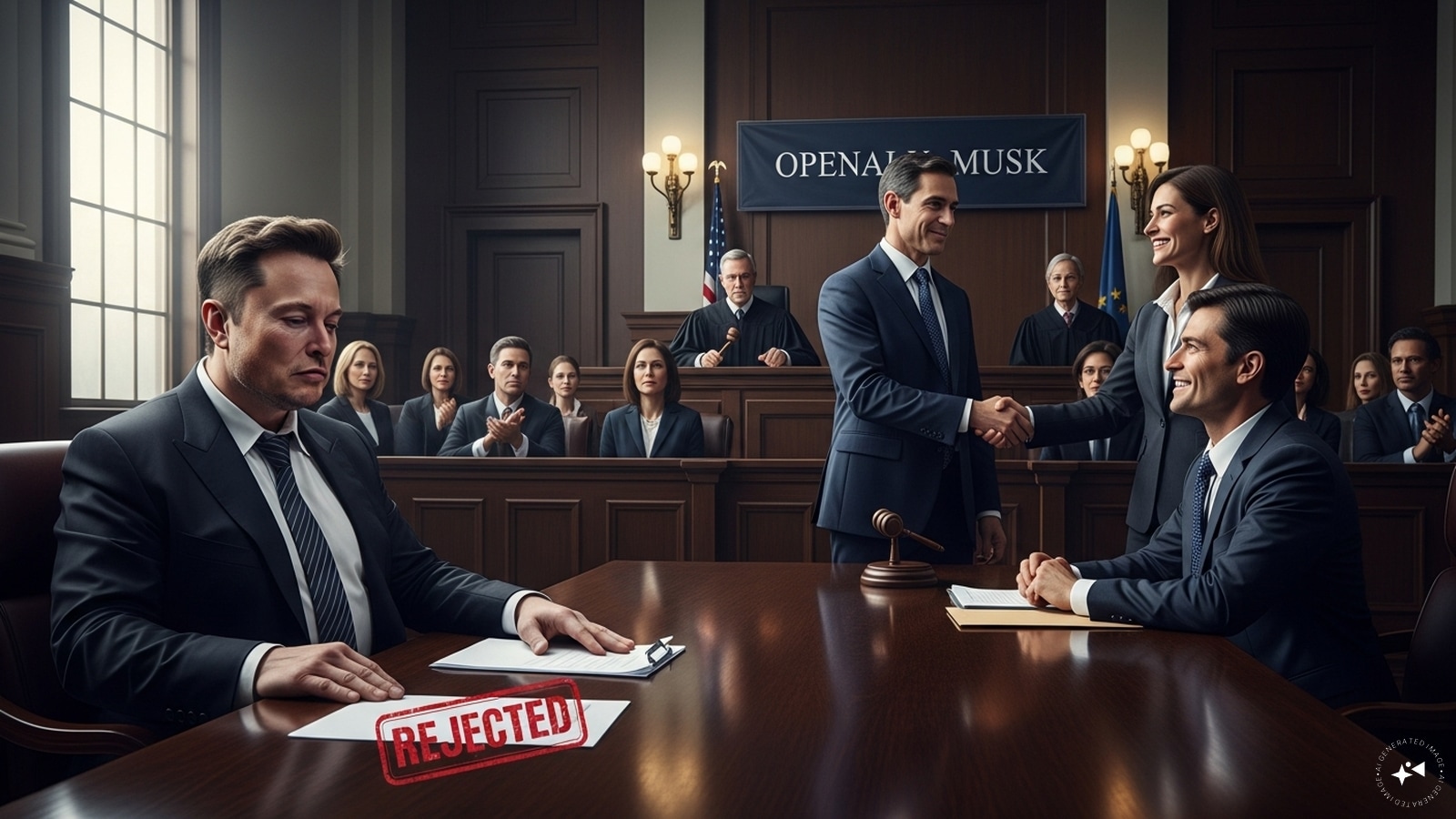
The press will continue to cover the courtroom handshake. They will analyze Altman’s smile and Musk’s tweets. They will declare a winner based on who paid the court fees.
Meanwhile, the chess pieces have moved exactly where they were intended to go. OpenAI is no longer a public trust; it is just another defense contractor in the Silicon Valley ecosystem, stripped of its mythos, fighting off antitrust scrutiny, and forced to compete on equal ground.
Musk lost the battle. The war just became a lot more level.