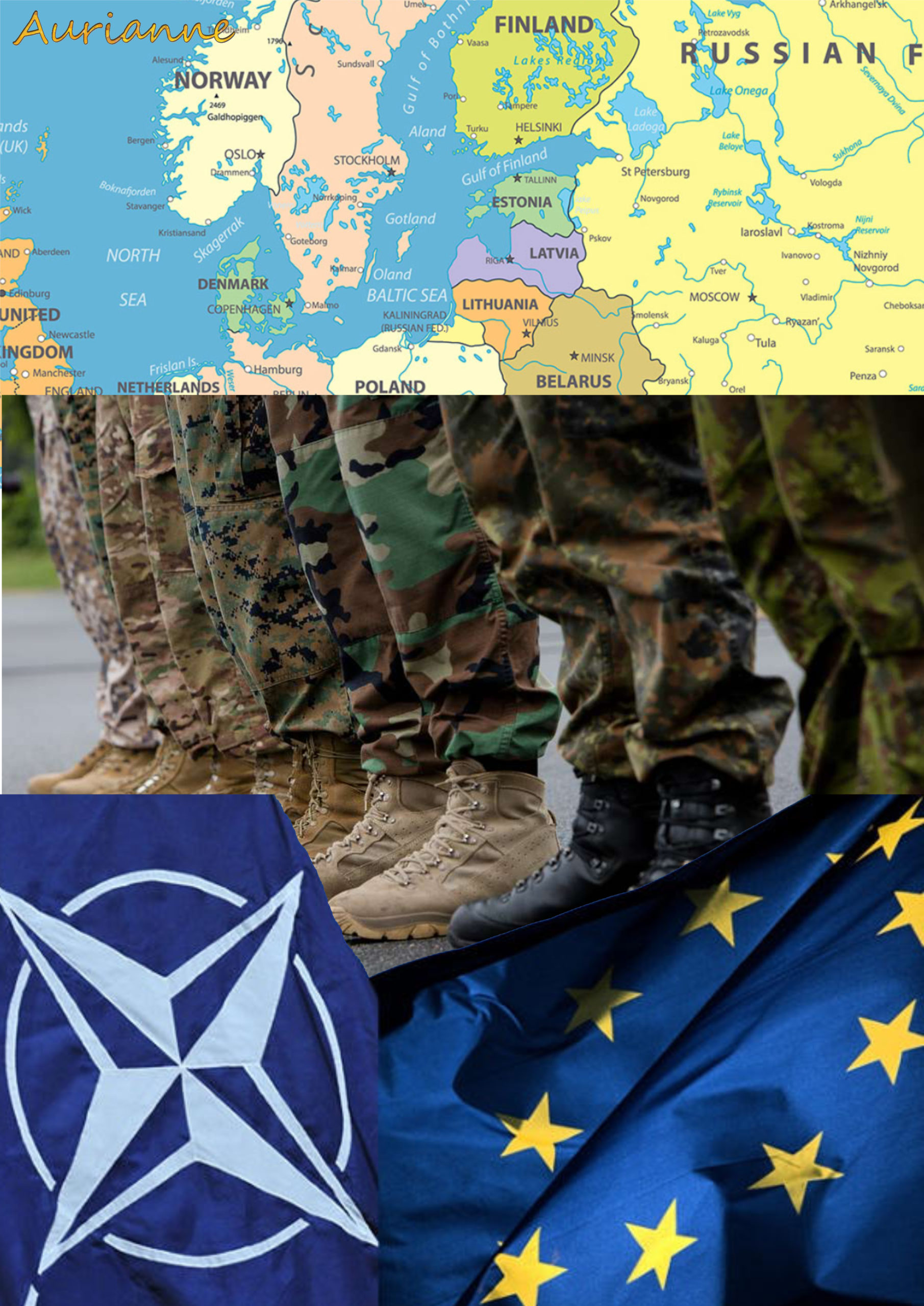
The coffee in the plastic cup has gone cold, but the colonel doesn't notice. He is staring at a digital map of the Suwalki Gap, a thin strip of land connecting Poland to the Baltic states. For decades, the shadow over this map was cast by a giant—an American giant. But in this hypothetical exercise in a basement in Brussels, the giant has walked out of the room. The chair is empty. The radar screens are flickering.
For seventy-five years, the North Atlantic Treaty Organization has been described as a tripod. One leg is European economic power. The second is a shared democratic history. The third, and by far the heaviest, is the American security guarantee. If you saw off that third leg, the conventional wisdom says the whole thing should come crashing down.
It doesn't.
Instead, the remaining legs groan, shift, and find a new, jagged balance. It is a terrifying transition, but the physics of survival are remarkably resilient. To understand why a post-American NATO remains a formidable force, we have to stop looking at the Pentagon's budget and start looking at the steel mills of the Ruhr, the shipyards of La Spezia, and the silent, lethal efficiency of a Swedish submarine sliding through the brackish water of the Baltic.
The Myth of the Paper Tiger
There is a persistent ghost story told in Washington and Moscow alike: that without the United States, Europe is a defenseless museum. This narrative is comfortable for those who like clear-cut power dynamics, but it ignores the cold, hard reality of the European arsenal.
Take a hypothetical officer named Elena. She is a logistics commander in the German Bundeswehr. In the old world, her job was to wait for the Americans to fly in the heavy lifting. In this new, leaner reality, she is looking at a continent that, even without the U.S., outspends Russia on defense by a factor of nearly three to one.
The numbers are startling when you strip away the American multi-trillion-dollar behemoth. Combined, the European members of NATO possess over 1.5 million active-duty personnel. They operate some of the most sophisticated fighter jets ever built, like the Eurofighter Typhoon and the French Rafale. They possess more than 2,000 main battle tanks.
The problem has never been a lack of "stuff." The problem has been the "glue."
Historically, the United States provided the satellite architecture, the mid-air refueling, and the high-level command structure that allowed a dozen different languages and military cultures to act as a single organism. Without the U.S., Elena doesn't lose her tanks; she loses the ability to talk to the Polish tanks ten miles to her left.
The transformation we are seeing now isn't about buying more bullets. It is about building a European "brain" to replace the American one. This is happening through the rapid adoption of "Joint All-Domain Command and Control" systems—digital networks that allow a French drone to feed data directly to a German artillery battery. It is less about brawn and more about the nervous system.
The Nuclear Silence
There is a specific kind of silence that falls over a room when you mention the "Nuclear Umbrella." For half a century, Europe slept under a blanket of American Minuteman missiles. If that blanket is pulled back, the air gets very cold, very fast.
But the room isn't empty.
France and the United Kingdom are nuclear powers. Their stockpiles are small compared to the thousands of warheads held by the Kremlin, but nuclear deterrence is not a game of high scores. It is a game of "enough." In the grim logic of MAD—Mutually Assured Destruction—having 500 warheads instead of 5,000 doesn't make you ten times more vulnerable. It simply means you can only destroy the enemy's fifty largest cities instead of their five hundred.
The deterrent remains.
Consider the "Force de Frappe," the French nuclear strike force. Unlike the American system, which is tied to a global strategy, the French doctrine has always been centered on "vital interests." If a post-American NATO shifts its center of gravity toward Paris and London, the calculation for an aggressor changes. They are no longer wondering if a president in Washington will risk New York for Tallinn. They are wondering if a Prime Minister in London will risk London for Riga.
The stakes become more intimate. More desperate. And in many ways, more believable.
The Great Integration
The real strength of a European-led NATO isn't found in a military parade. It is found in the boring, bureaucratic depths of standardized screw threads and shared fuel lines.
For years, the U.S. was the primary shopkeeper. Everyone bought American because American tech was the gold standard. But this created a dependency. Now, we see a shift toward "Strategic Autonomy." It sounds like a dry policy term, but for a soldier on the ground, it means something visceral: it means your spare parts are coming from a factory three hundred miles away in Czechia, not three thousand miles away in South Carolina.
The European defense industry is a sleeping giant that is finally rubbing its eyes. From the Leopard tanks of Germany to the K9 howitzers being produced in massive quantities in Poland through South Korean partnerships, the continent is becoming an arsenal in its own right.
This shift creates a different kind of power. It is a decentralized, horizontal power. If the American model was a hub-and-spoke system with Washington at the center, the new NATO is a web. Webs are harder to break. You can snap a spoke and the wheel wobbles. You can tear a section of a web and the rest of the structure still holds its prey.
The Baltic Shield
Let’s move from the abstract to the salt spray of the Baltic Sea. With the recent accession of Finland and Sweden, the Baltic has effectively become a "NATO Lake."
Imagine a Russian submarine commander trying to slip out of St. Petersburg. In the past, he worried about American attack subs. Now, he has to worry about the Swedish Gotland-class submarines—vessels so quiet they once "sunk" a U.S. aircraft carrier in a war game exercise. These subs were designed specifically for the shallow, cluttered waters of the Baltic. They are the ultimate home-turf advantage.
Sweden and Finland didn't just bring more soldiers; they brought a "Total Defense" culture. In these countries, the human element is the primary weapon. Every citizen is part of the defense plan. Every basement is a potential shelter; every bridge is wired for a specific purpose.
This is the "pretty damn strong" reality that critics often miss. A post-American NATO wouldn't try to project power in the South China Sea or the Middle East. It would focus with singular, terrifying intensity on its own borders. It would be a porcupine: small, prickly, and absolutely impossible to swallow without lethal consequences.
The Cost of the Empty Chair
We cannot pretend this transition would be bloodless or easy. The "Invisible Stakes" are the decades of trust that the U.S. provided. The Americans were the honest broker. When Greece and Turkey bristled at each other, it was often a phone call from the White House that lowered the temperature. Without that mediator, the internal frictions of Europe could become sparks.
There is also the matter of intelligence. The "Five Eyes" network and the vast American satellite constellation provide a god-like view of the battlefield. Europe can build its own satellites—and it is—but you cannot build thirty years of institutional memory overnight.
The transition would be a period of profound vulnerability. It would be the moment the lobster sheds its shell to grow a larger one. For a few years, the soft tissue is exposed.
Yet, look at the resolve triggered by the war in Ukraine. Countries that hadn't met their 2% GDP defense spending goals for decades hit them in eighteen months. Poland is on track to have the most powerful land army in Europe. The Baltic states are spending like their lives depend on it—because they do.
The fear of American abandonment is doing what decades of American pleading couldn't: it is forcing Europe to grow up.
The New Front Line
In a small town on the Estonian border, a volunteer guardsman stands watch. He has a day job in IT. He has a wife and two daughters. He knows that if the tanks come, he is the first line of defense.
He doesn't look toward the Atlantic anymore. He looks toward Warsaw, Helsinki, and Berlin.
The strength of this new alliance isn't found in the grandeur of a superpower's global reach. It is found in the grim, quiet determination of neighbors who realize there is no one left to call. They have to be enough for each other.
The American giant might leave the room, taking its massive shield and its thundering voice. But the people left at the table are not victims. They are the heirs to centuries of martial history, backed by the largest integrated economy on earth, and driven by the most powerful motivator known to man: the preservation of their own homes.
The chair is empty, the room is quieter, but the door is barred from the inside. And it is stronger than it looks.
The map on the wall hasn't changed, but the hands holding the compass are no longer trembling. They are steady, local, and ready to draw the line in the dirt.