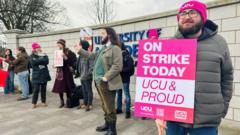
The North Sea wind doesn’t just blow in Aberdeen; it bites. It carries the scent of salt and ancient granite, swirling around the heavy stone arches of King’s College. Usually, this wind competes with the frantic chatter of students rushing to seminars or the rhythmic clicking of heels on cobblestones. Today, the air is thick with a different sound. It is the rhythmic, haunting thrum of a picket line.
Ten days.
That is the span of the current strike action. To a casual observer, it is a line of people in thick coats holding cardboard signs. To the University of Aberdeen administration, it is a logistical headache involving rescheduled exams and angry emails from parents. But for Dr. Elena Rossi—a hypothetical composite of the dozens of lecturers currently standing in the freezing drizzle—those ten days represent a breaking point that has been years in the making.
Elena didn’t enter academia for the money. Nobody does anymore. She entered for the "spark"—that fleeting moment in a lecture hall when a student’s eyes widen because they’ve finally grasped the nuance of a 14th-century manuscript or a complex chemical reaction. But lately, that spark has been buried under a mountain of precarious contracts, eroding pensions, and a workload that feels less like teaching and more like an endless shift in a knowledge factory.
The Mechanics of a Breaking Heart
The conflict at Aberdeen isn't an isolated tantrum. It is a microcosm of a systemic collapse across UK higher education. The University and College Union (UCU) members aren't just walking out over a few percentage points on a paycheck. They are striking against the "gig-ification" of the ivory tower.
Consider the numbers. While university vice-chancellors often command salaries upwards of £300,000, a significant portion of the teaching staff exists on "fixed-term" or "casual" contracts. Imagine trying to inspire the next generation of engineers or doctors while wondering if you’ll be able to pay your rent in four months. The insecurity is a low-frequency hum in the background of every research paper and every grading session. It is the invisible tax on the soul of the educator.
The University of Aberdeen, an institution that has stood since 1495, is currently caught in a vice. On one side, the relentless pressure of a marketized education system demands efficiency and "student-customer" satisfaction. On the other, the humans who actually deliver that education are being squeezed until they have nothing left to give. The ten days of strikes starting this week are the sound of that vice finally cracking.
The Student in the Middle
Walk past the picket line and you’ll find the students. Their position is agonizingly complex. They have paid thousands of pounds for an education that is currently being delivered in fragmented bursts. Some are angry. They feel like collateral damage in a war they didn't start.
But listen to a third-year history student standing near the edge of the crowd. Let’s call him Callum. Callum isn't shouting at his professors. He’s bringing them coffee.
"I'm paying for their expertise," Callum says, his breath visible in the cold air. "If my lecturer is too stressed to sleep because they’re worried about their pension being slashed by 35%, I’m not getting the education I paid for anyway. A burned-out teacher is just a ghost in a gown."
This is the hidden truth of the Aberdeen strikes. The interests of the staff and the students are becoming inextricably linked. The "learning conditions" of the student are exactly the same thing as the "working conditions" of the staff. When the university cuts staff costs to balance a ledger, they aren't just saving money. They are thinning the very fabric of the academic experience.
The Myth of the Ivory Tower
There is a popular misconception that academics live sheltered lives, insulated from the "real world" by tenured positions and dusty libraries. That world died decades ago. Today’s academic is a project manager, a mental health first-aider, a fundraiser, and an administrator, often all before lunch.
The strike is a desperate attempt to reclaim the "ivory tower" not as a place of elitism, but as a space where thought has value. When staff at Aberdeen walk out, they are protesting the transformation of a sanctuary of learning into a high-stakes real estate firm that happens to grant degrees.
The tension escalated recently when the university announced potential redundancies in certain departments, specifically targeting the languages and humanities. It sent a shockwave through the granite city. If a 500-year-old institution decides that learning French or Gaelic is no longer "economically viable," what does that say about our definition of a university? It suggests that we no longer value the pursuit of knowledge for its own sake, but only for its immediate ROI.
The Cold Math of the Picket Line
The administration argues that the strikes are "disruptive and regrettable." They point to the financial pressures facing the entire sector—inflation, the freezing of domestic tuition fees, and the volatile nature of international student recruitment. They aren't lying about the pressure. The math is cold.
But the staff argue that the math is being applied to the wrong variables. They see shiny new buildings going up while their real-term wages have plummeted by nearly 20% over the last decade. They see a management structure that has grown bloated while the number of people actually standing in front of students remains stagnant or shrinks.
It is a story of two different languages. Management speaks the language of "sustainability" and "strategic realignment." The staff speak the language of "dignity" and "intellectual integrity." These two dialects are currently incompatible.
The Silence in the Library
On a strike day, the Sir Duncan Rice Library at Aberdeen is eerily quiet. Usually, it is a beehive of late-night cramming and whispered coffee dates. When the staff are gone, the building feels like a hollow shell. It serves as a reminder that a university is not its architecture. It is not its brand. It is the collective energy of people who have dedicated their lives to the difficult, often thankless task of thinking deeply.
The ten days of action are a gamble. Every day on strike is a day of lost pay for workers who, in many cases, are already struggling. It is a sacrifice of the present to protect a future that feels increasingly precarious.
The standoff at Aberdeen is a signal flare. It is a warning that the current model of higher education is running on fumes. You can only ask people to do more with less for so long before the "more" becomes impossible and the "less" becomes nothing.
The picket line isn't just about a 2024 or 2025 contract. It is a battle for the soul of the Scottish Enlightenment. It is a question of whether we still believe that a society is measured by how it treats those who guard its knowledge.
The wind continues to howl across the campus. The signs are getting soggy. But the line holds. Because for Elena, Callum, and the hundreds of others standing in the granite shadow, the only thing more expensive than striking is staying silent. The empty lectern speaks louder than any lecture ever could. It says that something is broken, and it can’t be fixed with a press release. It can only be fixed by seeing the humans behind the grades.