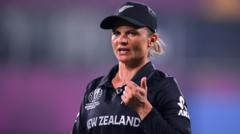
The architecture of New Zealand cricket is about to lose its most vital pillar. Suzie Bates, the prolific opening batter and former captain who has defined the White Ferns for two decades, has officially announced her retirement from international cricket. Her departure will take effect following the conclusion of the ICC Women’s T20 World Cup in England, scheduled for June and July 2026. This isn't just a veteran stepping aside; it is the closing chapter of a 20-year odyssey that saw women’s cricket transform from a neglected amateur pastime into a professionalized global powerhouse.
Bates has spent half her life in a New Zealand jersey. Since her debut as an 18-year-old against India in 2006, she has remained an immovable object at the top of the order, accumulating records that defy the standard shelf life of an elite athlete. Her decision to walk away after the World Cup in England is a calculated final mission. She isn't fading into the background; she is aiming to go out while holding a trophy in the very country where she has spent years as a mainstay of the domestic circuit. In other news, we also covered: UCLA Roster Churn and the Myth of the Transfer Portal Dynasty.
The Statistical Giant
To understand why this retirement sends such a shockwave through the sport, one must look at the sheer weight of the numbers. Bates is not merely a "great" player; she is statistically one of the most productive human beings to ever pick up a cricket bat.
In the shortest format, she stands alone. Her 4,717 T20 International runs make her the most prolific run-scorer in the history of the women's game. To put that in perspective, she was the first player—male or female—to cross the 3,000-run threshold in T20 internationals. In the One Day International (ODI) arena, she has amassed 5,964 runs, featuring 13 centuries. At the time of her announcement, she sits just 188 runs shy of Mithali Raj’s all-time record for total international runs in the women's game. Yahoo Sports has also covered this important subject in extensive detail.
- Total International Matches: 362 (as of April 2026)
- International Centuries: 14
- International Wickets: 145
- Years of Service: 20 (2006–2026)
The endurance required to maintain this level of performance across 362 matches is staggering. She has outlasted generations of teammates and opponents alike, serving as the bridge between the era of white skirts and the era of the Women’s Premier League (WPL) and the Hundred.
Beyond the Boundary
The "why" behind her retirement is less about a loss of form and more about the completion of a cycle. At 38, Bates has survived the physical toll of being a multi-sport athlete. Many forget that she was a dual-international, representing New Zealand in basketball at the 2008 Beijing Olympics. When she eventually chose cricket over the court, she brought a basketballer’s agility and spatial awareness to her fielding, becoming one of the most reliable pair of hands in the deep.
Her captaincy from 2011 to 2018 was marked by a relentless pursuit of professionalism. She took over a team that was often an afterthought in the New Zealand sporting landscape and demanded the standards of a high-performance unit. While she eventually stepped down to focus on her own game, the culture she built paved the way for the current crop of stars like Amelia Kerr and Sophie Devine.
The timing of this exit is no accident. By choosing the 2026 T20 World Cup in England, Bates is returning to a place that feels like a second home. She has been a frequent flyer in English county cricket and the Hundred, building a massive local following. Retiring in front of sold-out crowds at grounds like Lord’s or The Oval is a far cry from the empty parklands where she started her career.
The Unfinished Business
Despite her mountain of individual accolades, Bates remains haunted by the near-misses. She was a runner-up at the 2009 and 2010 T20 World Cups and was a central figure in the 2024 championship-winning squad in the UAE. However, the 2026 tournament represents a chance to secure back-to-back titles and cement the White Ferns' status as a dynasty.
Her teammates describe her as the "Grandma" of the team—a nickname she wears with pride. It reflects her role as a mentor who has seen it all. When New Zealand faces England, Ireland, and the West Indies in the group stages this June, they won't just be playing for a trophy. They will be playing to give their greatest-ever servant the exit she deserves.
Impact on the White Ferns Pipeline
The "how" of replacing Suzie Bates is a question New Zealand Cricket (NZC) hasn't had to answer for two decades. You do not simply replace 10,000 international runs and a world-class off-spin option.
Her departure creates a massive vacuum at the top of the order. While Amelia Kerr has evolved into one of the world's best all-rounders, she lacks the specific veteran stability that Bates provides in the powerplay. The immediate future for the White Ferns involves a high-risk transition period. NZC will likely have to accelerate the development of younger prospects from the Otago Sparks, Bates' home domestic side, but the reality is that no one in the current system possesses her unique combination of power and longevity.
Cricket is a game of cycles, and the Bates cycle has been longer and more fruitful than almost any other in the history of the sport. She has been the face of New Zealand cricket through its evolution from a fringe interest to a televised spectacle. When the final ball of the 2026 World Cup is bowled, a massive part of the sport’s institutional memory will walk off the field with her.
She leaves behind a game that looks nothing like the one she entered in 2006. That, perhaps, is her greatest legacy.