The engines do not cool down before the doors open again.
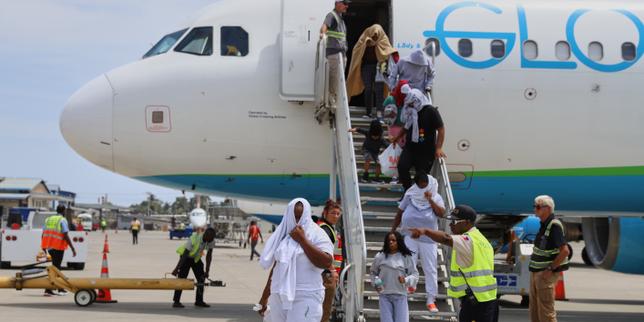
On the concrete apron of the airport in Port-au-Prince, the heat hits like a physical blow—heavy, thick with the scent of jet fuel, dust, and open air. For the men and women stepping down the metal stairs, clutching transparent plastic bags containing whatever meager belongings they were allowed to gather, this is not a homecoming. This is an expulsion. If you found value in this article, you should look at: this related article.
They left months, sometimes years ago. They crossed rivers, paid smugglers with money borrowed from aunts and neighbors, walked through the green hell of the Darién Gap, and slept in muddy tent cities under the shadow of razor wire at the southern border of the United States. They held onto a single, fragile idea: safety. A chance to work. A chance to send money back to a kitchen that had been empty for days.
Now, the tarmac burns beneath their shoes. For another angle on this story, check out the recent coverage from NPR.
Behind them, the aircraft waits to refuel and return north. Before them lies a city where the streets are governed not by police, but by armed coalitions whose checkpoints shift by the hour. Hospitals lack gauze. Schools are barricaded. The state itself is a ghost.
To look at immigration policy from a desk in Washington or Geneva is to see columns of numbers. A spreadsheet rows down neatly: 500 removed on Tuesday, 1,200 on Thursday. It is efficient. It is administrative. It is clean. But human beings are not data points. When you strip away the bureaucratic vocabulary—the repatriations, the deportations, the expedited removals—what remains is a profound, echoing tragedy of closed doors and unraveled lives.
Consider Jean.
Jean is not a real man, but he is every man standing on that tarmac. In his pocket, he carries a smartphone with a cracked screen. Inside it are photographs of his two daughters, ages four and seven, taken in a cramped apartment in Ohio where the heat rattled through the radiators every morning. For six months, Jean worked night shifts in a commercial laundry, folding sheets until his fingers cramped. He paid taxes using an individual taxpayer identification number. He never missed a shift. He knew the names of the cashiers at the corner bodega.
When immigration enforcement agents knocked on his door at dawn, Jean did not run. He knew the math. There was nowhere to run that wouldn't eventually lead back to this exact moment.
Now, Jean stands beneath the blazing Haitian sun, wondering how to explain to his mother—who lives in a wooden shack with a corrugated tin roof that leaks whenever the tropical storms roll in—that he is back. Not because he wanted to return. Not because he saved enough money to build a better house. But because a government three thousand miles away decided that his presence on their soil was an administrative irregularity that needed correcting.
The numbers tell a story of scale, but they conceal the mechanics of desperation.
Since the assassination of President Jovenel Moïse, Haiti has slid deeper into a multifaceted crisis that defies easy categorization. It is not merely a political vacuum; it is a total collapse of the civic fabric. Gangs control the ports, the highways, the fuel depots. Kidnappings are a morning commute risk. In this environment, returning thousands of citizens in rapid succession is not just a logistical challenge—it is pouring gasoline onto a smoldering ruin.
When international bodies and human rights organizations raise alarms, governments often shrug. Sovereignty, they argue, demands border control. Every nation has the right to determine who crosses its threshold. That is the legal reality. But legality and morality exist in an uneasy, often violent tension.
When you return a person to a territory where their life is in immediate, documented danger, you are participating in a chain of events that you can see, even if you choose to look away.
The flights keep landing.
Passengers emerge blinking into the harsh light. Some kneel and kiss the ground, though whether it is out of genuine relief to be home or the sheer psychological trauma of survival is impossible to tell. Others stand frozen, paralyzed by the realization that the money they spent on the journey—money their extended family spent years scraping together—is gone, vanished into the ether of coyote fees, bail bonds, and plane tickets paid for by a deportation order.
Debt in Haiti is hereditary in spirit, if not in law. When you borrow from a local moneylender at thirty percent monthly interest to send your son north, the debt does not evaporate just because the son is sent back. It compounds. It settles over a family like a shroud.
And so, the cycle resets.
Within weeks of returning, many of those who are expelled begin to calculate the impossible once more. They look at the empty cupboards. They listen to the gunfire echoing from the nearby neighborhood. They weigh the immense, terrifying risks of the jungle trail against the absolute certainty of starvation at home. The deterrence policy fails because the alternative—staying put—is viewed not as a hardship, but as a slow-motion sentence.
We like to think of borders as walls, as absolute dividers between order and chaos. But they are more like membranes, permeable to capital, ideas, and despair, yet stubbornly resistant to the human tide that seeks nothing more than a secure place to sleep.
The people on those planes are not invaders. They are neighbors, workers, parents, and children caught in the gears of a global economic machine that craves their labor while rejecting their presence.
The engines wind down. The stairs are pulled away. The cabin crew prepares for the next flight north, empty of passengers, ready to start the machinery over again. In the distance, beyond the perimeter fence of the airport, the traffic of Port-au-Prince churns in the dust, indifferent and waiting.