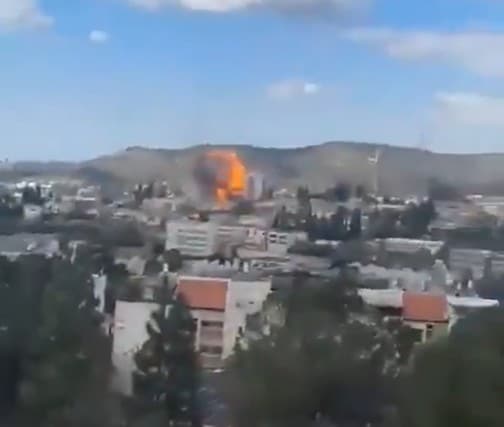
The kinetic strike on Beit Shemesh, resulting in eight confirmed fatalities, represents a fundamental shift in Iranian power projection from "strategic patience" to "active deterrence." While traditional reporting focuses on the immediate casualty count and the emotional weight of the retaliatory cycle following the assassination of Ali Khamenei, a rigorous strategic analysis must evaluate this event through the lens of escalation ladders and missile defense saturation thresholds. This strike is not merely a reactive spasm; it is a calculated test of Israel's multi-layered defense architecture and a signal of changed engagement rules in the Levant.
The Triad of Iranian Retaliatory Logic
To understand the strike on Beit Shemesh, one must deconstruct the three primary drivers governing Tehran’s current military posture. For another look, see: this related article.
- Regime Continuity and Internal Signaling: The death of a Supreme Leader creates a temporary vacuum of perceived authority. Kinetic action serves as a "resolve signal" to domestic hardliners and the Islamic Revolutionary Guard Corps (IRGC) rank-and-file, ensuring that the transition period is not viewed as a window of vulnerability.
- Saturation as a Strategic Variable: The efficacy of the Iron Dome and David’s Sling is predicated on interceptor-to-target ratios. By targeting a location like Beit Shemesh—situated between the high-density population centers of Jerusalem and Tel Aviv—Iran forces the Israel Defense Forces (IDF) to make resource-allocation decisions in real-time.
- The Deterrence Restoration Function: Iran's objective is to re-establish a "cost-plus" pricing model for Israeli operations. If the cost of an assassination remains diplomatically or kinetically low, the frequency of such operations increases. By inflicting high-digit civilian casualties, Iran attempts to reset the threshold for future high-value target (HVT) eliminations.
Technical Analysis of the Kinetic Event
The breach of the missile defense shield in the Beit Shemesh sector suggests a failure of either technical detection or interceptor density. Israeli defense systems operate on a probability-of-kill ($P_k$) formula, where multiple interceptors are often fired at a single incoming threat to ensure a near-100% success rate.
$$P_{sys} = 1 - (1 - P_k)^n$$ Related coverage regarding this has been shared by BBC News.
In this equation, $n$ represents the number of interceptors. When Iran utilizes a "salvo fire" tactic, they attempt to drive $n$ toward zero for specific projectiles by overwhelming the tracking radar’s capacity or exhausting the ready-to-fire interceptor magazines.
The geographical choice of Beit Shemesh is also technically significant. Its topography, nestled in the Judean Hills, creates unique radar "clutter" and line-of-sight challenges compared to the flat coastal plains of the Gush Dan region. If the incoming projectiles utilized low-altitude flight paths or terminal-phase maneuvering, the reaction time for local batteries would be reduced to seconds.
The Economic Attrition of Deflected Strikes
A critical oversight in standard reportage is the radical asymmetry in the cost of engagement. The "Cost-Exchange Ratio" (CER) heavily favors the aggressor in this scenario.
- Aggressor Costs: A medium-range ballistic missile (MRBM) or a high-end suicide drone may cost between $50,000 and $150,000.
- Defender Costs: A single Tamir interceptor (Iron Dome) costs approximately $40,000 to $50,000, while a Stunner interceptor (David’s Sling) exceeds $1 million per unit.
When Iran launches a coordinated strike, even "unsuccessful" hits that are intercepted represent a win in the war of attrition. They deplete the defender’s financial reserves and, more importantly, their physical inventory of interceptors, which have a much slower production cycle than the simple airframes used by the IRGC. The Beit Shemesh strike proved that even a low-percentage bypass of the shield results in high-consequence political and human costs, rendering the "90% interception rate" a misleading metric for total security.
Mapping the Escalation Ladder
The move from "proxy-led harassment" to "direct-state-origin strikes" indicates that the regional conflict has bypassed the lower rungs of the escalation ladder. We are now observing a transition from gray-zone warfare to limited theater war.
Stage 1: Proxy Attrition
Historically, Iran utilized Hezbollah or Houthi assets to maintain plausible deniability. This kept the conflict below the threshold of direct state-on-state war.
Stage 2: Tactical Direct Hits
The Beit Shemesh strike falls into this category. It is a direct launch from Iranian territory or IRGC-controlled assets in Iraq/Syria, removing the veil of proxy involvement.
Stage 3: Infrastructure Neutralization
The likely next rung involves targeting "dual-use" infrastructure—power grids, water desalination plants, or the Port of Haifa. The intent here is not just to kill, but to degrade the functional capacity of the state.
Bottlenecks in Israeli Response Options
Israel’s strategic response is constrained by three primary bottlenecks that are rarely quantified in the media.
The Intelligence Gap: To retaliate effectively without sparking a global conflagration, Israel requires precise "target-rich" intelligence within Iran that bypasses hardened underground facilities. The death of Khamenei has likely moved the IRGC leadership into a mobile or "bunker-state" posture, making immediate decapitation strikes technically difficult.
The Diplomatic Ceiling: The United States and regional partners (Jordan, Saudi Arabia, UAE) provide the "defensive depth" required to track and intercept long-range threats. However, this support is contingent on Israel's restraint. A massive counter-escalation that threatens global oil prices or regional stability would likely see a retraction of the shared radar and intelligence data that makes the Israeli shield effective.
The Logistics of Protracted Defense: Israel’s military is designed for "short, decisive wars." A prolonged campaign of intermittent ballistic strikes from Iran creates a permanent state of economic and psychological strain. The mobilization of reserves (Miluim) pulls the most productive members of the workforce out of the high-tech economy, leading to a measurable decline in GDP over time.
Psychological Operations and Civil Resilience
The strike on Beit Shemesh targets the "Resilience Function" of the Israeli public. In strategic terms, the goal of urban bombardment is rarely the total destruction of the enemy’s military; it is the destruction of the civilian "will to endure."
By hitting a city that is not a primary military hub, Iran is communicating that no "safe zones" exist. This creates a displacement pressure, where internal migration from threatened areas puts further strain on the government’s social services and infrastructure. The metric for Iranian success in this strike is not just the eight lives lost, but the millions of hours of economic productivity lost to "red alert" protocols and the subsequent drop in consumer confidence.
Strategic Forecast: The Shift to Kinetic Parity
We are entering a period where "defensive dominance" is no longer a guaranteed state. The Beit Shemesh event demonstrates that the technological gap between Iranian offensive capabilities and Israeli defensive systems is narrowing.
The immediate strategic play for the IDF will not be a simple "eye for an eye" strike on an Iranian city. Instead, look for a shift toward "Left-of-Launch" operations. This involves cyber and kinetic interference with the Iranian supply chain—targeting the factories, fuel depots, and command-and-control nodes before a missile ever reaches a TEL (Transporter Erector Launcher).
The failure to prevent the Beit Shemesh fatalities suggests that the current "interception-first" strategy has reached a point of diminishing returns. The upcoming operational cycle will likely prioritize the systematic destruction of Iranian launch platforms in western Iran and eastern Syria, regardless of the diplomatic friction this causes with regional stakeholders. The "Red Line" has moved; the defense must now move from the sky to the soil of the origin point.