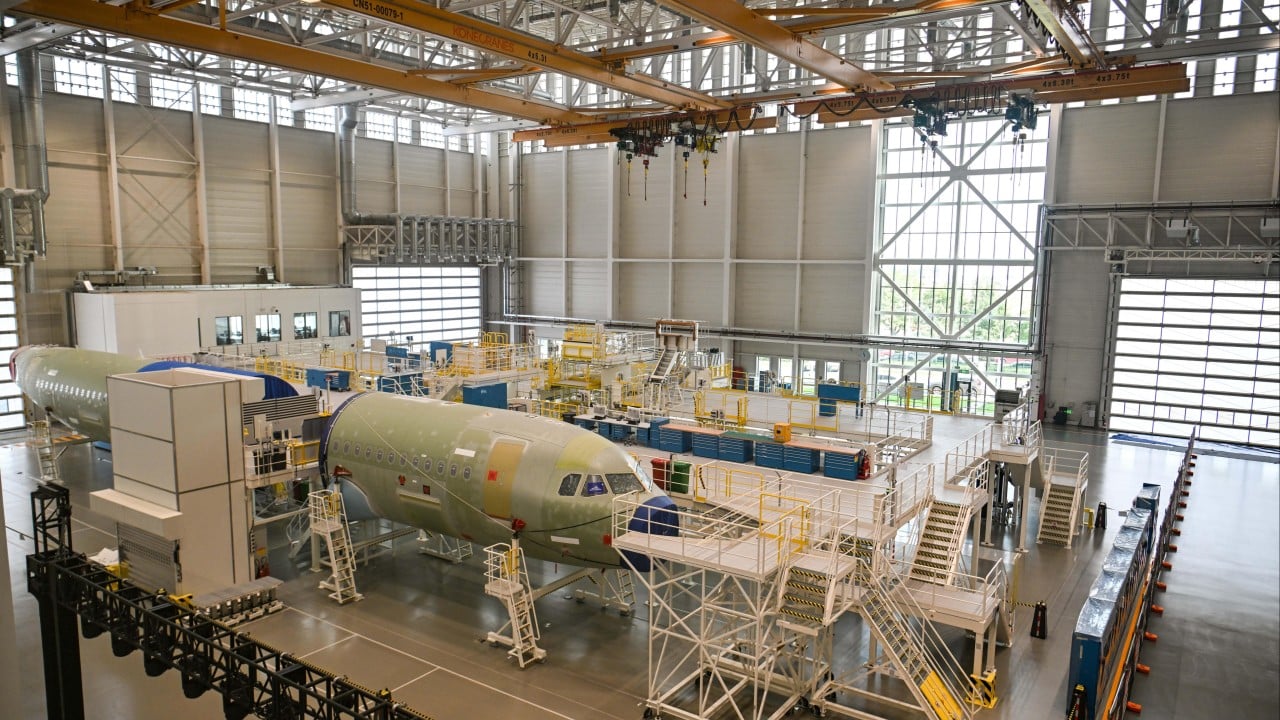
The Shortsighted Industrial Transfer
European aerospace giants are trading long-term global dominance for short-term market access in China. By establishing final assembly lines and transferring manufacturing expertise directly into Chinese industrial hubs, companies like Airbus are inadvertently accelerating the development of the Commercial Aircraft Corporation of China (COMAC). This strategic miscalculation goes far beyond simple product sales. It provides the exact operational blueprint, quality control frameworks, and supply chain management skills that Beijing needs to break the Western aviation duopoly.
While European executives celebrate multi-billion-dollar order books in Beijing, they are actively training their future executioners. This is not a standard story of intellectual property theft. It is a legal, structured, and voluntary transfer of Western industrial capability.
The Illusion of the Great Chinese Market
For the past two decades, Western aviation executives operated under a simple premise. They believed that China's domestic aviation market was so massive that it could easily accommodate Boeing, Airbus, and a minor domestic player without upsetting the global balance of power.
The numbers seemed to justify the gamble. Boeing and Airbus analysts routinely predict that China will require over 8,500 new commercial aircraft over the next twenty years. To secure a dominant piece of this market, European decision-makers decided to localize production. The Airbus Final Assembly Line (FAL) in Tianjin, established in 2008, was the cornerstone of this strategy.
But this strategy ignored the fundamental nature of Chinese state capitalism. The Chinese Communist Party does not import goods indefinitely if it can build them at home. The long-term goal has always been import substitution. European aviation leaders viewed Tianjin as a permanent sales gateway. Beijing viewed it as an intermediate training ground.
How the Transfer Actually Works
The transfer of aerospace capability does not happen through stolen blueprints smuggled out in the dead of night. It happens through daily, mundane operational routines.
- Quality Management Systems: European engineers taught Chinese suppliers how to meet the stringent safety and quality standards of the European Union Aviation Safety Agency (EASA).
- Supply Chain Integration: Local Chinese sub-contractors learned how to manage the logistical nightmare of tracking millions of aerospace parts across international borders.
- Workforce Upskilling: Thousands of Chinese technicians and plant managers were trained in European manufacturing philosophies, lean production techniques, and advanced riveting and bonding methods.
Once a local supplier learns how to manufacture a wing component or a fuselage section to Airbus standards, that supplier does not forget those skills when working on a COMAC contract. The exact same factories, certified under Western oversight, are now producing components for China's homegrown C919 narrowbody jet.
The C919 and the Illusion of Western Dependency
Skeptics of China's aerospace ambitions frequently point to the C919’s supply chain as proof that the country cannot build a competitive airliner alone. They are technically correct today. The C919 is heavily reliant on Western components. Its engines come from CFM International, a joint venture between American GE Aerospace and French Safran. Its avionics, landing gear, and environmental control systems are packed with technology from Honeywell, Collins Aerospace, and Liebherr.
This reliance creates a false sense of security in Western capitals. Policymakers assume that because they control the high-tech components, they control the fate of the aircraft.
This view misunderstands how complex engineering industries mature. No country jumps straight from manufacturing bicycles to building advanced turbofan engines. The critical first step is mastering integration. Bringing together thousands of disparate systems from dozens of international suppliers and making them fly safely is a monumental achievement. By mastering the integration of Western parts on the C919, COMAC has crossed the most difficult technological threshold.
The second step is already underway. Beijing is pouring billions into the development of the CJ-1000A engine, designed specifically to replace the Western CFM engines currently powering the C919. Western executives who believe their technological lead is permanent are ignoring the rapid transformation of the automotive and high-speed rail sectors, where Western technology was systematically replaced by domestic variants within fifteen years.
The Asymmetrical Regulatory War
The battle for global aerospace dominance is fought as much in regulatory offices as it is in factories. For a Chinese airliner like the C919 to achieve true global reach, it needs certification from Western regulators, specifically EASA in Europe and the Federal Aviation Administration (FAA) in the United States. Without these stamps of approval, the aircraft cannot fly commercial routes in most international jurisdictions.
Right now, EASA is facing intense political and industrial pressure regarding the validation of the C919.
+---------------------------+---------------------------------------------+
| Western Strategy          | Chinese Counter-Strategy                    |
+---------------------------+---------------------------------------------+
| Protect market share via  | Leverage domestic market access to force    |
| regulatory delays.        | European certification of COMAC jets.       |
+---------------------------+---------------------------------------------+
| Keep high-tech supply     | Mandate joint ventures to slowly absorb     |
| chains localized.         | component manufacturing secrets.            |
+---------------------------+---------------------------------------------+
Beijing holds a massive hammer in these negotiations. It controls the purchase rights for hundreds of Airbus aircraft that European factories need to sustain their production lines. If Europe refuses to certify the C919, China can simply slow down its purchases of European jets or shift orders to other markets. European regulators are caught in a pincer movement between defending safety standards and protecting their primary export industry from economic retaliation.
The Trillion Dollar Supply Chain Trap
The true danger for Europe lies in the vulnerability of its own supply chain. Decades of globalization led European aerospace manufacturers to outsource tier-two and tier-three component manufacturing to lower-cost regions, including China. Today, European factories rely on Chinese suppliers for everything from raw titanium forgings to complex machined aluminum brackets.
This creates an irreversible dependency. If Europe attempts to cut off China's access to aerospace manufacturing knowledge, Beijing can disrupt the flow of critical components back to Europe. The aviation supply chain is incredibly brittle. A shortage of a single type of specialized fastner or forged ring can halt an assembly line in Toulouse or Hamburg for months.
Europe has spent twenty years building an industrial system where it cannot survive without the Chinese market, while simultaneously teaching China how to survive without European planes.
The Coming Battleground for Global Routes
COMAC does not need to sell aircraft to Lufthansa, British Airways, or Delta to become a major threat. The initial battle will not take place in Western skies. It will happen in the developing world.
Aviation growth is exploding across Southeast Asia, Central Asia, Africa, and parts of Latin America. These are markets where state-backed Chinese financing can be bundled directly with aircraft sales. When a developing nation needs infrastructure development, Beijing can offer a complete package: loans for airport construction, state-built runways, and a fleet of discounted C919 aircraft to kickstart a national airline.
Western manufacturers cannot compete with the financial backing of a sovereign state that is willing to take financial losses to achieve geopolitical influence. Every C919 sold in Indonesia, Uzbekistan, or Nigeria is an Airbus A320 or Boeing 737 that will never be ordered. As COMAC gains operational hours and refines its airframe based on real-world data from these secondary markets, the aircraft will improve.
The ultimate irony of Europe's aerospace policy is that it paid for its current profits by financing its own long-term replacement. European aviation leaders traded their crown jewels for quarterly earnings, forgetting that in state-directed economies, the goal of cooperation is always termination. The factories in Tianjin continue to turn out aircraft, but the clock is ticking down on Western dominance in the skies.