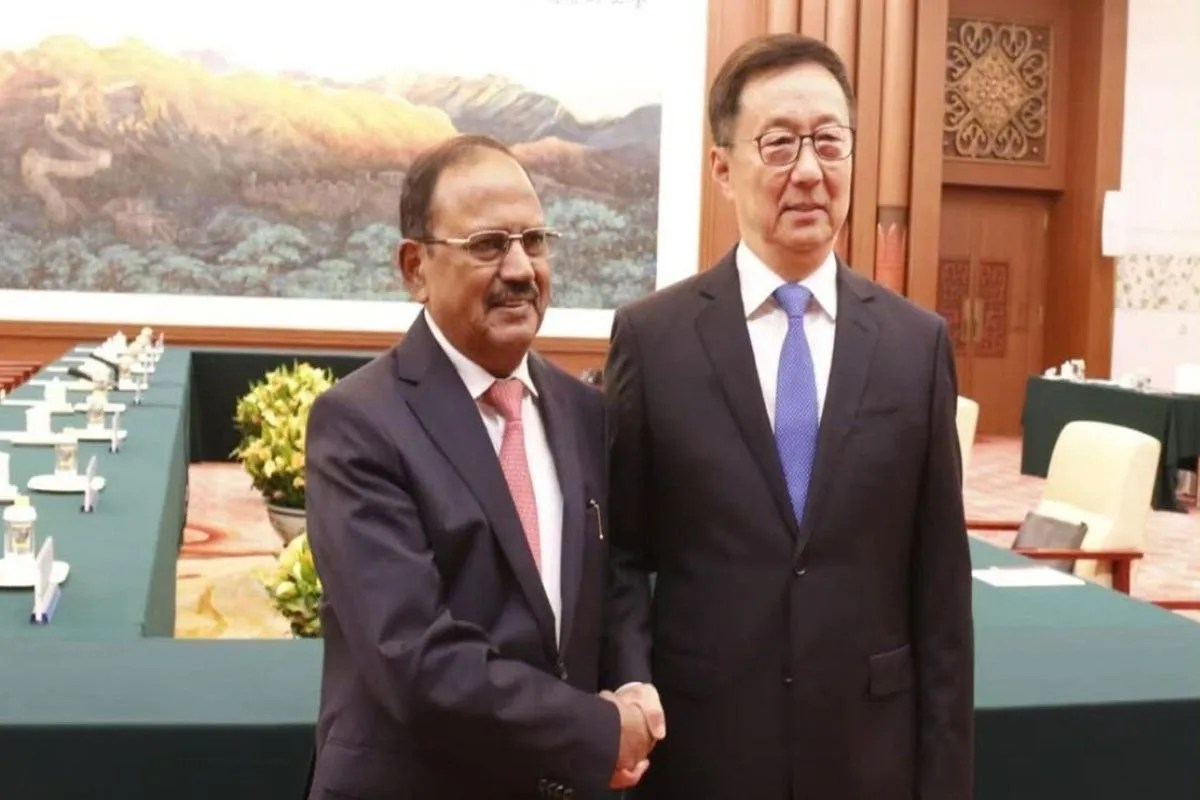
The media wants you to believe that a handshake in a high-security conference room changes the geopolitical destiny of two nuclear-armed giants. Every mainstream outlet rushed to frame the recent diplomatic engagement between India's National Security Advisor Ajit Doval and Chinese counterparts as a monumental breakthrough. They served up the usual boilerplate. Thawing ice. New horizons. Strategic alignment.
It is absolute theater.
If you think a single diplomatic huddle over border patrols is going to rewrite the structural animosity etched into the Himalayas, you are not paying attention. The lazy consensus in foreign policy circles assumes that dialogue equals resolution. It does not. More often than not, dialogue is simply the tool states use to manage friction while they sharpen their bayonets out of sight.
Let us dismantle the fiction and look at the brutal mechanical reality of the India-China bilateral dynamic.
The Myth of the Border Fix
For years, the lazy narrative has pinned the entirety of the Sino-Indian cold war on a few disputed square kilometers of barren rock in Ladakh and Arunachal Pradesh. Fix the line of actual control, the argument goes, and trade flows freely, trust returns, and Asia enters a golden century.
This is backward.
The border is not the disease. It is merely a symptom of a much deeper, structural incompatibility. Two rising powers sharing a contiguous border and an overlapping sphere of influence in South Asia and the Indian Ocean cannot simply negotiate their way into brotherhood. Beijing views its periphery through an imperial lens inherited from dynasties past and refined by modern party hegemony. New Delhi views its security through the lens of sovereign autonomy and continental defense.
Imagine a scenario where both militaries successfully pull back ten kilometers tomorrow morning. Does China suddenly abandon its port developments in Pakistan? Does India drop its defense partnerships with Washington and Tokyo? Do Chinese supply chains stop dominating critical Indian manufacturing inputs?
Of course not. The structural competition for dominance in the Global South and the Indo-Pacific remains entirely intact. Treating the border standoff as the root cause of tension is intellectual laziness designed to give editorial writers easy headlines every time two diplomats exchange pleasantries.
Why Silence Beats Summits
Real diplomacy in high-stakes environments does not happen under the flashbulbs of state-run media agencies. When Ajit Doval sits across the table from Chinese officials, the primary objective is not peace for our time. The objective is signaling red lines and preventing miscalculation.
There is a profound difference between a peace accord and a crisis management protocol. The media confuses the two every single time.
When you look at the track record of past agreements, the pattern is glaring. Treaties are signed, patrols continue to brush against each other, and the cycle repeats. Why? Because neither side can afford to look weak domestically. In New Delhi and Beijing, nationalism is the primary currency of political legitimacy. A leader who compromises too much on territorial integrity signs their own political death warrant.
Therefore, these high-level meetings serve a singular, cold-blooded utility: buying time. Beijing wants time to consolidate its economic recovery and manage its domestic property crisis without a two-front strategic distraction. New Delhi wants time to build out domestic semiconductor fabrication, expand naval infrastructure in the Andaman Islands, and scale up indigenous defense manufacturing before any major kinetic flashpoint occurs.
It is a cold, calculated standoff wrapped in the diplomatic language of cooperation.
The Economic Trap We Refuse to Name
Let us talk about the elephant in the room that commentators conveniently ignore: trade dependency.
Every time tensions flare, politicians threaten complete economic decoupling. Every few months, headlines trumpet new bans on Chinese apps or tighter scrutiny on direct foreign investments. Yet, look at the hard trade data. India’s import reliance on critical Chinese components—active pharmaceutical ingredients, heavy machinery, and electronics components—remains stubbornly high.
You cannot decouple from your primary manufacturing supplier overnight just because of patriotic fervor on evening television.
China knows this. India knows this. The Doval-Han channel operates against this backdrop of economic friction where both nations are trapped in an asymmetric embrace. India needs cheap Chinese capital goods to fuel its infrastructure boom, while China needs a massive, growing consumer market to dump its overcapacity.
Pretending that a diplomatic sit-down alters this underlying economic gravity is pure delusion. The supply chains dictate the politics, not the other way around.
What the PAA Questions Get Wrong
When people search for information on these high-level bilateral talks, the queries always revolve around the same predictable themes. Will trade resume? Is the border finally safe? Has trust been restored?
The premise of every single one of those questions is fundamentally flawed.
You are asking if trust can be restored between two entities whose core strategic trajectories are fundamentally divergent. That is like asking two tectonic plates to learn to compromise. They do not compromise. They grind against each other until energy releases in violent ways, or they lock into a tense, unyielding stasis.
The correct question is not whether relations are improving. The correct question is how well both sides are managing the inevitability of friction.
Doval and his counterparts are not architects of peace. They are risk managers. Their job is to ensure that a localized brawl between patrol squads in the high Himalayas does not escalate into a catastrophic economic and military war that neither economy can survive.
The Uncomfortable Prescription
If you want to understand how India should handle its northern neighbor, stop looking at diplomatic communiqués and start looking at manufacturing output, naval tonnage, and cyber defense budgets.
The only language Beijing respects is hard, immutable power. Goodwill is a currency spent by the naive. When India negotiates from a position of economic vulnerability and supply chain dependency, diplomatic breakthroughs are nothing more than tactical pauses granted by a stronger adversary.
The real work is not happening in air-conditioned conference halls in Geneva or Beijing. It is happening in shipyards, research labs, and factory floors where the actual architecture of deterrence is being forged.
The handshakes are for the cameras. The leverage is what happens when the cameras turn off.