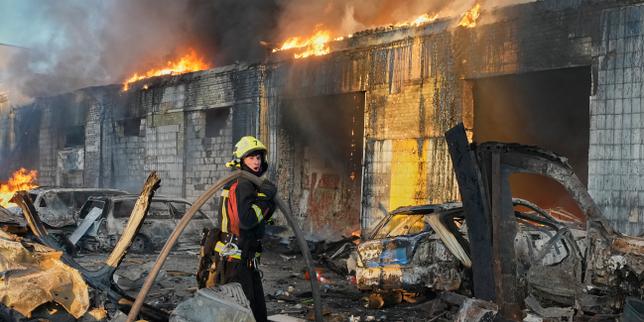
Another three-day lull. Another breathless news cycle screaming about a brutal return to missile strikes on the capital. Analysts on television nod gravely, mapping out escalation ladders and drawing neat red lines across maps of Eastern Europe. They treat every tactical adjustment as a grand ideological shift.
It is entirely performative nonsense.
If you still believe that modern high-intensity conflict operates on a tidy rhythm of truces followed by shocking betrayals, you are watching the war through a twenty-first-century PR lens rather than looking at raw logistical reality. The conventional narrative treats these strikes as emotional outbursts or sudden spikes in malice. That is fundamentally wrong. What we are witnessing is the cold, calculated arithmetic of attrition, where pause and pressure are simply opposing dials on the same industrial machine.
Let us dismantle the core falsehoods driving the current coverage.
The Myth of the Strategic Pause
The media loves a good ceasefire. It fits the narrative arc of a dramatic script. When artillery falls silent for seventy-two hours, pundits scramble to declare a diplomatic opening, a humanitarian gesture, or a sign of exhaustion.
It is none of those things.
In modern mechanized warfare, operational pauses are rarely about peace. They are about payload consolidation, maintenance windows, and satellite telemetry updates. When launches halt for three days, flight crews are sleeping, mobile launchers are relocating to avoid counter-battery fire, and supply chains are shifting pallets of precision-guided munitions from deep-storage depots to frontline railheads.
Treating a brief operational hiatus as a genuine truce is like watching a boxer drop his hands for ten seconds to catch his breath and assuming he has decided to retire. The moment the missiles start falling on Kyiv again, the talking heads act surprised. They clutch their pearls and wonder how diplomacy failed. Diplomacy never had a seat at the table. The schedule simply moved from the maintenance phase back to the execution phase.
The Geography of Illusion
Another persistent delusion is the obsession with the capital as the ultimate barometer of the conflict. Capitals matter politically, but logistically, they are often giant, noisy distractions.
During my time working alongside defense logistics analysts tracking supply chain bottlenecks in contested zones, a basic truth became crystal clear: attacking a heavily defended political hub like Kyiv is rarely about seizing territory. It is about bandwidth consumption. Every Patriot battery, every interceptor missile, and every radar crew redeployed to protect the skyline of the capital is a resource starved from the actual contested zones in the east and south.
When the strikes resume after a brief dry spell, the strategic objective is not to terrorize civilians—though that is the lazy framing repeated ad nauseam by cable news. The objective is to force the defender into an impossible math problem. Do you spend your limited air defense inventory protecting government infrastructure, or do you save it for the logistics hubs keeping the front lines supplied?
Every time a siren wails across the capital and missiles light up the night sky, people look up at the clouds. They should be looking at the rail junctions three hundred miles away. The attack on Kyiv is often the feint, or at least the secondary theater designed to pin down high-value defensive assets while the real grinding progress happens in the trenches of the Donbas.
The Cost of Consuming Propaganda
We have created an information ecosystem that demands daily emotional peaks. A war cannot simply be a slow, grinding mathematical equation where two sides bleed slowly until one collapses under its own debt and demographic deficit. That does not sell advertising. That does not generate panic-driven social media engagement.
So we get the episodic framing. Truce. Betrayal. Strikes. Outrage. Repeat.
This cycle robs the public of any real understanding of how this ends. Wars of this scale are not won by dramatic single strikes on government districts or sudden humanitarian awakenings. They are won by steel production capacity, truck tire manufacturing, microchip smuggling networks, and the psychological stamina of populations who realize that the politicians on television are living in a completely different reality from the people ducking shrapnel.
The honest truth—the one nobody wants to print because it lacks a neat moral resolution—is that these strikes are routine maintenance of an ongoing catastrophe. They will happen whenever the logistics line clears and the targeting data confirms a viable window.
Stop looking for meaning where there is only mechanics. Stop treating routine military logistics as moral theater. Until we look at this conflict through the lens of industrial capacity rather than breaking news chyrons, we will remain perpetually surprised by the obvious.