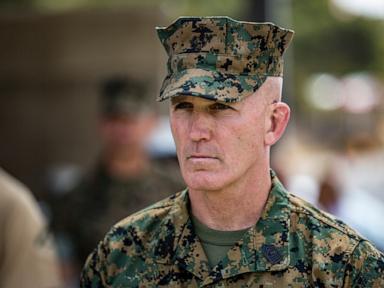
When news broke in November 2026 that a famed Marine Corps veteran was under federal investigation over undisclosed allegations, social media did what it always does. People instantly split into two loud, completely unhelpful camps. One side declared retired Sgt. Maj. Bradley Kasal guilty before a single charge was ever filed. The other side dismissed the entire probe as a smear campaign against a certified war hero who bled for his country in Fallujah.
Both reactions miss the point. Also making news in related news: Stop Obsessing Over Earthquake Maps When Peru Shakes.
If you actually look at the confirmed facts from CBS News and the Associated Press, the story isn't a simple internet morality play. It's a messy, high-stakes collision between military legend, high school Youth Leadership oversight, and how federal agencies investigate boundary-crossing behavior. You don't need to pick a tribal side to understand what's happening here. You just need to separate verified institutional records from online noise.
Why Bradley Kasal Matters Beyond a Single News Headline
To understand why this investigation sent shockwaves through the military community, you have to understand who Bradley Kasal is. He isn't just another retiree with a lapel pin. Further insights on this are explored by NBC News.
In November 2004, during the Second Battle of Fallujah, then-1st Sgt. Kasal entered a building in Iraq—later known in Marine lore as the "Hell House"—to rescue wounded Marines pinned down by insurgents. He took heavy gunfire, suffered a shattered leg, and used his own body to shield a fellow Marine from a grenade blast. Photographer Lucian Read captured the moment two lance corporals, Chris Marquez and Dan Shaffer, carried a bloodied Kasal out of the building while he still gripped his pistol and combat knife.
That single image became immortal. It inspired the "No Man Left Behind" statue standing at Camp Pendleton and Camp Lejeune. Kasal received the Navy Cross—the nation's second-highest decoration for combat valor behind the Medal of Honor—along with two Purple Hearts. He served 34 years in uniform before retiring in 2018, and the Marine Corps Heritage Foundation even has an annual award bearing his name.
When someone with that kind of towering reputation becomes the focus of a felony-level federal inquiry, people struggle to hold two thoughts in their head at once. Combat valor is real. So is the duty of adults to maintain strict professional boundaries around teenagers. One doesn't erase the other, and neither gives anyone a free pass from scrutiny.
What Federal Investigators Have Actually Confirmed
Let's strip away the rumors and look strictly at what officials have put on the record. Because right now, the gap between what's confirmed and what people are assuming is massive.
In mid-November 2026, the Naval Criminal Investigative Service (NCIS) confirmed that its Camp Pendleton field office is conducting an active investigation involving Kasal. Why NCIS? Because NCIS serves as the Department of the Navy's lead agency for felony-level criminal investigations. The U.S. Marine Corps separately acknowledged that it's aware of allegations tied to Kasal's post-retirement job as a civilian Junior Reserve Officers' Training Corps (JROTC) instructor.
Here is the confirmed timeline of his employment:
- August 2018: The Clark County School District in Nevada hired Kasal to work in the JROTC program at Basic Academy of International Studies, a public high school in Henderson.
- August 2025: Kasal resigned from his position at the school district.
- November 2026: CBS News first reported the active federal probe, followed by official confirmations from NCIS and the Marine Corps.
Notice what isn't on that list. There is no indictment. There is no arrest warrant. Neither NCIS nor the Clark County School District has publicly named a specific criminal statute or released a charging document. NCIS explicitly declined to share specifics to protect the integrity of an ongoing investigation.
That distinction matters. In federal law enforcement, an active investigation means agents are gathering evidence, interviewing witnesses, and determining whether a crime occurred. It is not a verdict. Treating an open inquiry like a conviction is lazy journalism and bad citizenship.
Inside the Henderson JROTC Accounts and Boundary Questions
So if NCIS hasn't released formal charges, why are federal agents interviewing former high school students?
Reporting from CBS News and the Associated Press based on interviews with former cadets and a former school district employee paints a complicated picture of Kasal's seven years at Basic Academy. Honestly, if you've ever worked around youth programs or school administration, the details jump right off the page.
Former students described Kasal as deeply involved in their lives—sometimes in ways they viewed as generous, and other times in ways that made peers uneasy. According to former cadet interviews, he regularly bought food for students who couldn't afford it, drove cadets home, organized group hikes near the school, and even brought tamales for an entire class. One former cadet told reporters he felt like a father figure and a strong role model.
At the same time, other accounts highlight clear red flags regarding adult-student boundaries:
- Repeated individual favors: Former cadet Greenwell told CBS News that while helping a hungry kid is commendable, regularly buying Starbucks for a specific female student and consistently driving students home "looks bad" and crosses a line.
- Private communications and an adoption offer: One former female cadet stated she met Kasal at age 14 and confided in him about struggles at home and her dating life. After knowing her for roughly a year, she alleged he sent her a text offering to adopt her, writing, "I'm not asking as charity. I'm asking because your [sic] wanted".
- Prior internal warnings: A former Clark County School District employee told CBS News that Kasal had been advised multiple times about how his interactions with students looked and was warned to avoid putting himself in compromising situations.
Look at that third point again. Being warned by colleagues about perception and boundary lines isn't proof of a felony. It is, however, textbook evidence of how institutions fail when reputation shields someone from firm enforcement.
Why "Father Figure" Mentorship Goes Wrong in Youth Programs
I've seen this dynamic play out in schools, sports teams, and youth organizations for years. Adults who come from tight-knit, high-trust environments like the military often view mentorship through a familial lens. You take care of your troops. You feed them, you check on their personal lives, you make sure they get home safe.
That instinct works when you're leading 20-year-old Marines in a combat zone. It breaks down completely when you're a civilian employee supervising 14- and 15-year-old high schoolers.
Public schools operate on rigid boundary rules for a reason. When an authority figure starts texting teenagers privately, giving regular one-on-one rides, or singling out individual students for gifts and coffee, two things happen. First, it creates an environment where grooming or abuse can hide in plain sight. Second, even if an adult's intentions were entirely benign, it erodes institutional trust and puts everyone at risk.
The Bigger JROTC Oversight Problem Nobody Wants to Fix
This story isn't happening in a vacuum. If you think the Basic Academy situation is an isolated fluke, you haven't been paying attention to JROTC oversight over the past few years.
The Pentagon funds Junior ROTC programs at thousands of high schools across the United States, employing retired military personnel as instructors. These veterans aren't on active duty; they're hired as civilian school district employees. That split governance creates a massive accountability blind spot.
Local school districts often assume the military vets these instructors thoroughly and enforces strict standards. Meanwhile, the military branches often treat JROTC instructors as local school employees whose day-to-day classroom conduct falls under principal and district supervision. When complaints arise, paperwork gets lost between school human resources offices and military cadet commands.
Major investigations by outlets like The New York Times in recent years have documented hundreds of misconduct allegations involving JROTC instructors nationwide—ranging from inappropriate relationships to sexual misconduct—frequently involving instructors who were quietly allowed to resign rather than face immediate public accountability.
Look at the dates in Henderson again. Kasal resigned in August 2025. The public didn't learn about a federal investigation until November 2026. That 15-month gap between a quiet resignation and public scrutiny is a classic symptom of how school districts and federal agencies handle sensitive personnel cases behind closed doors.
Why NCIS Has Jurisdiction Over a Retired Veteran
A common question floating around right now is why a Navy criminal agency is investigating a retired Marine who worked as a civilian high school teacher. People assume once you take off the uniform and get your DD-214, the military's legal reach ends.
That's not entirely true.
While civilian local police—like the Henderson Police Department or Clark County School District Police—handle standard state-level school crimes, federal military investigators step in when cases intersect with Department of Defense programs, military retirees subject to the Uniform Code of Military Justice (UCMJ), or federally funded JROTC operations. Under federal law, military retirees drawing retired pay remain legally subject to certain UCMJ provisions, and NCIS routinely coordinates with local law enforcement and federal prosecutors when allegations involve military-affiliated youth programs.
In practical terms, NCIS involvement signals that investigators are looking into whether the alleged conduct crosses into serious criminal territory, rather than just a violation of school district HR policy.
How to Follow Developing Federal Probes Without Falling for Clickbait
When a high-profile figure—especially a decorated veteran—faces undisclosed allegations, the information ecosystem gets toxic fast. Outlets race for clicks with vague headlines, while partisan commentators twist partial quotes to fit their worldview.
If you want to track this case—or any major federal investigation—accurately over the coming months, use a strict filter:
- Watch for court filings, not headlines. An NCIS confirmation means an inquiry exists. Real legal milestones only happen if a U.S. Attorney's Office, a state prosecutor, or a military convening authority files formal charges, unseals an indictment, or announces the probe is closed without action.
- Separate policy violations from criminal offenses. Driving a student home or texting a cadet violates standard school district boundaries. That doesn't automatically mean a felony occurred. Investigators look for specific statutory elements—coercion, unlawful contact, obstruction, or exploitation—before bringing charges.
- Demand primary sourcing. Stick to reporting from outlets that directly quote named officials, court records, or vetted witnesses—such as CBS News and the Associated Press—and ignore aggregator blogs that rewrite those reports with sensationalized guesses.
- Hold local school boards accountable for JROTC guardrails. Parents with kids in JROTC programs shouldn't wait for federal agents to show up before asking questions. Check your local district's policies on one-on-one transportation, off-campus trips, and direct text messaging between instructors and cadets.
Bradley Kasal's actions in Fallujah in 2004 are carved into Marine Corps history. Nothing that happens in Nevada changes what he did to save fellow Marines under fire. At the same time, past heroism doesn't exempt anyone from accountability in a high school classroom. Let NCIS finish its work, watch the actual legal record, and refuse to let internet outrage replace facts.
To see how CBS News initially broke the story and hear direct accounts from former cadets, watch CBS News report on the Bradley Kasal federal investigation, which lays out the initial institutional confirmations and student interviews.