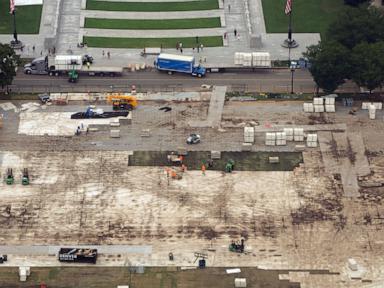
The media machine is at it again, serving up the same lazy narrative about Washington turf. When headlines exploded over Donald Trump blaming vandals for dead grass near the World War II Memorial, the mainstream press immediately rushed to a predictable conclusion. They pointed out that a massive July 4 stage sat on that exact spot, noted that heavy crowds trampled the area, and smugly declared the damage was merely the natural byproduct of a massive political event combined with poor contractor cleanup.
Case closed, right? Wrong.
This surface-level critique completely misses the actual mechanics of urban federal land management, large-scale event logistics, and the political theater of public infrastructure in the nation's capital. I have spent years tracking the financial and physical toll that massive presidential spectacles inflict on municipal ecosystems. Dismissing the entire debate as a simple argument between foot traffic and executive denial ignores the uncomfortable reality of how public spaces are engineered, utilized, and weaponized for political narratives.
Let us dismantle the lazy consensus.
The Physics of Heavy Event Engineering on Fragile Turf
The core argument driving mainstream coverage is that four hundred thousand attendees and heavy steel scaffolding naturally wreck grass. That is true, but it is also a massive oversimplification.
When you place multi-ton bandstands, heavy-duty flooring panels, and dense seating blocks on the National Mall during July, you are not just walking on grass; you are suffocating a living biological system under layers of impermeable plastic and plywood during peak summer heat. Turf doesn't just die from shoes; it dies from heat stress trapped under infrastructure, soil compaction that chokes out root oxygen, and chemical leaching from temporary power setups.
Imagine a scenario where a contractor rushes teardown protocol to meet a tight municipal deadline. The grass beneath those structures was already on life support within forty-eight hours of installation. To blame ordinary foot traffic or isolate it down to malicious actors alone ignores the baseline destruction caused by erecting temporary mega-venues on protected federal grounds.
Yet, reducing this entirely to "contractor error" or "just a crowded party" is equally lazy.
The Political Utility of Blame Shifting
Why does a patch of dead grass become a high-stakes geopolitical football? Because in Washington, physical property is never just property. It is a canvas for legitimacy.
When federal officials like U.S. Attorney Jeanine Pirro attribute infrastructure wear to structural decay or poor construction, and the executive branch pushes back with accusations of targeted malice, we are watching a structural clash over institutional competence. Insiders know that maintaining the National Mall is a logistical nightmare under the best of conditions. Budgets are chronically stretched, bureaucratic red tape chokes swift turf remediation, and every square foot of sod carries immense symbolic weight.
When specific numbers or cryptic phrases get dragged into the conversation—such as the alleged markings discovered on the turf weeks prior—the debate shifts instantly from agronomy to security. Critics want you to believe that any claim of intentional destruction is purely defensive posturing. But that perspective assumes public monuments exist in a vacuum devoid of political hostility. In reality, high-profile memorials in Washington are lightning rods for direct civil disobedience and targeted property defacement. Pretending that political hostility never extends to the ground beneath these monuments ignores the documented history of vandalism that regularly plagues the capital.
The Real Cost of Megaprojects on Public Parks
The uncomfortable truth both sides refuse to admit is that hosting massive, hyper-politicized spectacles on fragile ecological zones is fundamentally unsustainable.
If you want a pristine national park system, you cannot simultaneously drop industrial-scale entertainment infrastructure onto a shallow-rooted lawn every time a milestone anniversary rolls around. The National Mall was designed as an open civic green space, not an amphitheater built to withstand the structural weight of multi-day presidential productions.
The mainstream wants you to argue about whether a specific brown patch was killed by a boot, a bulldozer, or a spray can. That is a trap designed to keep you mired in petty daily news cycles. The actual failure lies in a system that insists on turning fragile urban parks into political battlegrounds, year after year, while pretending the ecosystem can absorb the shock without severe consequences.
Stop asking whether the turf was ruined by partygoers or bad actors. The real question is why we keep treating our most sacred national commons like a disposable festival ground.