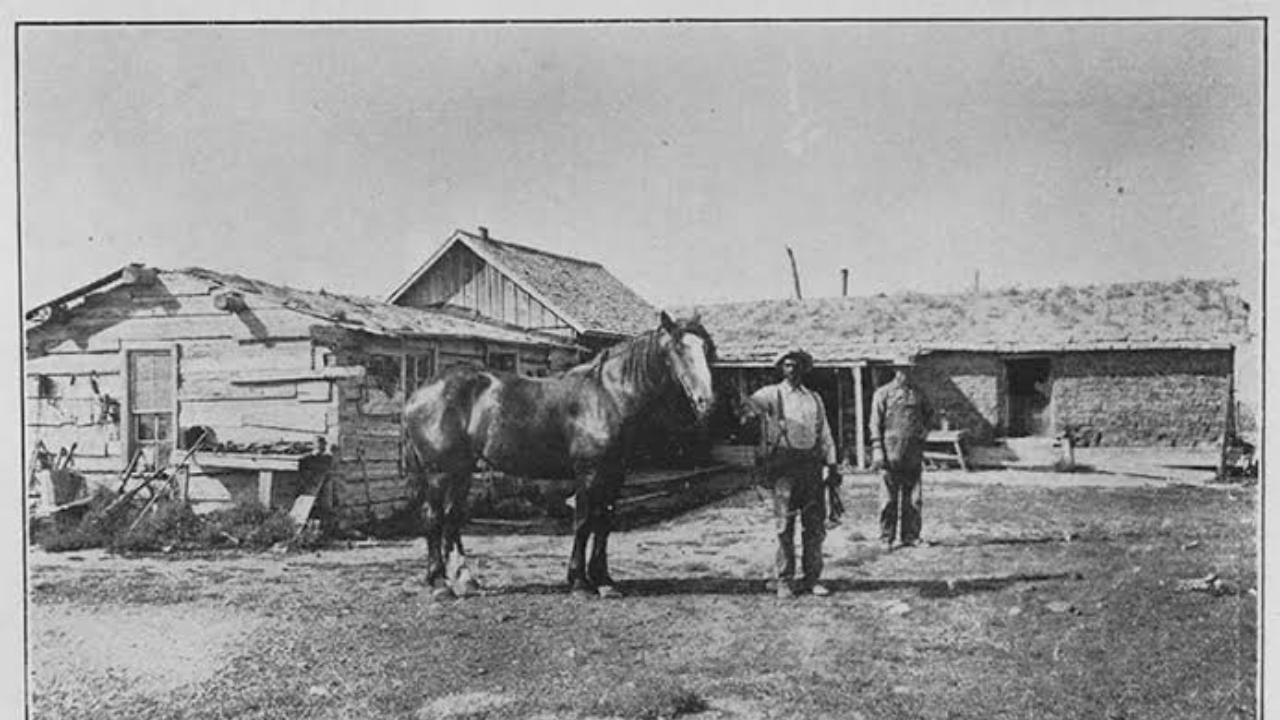
History often reads like a rigid ledger of laws passed in Washington and battles fought on distant ridges. We track the Homestead Act of 1862 through dry congressional records, noting the parameters of free land, the acreage caps, and the five-year residency requirement. Yet official policy tells only half the story. On the treeless plains of Nebraska, a profound demographic shift occurred when former slaves and Union Army veterans picked up shovels, pushed past the eastern fringe of settlement, and transformed the American frontier. They did not merely participate in the homesteading rush. They weaponized the law to build generational autonomy just years after escaping the plantation blocks of the South.
Understanding this movement requires looking past the romantic mythology of the covered wagon. The reality of the Nebraska prairie was brutal, unforgiving, and deeply administrative. To grasp how Black homesteaders carved out existence in places like the DeWitty community, one must examine the intersection of military bounty land warrants, civil rights legislation, and the sheer physical toll of sod busting. This was an era of intense economic recalibration. The federal government was eager to settle the West to secure rail routes and project national sovereignty, inadvertently opening a back door to land ownership for thousands of citizens who had been legally classified as property less than a decade prior.
The Mechanics of the Claim
The Homestead Act promised 160 acres of public land to any citizen or intended citizen who was head of a household and willing to cultivate the soil. For a Black veteran returning from the Civil War, this offer carried unprecedented weight. The United States Colored Troops had mobilized over 170,000 soldiers, many of whom viewed military service as the ultimate ticket to full citizenship and economic stability. When the guns fell silent in 1865, the battlefield transitions shifted immediately to the land office.
The process demanded capital that many newly emancipated individuals simply did not possess. Filing fees, surveying costs, and the price of basic agricultural implements created immediate barriers. Veterans held a distinct advantage through military service provisions, which occasionally credited their time in uniform toward the residency requirement, yet survival still hinged on immediate cash flow.
- Filing Fees: Ranged from ten to eighteen dollars, a steep sum for families living through post-war deflation.
- Building Requirements: A habitable dwelling, usually measuring at least 8 by 14 feet, had to be constructed on site.
- Cultivation Proof: Testimony from neighbors was mandatory to verify that crops were actually going into the ground.
These administrative hurdles kept speculation high while simultaneously weeding out undercapitalized settlers. Those who persisted understood that ownership meant political voice. Land ownership qualified men to serve on juries, vote without economic intimidation, and secure loans from local merchants. The prairie was a blank slate, but writing on it required immense administrative stamina.
The Nebraska Experiment
Nebraska was the proving ground. While states like Kansas received massive influxes of Exodusters escaping the violent redemption era of the South, Nebraska offered a unique mix of harsh weather, isolation, and fertile river valleys. Settlers faced cyclical droughts, prairie fires that could leap rivers, and blizzards that trapped families inside sod houses for weeks.
In Blaine County, deep in the Sandhills, a remarkable community took root. Founded largely by Black homesteaders, including veterans like Charles DeWitty, this settlement defied the conventional historical narrative that minority settlers only survived in tightly clustered urban enclaves or southern tenant farms. They ran cattle, established local schools, and built a self-sustaining economy based on open-range ranching and dryland farming.
+-------------------------------------------------------------------+
|                  THE NEBRASKA HOMESTEAD LIFECYCLE                 |
|                                                                   |
|  1. Filing Intent -> Pay initial fee at the regional land office  |
|  2. Construction  -> Build a sod house from interlocking turf    |
|  3. Cultivation   -> Break the prairie sod using heavy plows      |
|  4. Proving Up    -> Five years of residence and verified crops  |
+-------------------------------------------------------------------+
Water was the primary bottleneck. Traditional eastern farming techniques failed entirely in the semi-arid environment of western Nebraska. Settlers had to adapt quickly, sinking deep wells by hand or adopting cattle-grazing strategies that utilized the native bluestem grass. Every innovation was born out of direct necessity, driven by families who had zero margin for error. If the corn crop withered under a July heatwave, the winter meant starvation unless local wage labor on the expanding Union Pacific Railroad could bridge the gap.
The Myth of Equal Opportunity
We must discard the comforting notion that the western frontier was a colorblind meritocracy. While the text of the Homestead Act did not explicitly bar Black applicants, the implementation was rife with systemic bias. Land office agents were frequently local political appointees with deep ties to regional white power structures. They could arbitrarily reject claims, misfile paperwork to trigger default clauses, or direct Black settlers toward marginal, sandy acreage incapable of supporting crops.
Violence and intimidation also played a role. While overt racial conflict was sometimes less explosive in isolated Nebraska than in the cotton belt, social exclusion was absolute. Black homesteaders created their own networks of mutual aid, sharing seed stock, pooling labor for harvest, and educating their children in segregated or independent rural schoolhouses.
Furthermore, the cattle barons of the open range viewed small-scale homesteaders as an existential threat. Ranching syndicates utilized aggressive legal maneuvers, illegal fencing of public domain, and intimidation tactics to drive independent farmers off the land. Black homesteaders faced this dual pressure: the standard hostility directed at all smallholders combined with the specific, racially motivated hostility of neighbors who resented their presence as landowners.
The Long Shadow of the Patent
Securing the final land patent—the official parchment signed by the President transferring title from the federal government to the individual—was only the first hurdle of a multi-generational marathon. Once the land was secured, owners faced the challenge of holding onto it through economic panics, such as the Long Depression of the 1870s and the catastrophic droughts of the 1890s.
Mortgages carried exorbitant interest rates, often exceeding fifteen percent. When commodity prices for corn and wheat crashed globally, debt collectors swooped in. Many original homesteads slipped out of family hands during these downturns, swallowed up by larger agricultural operations or timber and cattle syndicates.
Yet the legacy survived in the legal footprints left behind in county courthouses. These records prove that marginalized people did not just endure history; they staked permanent physical claims upon the continent at the exact moment the nation was trying to define who belonged. The sod houses melted back into the earth decades ago, but the title deeds carved out a baseline of generational wealth that changed the trajectory of families who refused to remain landless.
Unfinished Business on the Plains
The narrative of homesteading is often wrapped up and shelved as a nineteenth-century novelty, a quaint chapter involving wooden plows and bonnets. That perspective ignores the enduring legal frameworks of property rights that dictate modern wealth distribution. The ability to pass down 160 acres to children meant educational opportunities, startup capital for businesses, and a buffer against systemic poverty.
When we reexamine the archives of places like DeWitty, we are not looking at an anomaly. We are looking at the blueprint of how resilience operates when the law offers a door, but leaves the user to pick the lock themselves. The plains demanded everything from these settlers, and in return, they wrote their names permanently into the dirt of the American West.