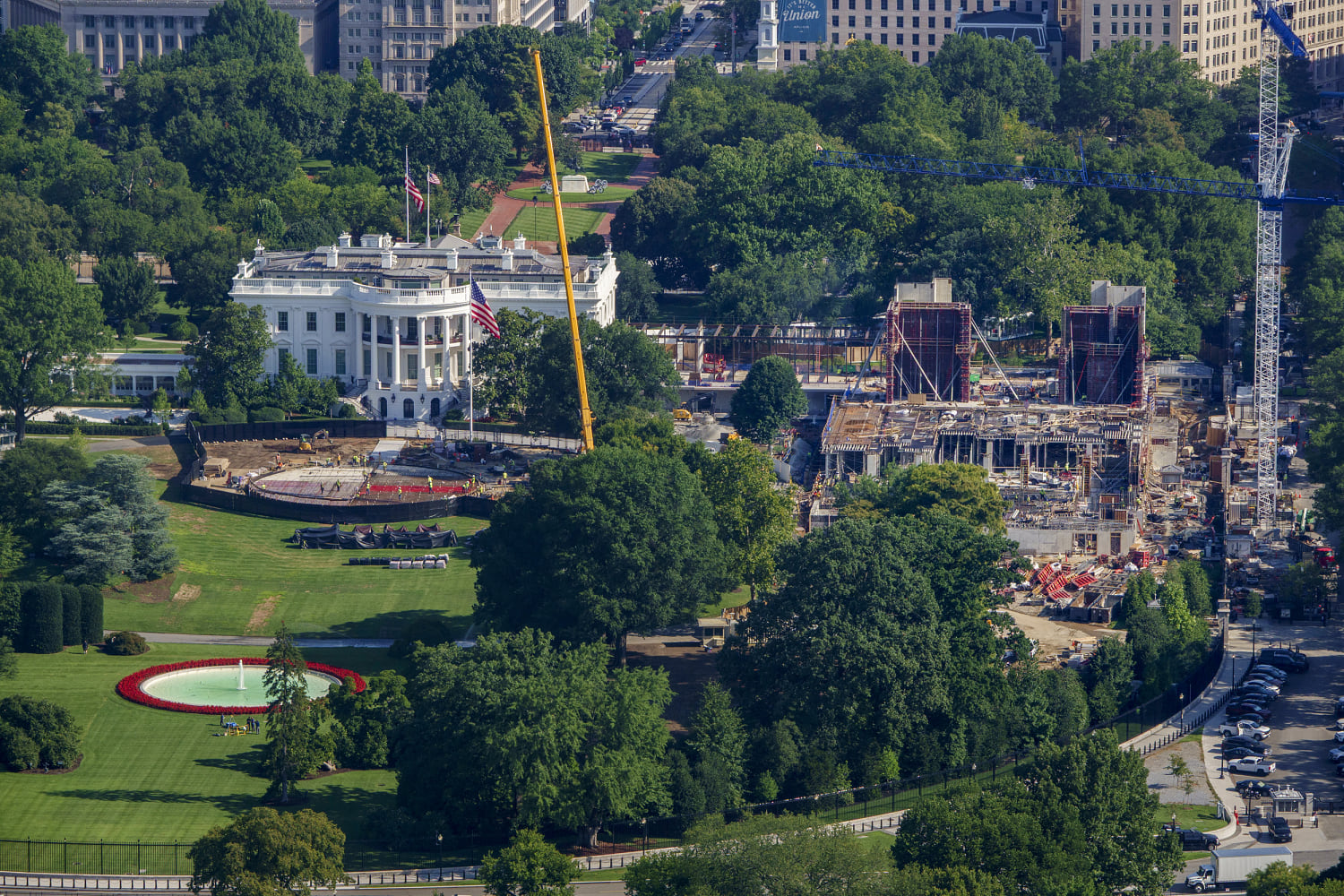
The constitutional friction generated by the emergency appeal to the Supreme Court regarding the White House East Wing reconstruction exposes the structural limits of executive power over federal property. When Solicitor General D. John Sauer filed for emergency relief to prevent an injunction from halting the construction of the 90,000-square-foot facility, the legal battle moved past historic preservation disputes into a core separation-of-powers test. The central mechanism driving this conflict is the collision between unilateral executive execution and Article I congressional appropriation and property control.
Understanding the dispute requires deconstructing the three primary pillars of the administration's legal argument: national security integration, property management discretion, and private funding autonomy. Each pillar establishes a distinct vector of authority, yet each runs into the established constitutional boundaries defined by federal property statutes.
The National Security Integration Vector
The primary justification presented in the emergency filings centers on the classification of the superstructure as an integrated military complex rather than a standalone entertainment venue. By designating the subsurface and surface works as a unified defensive architecture incorporating reinforced concrete, specialized venting, and secure command space, the administration attempts to shift the legal categorization of the project. Under this framework, defensive engineering falls within the inherent commander-in-chief powers and delegated security management authorities.
The counter-argument hinges on structural severability. Lower courts and the D.C. Circuit panel maintained a functional distinction between subterranean security elements and the aboveground assembly structure. While underground bunkers, medical facilities, and command nodes enjoy judicial latitude due to established executive security protocols, the aboveground footprint—designed to accommodate nearly one thousand guests—fails to clear the threshold of operational necessity. The legal friction is thus a matter of categorization: whether an entertainment ballroom can legally inherit defensive immunity simply by sitting atop a reinforced substructure.
The Property Management Cost Function
A parallel vector of debate involves the financing mechanism and its constitutional implications. The administration bypassed traditional federal budgeting by securing private donations to fund the escalating capital expenditure, which has expanded from an initial $200 million projection to roughly $400 million. Proponents argue that zero taxpayer expenditure removes the project from the strict oversight of congressional appropriations riders, asserting an inherent presidential right to upgrade and beautify the executive residence without dipping into the federal treasury.
This perspective collides directly with the Property Clause of the Constitution, which grants Congress ultimate authority over federal territory and assets. Legal scholars and the historic preservation groups challenging the demolition of the original East Wing emphasize that ownership and control of federal real estate are distinct from operational maintenance. The legal constraint is clear: avoiding the federal budget does not bypass statutory requirements governing historic federal structures, nor does private funding negate the statutory mandate for congressional authorization on major alterations of federal monuments.
The Standing and Judicial Review Mechanism
The procedural journey of the case exposes the mechanics of judicial intervention in executive branch capital projects. When the National Trust for Historic Preservation filed suit following the demolition phase, it triggered an inquiry into administrative standing and irreparable harm. The appellate ruling affirmed that executive self-help regarding permanent architectural transformations of historic federal properties exceeds the boundaries of implied statutory delegation.
The emergency stay request placed before the Supreme Court demands an evaluation of the equities: the financial and structural risks of halting a project reported to be significantly complete versus the constitutional injury of allowing unauthorized permanent alterations to a co-equal branch's oversight domain. The administration contends that halting construction leaves contractors in limbo and creates structural vulnerabilities, while plaintiffs maintain that allowing completion creates a fait accompli that renders judicial review moot.
Strategic Execution Path
To resolve the impasse without triggering a constitutional crisis, the administration must pursue a two-track strategy. First, formalize the security documentation for the subterranean infrastructure to permanently insulate the defensive engineering from the aesthetic dispute. Second, submit a retroactive authorization package to Congress that unbundles the defensive requirements from the public-assembly superstructure, trading architectural concessions for statutory clearance. This decouples the non-negotiable security asset from the contested entertainment space, aligning the project with constitutional separation of powers.