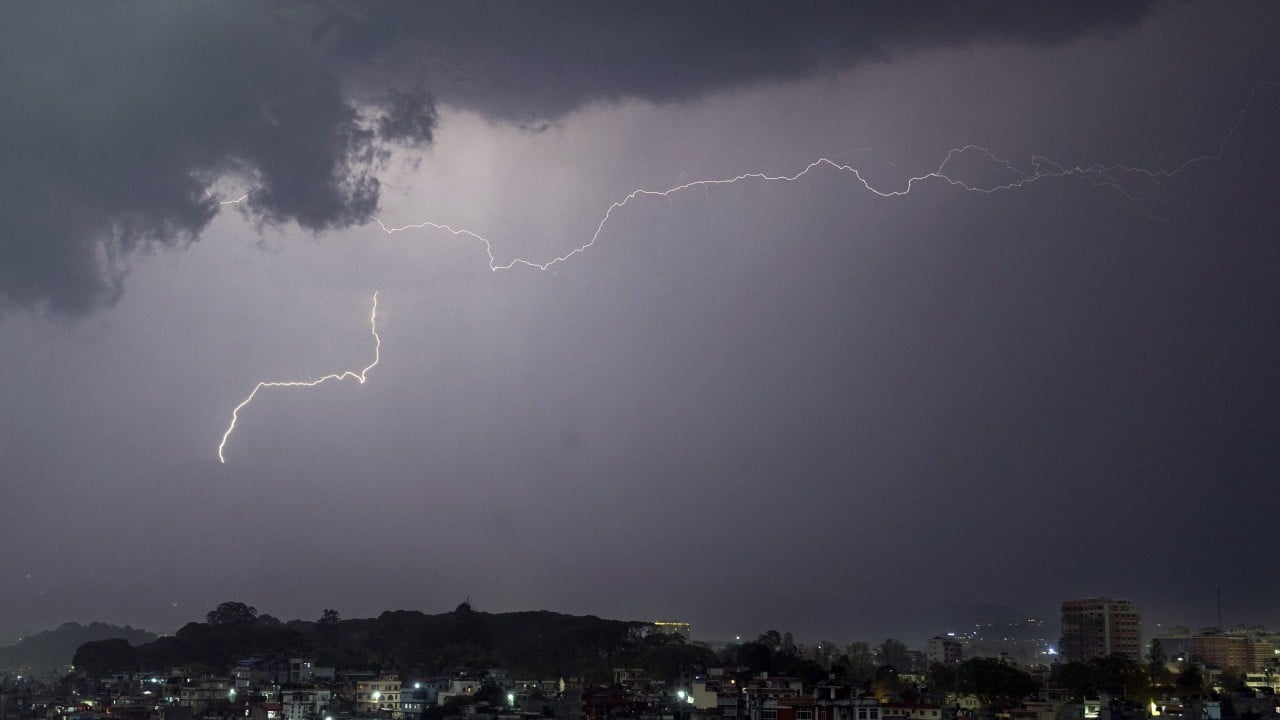
The rain does not fall in the Himalayas. It shatters.
When the monsoon breaches the high mountain passes, it arrives not as weather, but as an invading army. Water slams into mud brick, swells glacial streams into roaring walls of brown fury, and tears away the footpaths that generations have relied upon to cross the gorges. Down in the valleys of Nepal, the air turns heavy with the smell of wet earth and impending ruin. You learn to listen for the low, vibrating growl of the riverbed at night. That sound means the mountain is moving.
And when the mountain moves, maps become useless.
For years, disaster response in these high-altitude border zones has been a desperate game of blindman's buff. Rescuers operate in a vacuum of information. Communication lines snap during the first hour of a cloudburst. Landslides isolate entire communities before anyone in Kathmandu or Beijing knows a village has been wiped from the map. You are left guessing. You send helicopters into impenetrable fog. You wait for runners who may never arrive.
Then, high above the stratosphere, something extraordinary shifts.
Far beyond the reach of the wind, orbiting silently in the cold vacuum of space, a sentinel opens its eyes. It is an instrument built for an entirely different kind of war—one fought against the sky itself. Designed to track the most violent electrical discharges on the planet, this high-powered lightning-chasing satellite possesses a sensory apparatus so acute it can pinpoint the exact heartbeat of a storm from hundreds of miles up.
Think of it as a cosmic seismograph. Just as an earthquake sends ripples through the crust of the earth, a massive atmospheric convulsion sends electromagnetic shocks screaming into the upper atmosphere. This satellite captures those invisible pulses.
Recently, that orbital machinery pivoted downward.
In a quiet triumph of international cooperation, the orbital asset typically reserved for tracking atmospheric electrical storms turned its gaze toward the unfolding disaster zones of China and Nepal. Flood relief efforts required a miracle of modern data, and space answered.
The mechanism behind this is deceptively simple in theory, though staggering in execution. When catastrophic rains swell river basins across borders, conventional radar struggles through thick monsoon cloud cover. Satellites equipped with advanced optical lenses find themselves blinded by relentless gray sludge in the sky. But high-frequency electromagnetic monitoring does not care about clouds. It pierces the darkness. It maps the torrential energy feeding the storms in real time.
Consider what happens on the ground when this data finally flows.
A disaster coordinator sitting in a cramped command tent miles from the nearest paved road looks down at a glowing tablet. Minutes ago, that screen was blank. Now, it pulses with predictive clarity. The satellite telemetry, integrated with ground sensors, outlines precisely where the next flash flood wave will crest. It shows which bridge has held and which canyon has transformed into a lethal funnel.
This is not abstract technology. This is the difference between a family scrambling to the roof of a collapsing home and a helicopter arriving ten minutes before the mud hits the door.
We often talk about space exploration as a pursuit of the infinite, a billionaire's race to plant flags on dead rocks. We forget that the most profound achievements of orbital technology are entirely terrestrial. They look backward. They look down. They look at us, shivering in the mud, wondering if help is coming.
In the valleys of Nepal, survival has always been an intimate, brutal negotiation with gravity. The monsoon does not negotiate. It simply takes. But for the first time, the invisible lightning dancing across the upper stratosphere is whispering secrets back down to the earth. It is telling us where the storm is going before it gets there.
The rain still falls. The rivers still roar in the dark. But the blindfold has finally slipped.