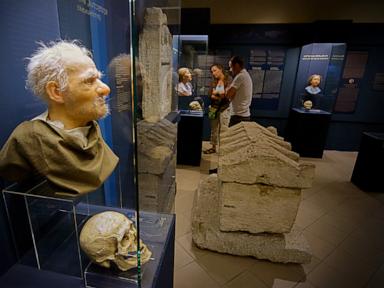
The air inside the museum hall is cool, a sharp relief from the heavy midsummer humidity hanging over Budapest. Outside, the modern city hums with the electric vibration of trams, traffic, and tourists rushing toward air-conditioned cafes. Inside, the silence is thick, broken only by the quiet scuff of sneakers on polished concrete.
I am standing inches away from a man who died nearly two thousand years ago.
He is not a marble emperor with a blank, idealized stare. He does not wear a laurel wreath, and no one ever carved his triumphs into a victory column. He is ordinary. His skin is weathered, mapped with the faint, telltale creases of a life spent squinting against the harsh glare of the Danube frontier. His nose is slightly crooked, set at an awkward angle that suggests a violent break that never healed quite right. A gap in his left jaw reveals a missing tooth, a quiet testament to a tavern brawl that got out of hand after one too many cups of cheap, sour wine.
His reconstructed name is Respectus. He was a plasterer, a man who earned his daily bread by hauling heavy stone blocks and slapping wet lime onto the walls of a city that was constantly trying to keep the wilderness at bay.
For as long as we have studied history, we have been fed a diet of monuments. We look at Rome and we see the Colosseum, the Pantheon, and the pristine white busts of men who ordered legions to their deaths from the safety of gilded palaces. We have been conditioned to view the ancient world through a telescope, looking only at the highest peaks. But the telescope misses the valleys. It misses the mud, the sweat, the toothaches, and the sheer, exhausting effort of simply surviving the day.
This exhibition at the Aquincum Museum, simple and shattering in its execution, changes the focal length entirely. Titled Once We Were Like You, it does something that centuries of textbooks have failed to do: it forces us to look our ancestors in the eye.
The Weight of the Unremembered
To understand who these people were, you have to understand where they lived. Aquincum was not a place of leisure. It was a frontier outpost, a sprawling military and civilian hub perched on the very edge of the Roman world. To the west lay the civilized administrative machine of Rome; to the east, across the muddy waters of the Danube, lay the vast, unpredictable territory of the barbarian tribes. It was a place of constant tension, a pressure cooker of cultures, languages, and desperation.
When archaeologists excavate sites like Aquincum, the human remains are often treated as data points. They are measured, cataloged, placed in cardboard boxes, and stored in the dark recesses of university basements. They become numbers in a spreadsheet.
But a skeleton is not just data. It is the architectural blueprint of a struggle.
"The bodies have no weight, no life, no soul," co-curator Loránt Vass remarked when describing the tragedy of forgotten remains. His words struck a chord with me as I walked through the gallery. It is easy to look at a glass case full of brown, mineralized bones and feel absolutely nothing. It is a biological abstraction. We need a bridge to cross the two-millennium chasm between our world and theirs.
That bridge was built using a combination of forensic science, genetic mapping, and the steady hand of a sculptor.
Scientists extracted ancient DNA from the petrous bones—the dense portion of the temporal bone at the base of the skull—of over a dozen individuals unearthed from the ancient cemeteries of Aquincum. This genetic material did not just tell them about ancestry; it acted as a photographic negative, revealing the pigmentation of their eyes, the exact shade of their hair, the tone of their skin, and even whether they carried the genetic markers for freckles.
From there, the skull became a canvas.
The Plasterer, the Soldier, and the Slave
Consider Respectus again. To build his face, sculptor Emese Gábor did not rely on the clinical, flat projections of artificial intelligence. Digital models exist on screens, distant and untouchable. Instead, Gábor used physical, life-size silicone models. She layered clay over 3D-printed replicas of the skulls, calculating tissue depth based on forensic markers left by muscle attachments on the bone.
The result is six hyper-realistic, life-sized figures that seem to breathe if you look at them long enough.
+------------------+------------------+-----------------------------+
| Reconstructed ID | Probable Role    | Distinguishing Physicality  |
+------------------+------------------+-----------------------------+
| Respectus        | Construction     | Broken nose, missing tooth, |
|                  | Worker           | heavy bone inflammation     |
+------------------+------------------+-----------------------------+
| The Stable Boy   | Animal Handler   | Stunted growth, spinal wear  |
+------------------+------------------+-----------------------------+
| The Soldier      | Frontier Guard   | Healed cranial trauma       |
+------------------+------------------+-----------------------------+
When you look closely at these faces, you begin to see the story of a class of people who left no written records. The skeletal remains of almost all the individuals chosen for this exhibition show severe signs of bone inflammation.
Think about what that means in daily life. It means waking up in a cold, damp room on the banks of the Danube with a dull, throbbing ache in your lower back. It means lifting heavy amphorae of grain or splitting rough limestone blocks when your joints are screaming for rest, knowing that if you stop working, you do not eat. Many of these skeletons also showed clear markers of childhood malnutrition and periods of prolonged hunger.
They belonged to the lower middle class and the working poor—the invisible engine of the Roman Empire. They were the ones who actually dug the trenches, laid the bricks, cooked the meals, and groomed the cavalry horses while the elites wrote poetry and debated philosophy in Rome.
A Borderlands Melting Pot
But the most surprising revelation of the genetic analysis is not how hard these people worked, but where they came from.
Aquincum was not a monoculture. It was a chaotic, cosmopolitan frontier city. The DNA results paint a picture of a population that was incredibly diverse, drawing people from every corner of the known world.
Beside the descendants of local Celtic tribes and Roman citizens who had migrated from the Italian peninsula, the researchers found genetic signatures belonging to people whose ancestors originated in modern-day Scotland and Syria. There were also members of the nomadic Sarmatian tribes, people of the Eurasian steppes who had been captured, traded, or recruited into the imperial machinery.
Imagine a warm evening in Aquincum in the late second century.
You walk down a narrow, dusty street lined with wooden shops. You smell the pungent aroma of garum—fermented fish sauce—mingling with the scent of roasted mutton and woodsmoke. You hear a cacophony of dialects. A soldier from the Syrian desert is trying to buy a leather strap from a local Celtic merchant, using a broken, heavily accented Latin. A Sarmatian stable boy is quiet, brushing down a horse, his thoughts thousands of miles away on the open grasslands.
These people did not just live side by side; they built a community. They married, had children, fought in taverns, and eventually died and were buried in the same soil.
Looking Back to See Ourselves
Standing in the quiet gallery of the Aquincum Museum, it is impossible not to feel a sense of vulnerability. It is a sobering realization that our lives, which we consider so unique, so modern, and so permanent, are built on the exact same human architecture.
We worry about paying the rent; Respectus worried about his daily wage for plastering walls. We deal with chronic pain and stress; they lived with bone inflammation and the constant threat of seasonal hunger. We seek connection, build families, and try to carve out a small space of comfort in an unstable world; so did they.
The title of the exhibition, Once We Were Like You, is not just a clever museum slogan. It is a direct challenge to the visitor. It is a quiet reminder that the distance between us and them is not a matter of intelligence, emotion, or humanity. It is simply a matter of time.
Eventually, our cities will also become layers of dust. Our digital records will vanish, our screens will go dark, and future generations may look at our bones, trying to piece together who we were, what we loved, and what broke our bones.
The face of Respectus, with his crooked nose and his tired, deeply human eyes, looks out from his glass case. He does not demand our pity. He demands our recognition. He is a reminder that history is not a collection of dates, empires, and conquests. It is the story of ordinary people, doing the best they can, on the edge of whatever world they happen to inhabit.


