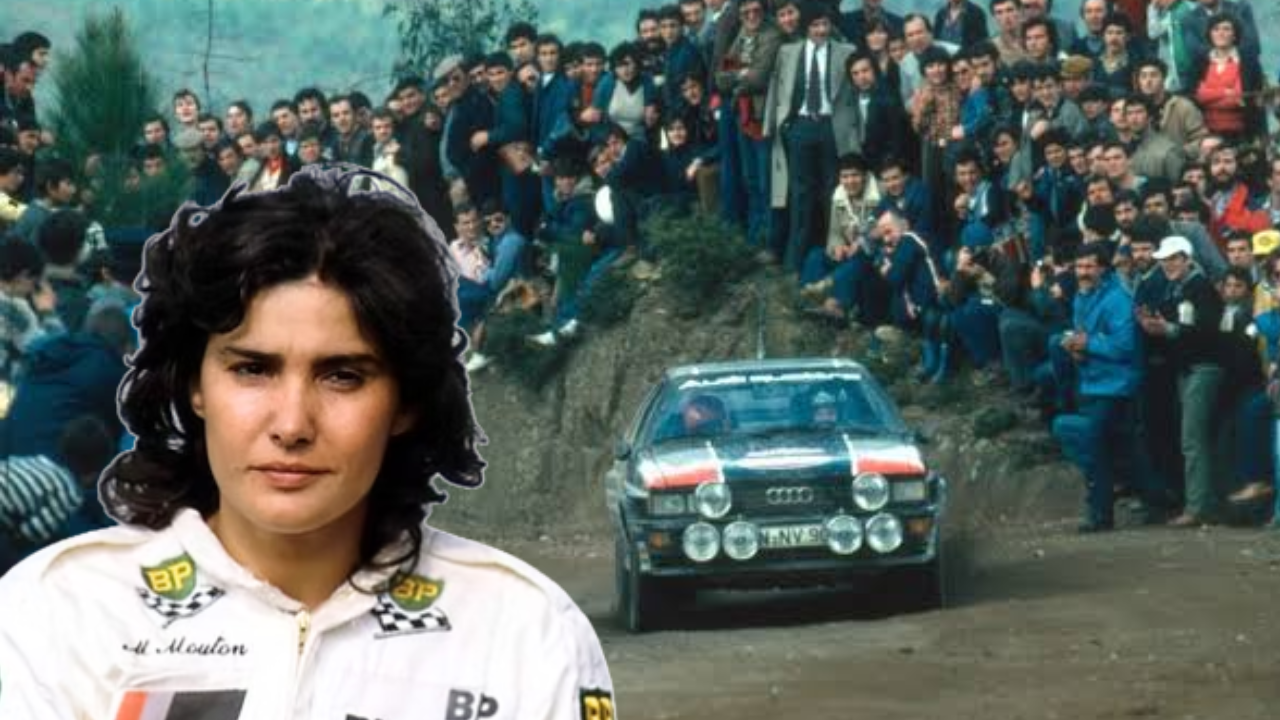
Gravel spits. Rubber screams against a surface that wants nothing to do with it. Inside the cockpit of an Audi Quattro, the world shrinks to a violent blur of blinding white snowbanks and slate-gray cliffs, blurring past at a hundred and twenty miles per hour. Most people would close their eyes. Michèle Mouton watched every inch of it through the smoke and the fury, her hands locked onto the steering wheel like iron.
She did not start out as a legend. She started out as a daughter standing in a vineyard in the south of France, listening to a man who possessed a quiet, unyielding kind of authority.
Her father, Pierre Mouton, had a simple challenge for her. He bought a fierce little Alpine A110, handed her the keys, and drew a hard line in the dirt. He told her she could drive it in competition, but she had to prove she belonged there. If she was fast, she could stay. If she was slow, she had to sell the car and walk away forever. There were no participation trophies in the high-stakes world of European rallying. There was only the stopwatch, and the stopwatch does not care about your gender, your background, or your doubts.
Consider what happens next. She did not just match the times of her peers. She shattered them.
Rallying is not like track racing. On a circuit, you memorize every apex, every curb, every bump over a thousand laps. In rallying, you are hurtling blind down a treacherous mountain road you have never seen before, relying entirely on a co-driver screaming pacenotes into an intercom while the car violently pitches sideways over blind crests. It is an exercise in pure trust and calculated terror. To master it requires a cold, surgical precision combined with a reckless sort of courage.
Mouton had both in abundance.
By the late 1970s, she was tearing up the French and European rally circuits, catching the sharp eye of the legendary Audi Sport team. At the time, Audi was building something radical. They were developing the Quattro, a revolutionary all-wheel-drive machine that many traditionalists mocked as a heavy, bulky monster destined to fail. The team manager, Roland Gumpert, saw something fierce in Mouton. He offered her a seat.
The establishment balked. The World Rally Championship was an old boys club, thick with cigarette smoke, casual sexism, and drivers who viewed women as paddock ornaments rather than fierce competitors. When Mouton pulled up to the starting line, rival drivers made open bets that she would not last a single stage. They called her nicknames. They whispered behind her back.
Mouton did not argue with them. She let the turbocharger do the talking.
In 1981, at the Rallye Sanremo in Italy, she did the unthinkable. She drove that snarling Audi Quattro through the dust and night to claim her first World Rally Championship victory. As she crossed the finish line, she became the first woman ever to win a WRC event. The men who had laughed at her in the service park suddenly found themselves staring at the back of her car as she hoisted the winner’s trophy high into the air.
The air in the garage shifted. The paddock went quiet.
She was just getting warmed up. The following year, 1982, became the stuff of motorsport mythology. Mouton went toe-to-toe with the legendary Walter Röhrl for the world title. She won the Rallye Monte-Carlo, the Acropolis Rally, and the Rallye de Portugal, driving with a blistering, incandescent speed that left seasoned veterans questioning everything they knew about the sport.
Fans lined the muddy mountain passes just to catch a glimpse of the flying Frenchwoman. They held up signs bearing a new title, one forged entirely in sweat and gasoline: the fastest woman alive.
Then came tragedy. During the grueling Rallye Côte d'Ivoire, news reached her that her beloved father had fallen critically ill and was undergoing surgery. Grief-stricken and exhausted, she forced herself back into the car to finish the race. Moments before the final stretch, word came that her father had passed away. She drove the final miles through a blur of tears, securing second place in the championship standings, the highest finish ever achieved by a woman in the history of top-tier motorsport.
The world expected her to break. Instead, she adapted.
When Group B rallying was eventually banned due to its terrifying, uncontrollable speeds, Mouton did not simply fade into history. She took her helmet off, looked at the horizon, and decided to build something new. She co-founded the Race of Champions, bringing the greatest drivers from Formula 1, Rally, and NASCAR together on a level playing field to determine who was truly the best behind the wheel.
Today, when young girls pull on a racing helmet and stare down a starting grid, they do not have to wonder if they belong there. The path has been cleared. The trail has been blazed by a pair of steady hands gripping a steering wheel through the dust of Sanremo.
The engine cools. The hot oil crackles in the stillness of the garage. But the echoes of those roaring exhausts never really fade away.